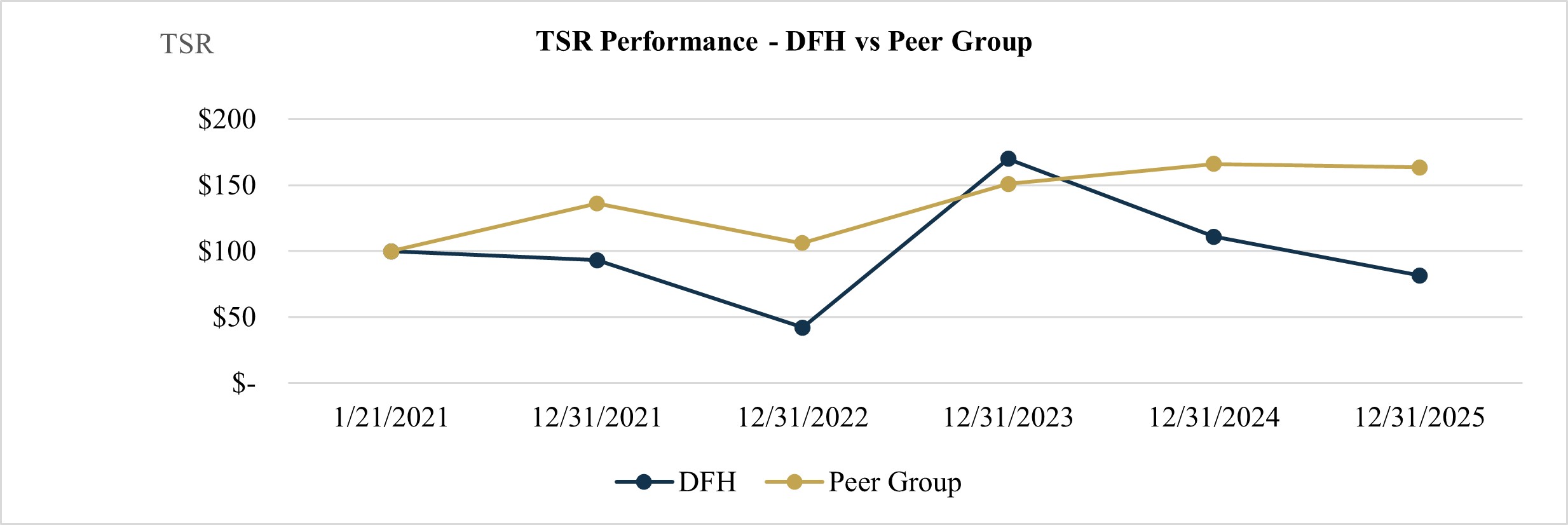
0001825088PRE 14Afalseiso4217:USD00018250882025-01-012025-12-3100018250882024-01-012024-12-3100018250882023-01-012023-12-3100018250882022-01-012022-12-3100018250882021-01-012021-12-31000182508812025-01-012025-12-310001825088ecd:EqtyAwrdsInSummryCompstnTblForAplblYrMemberecd:PeoMember2025-01-012025-12-310001825088ecd:YrEndFrValOfEqtyAwrdsGrntdInCvrdYrOutsdngAndUnvstdMemberecd:PeoMember2025-01-012025-12-310001825088ecd:ChngInFrValOfOutsdngAndUnvstdEqtyAwrdsGrntdInPrrYrsMemberecd:PeoMember2025-01-012025-12-310001825088ecd:VstngDtFrValOfEqtyAwrdsGrntdAndVstdInCvrdYrMemberecd:PeoMember2025-01-012025-12-310001825088ecd:ChngInFrValAsOfVstngDtOfPrrYrEqtyAwrdsVstdInCvrdYrMemberecd:PeoMember2025-01-012025-12-310001825088ecd:FrValAsOfPrrYrEndOfEqtyAwrdsGrntdInPrrYrsFldVstngCondsDrngCvrdYrMemberecd:PeoMember2025-01-012025-12-310001825088ecd:EqtyAwrdsInSummryCompstnTblForAplblYrMemberecd:PeoMember2024-01-012024-12-310001825088ecd:YrEndFrValOfEqtyAwrdsGrntdInCvrdYrOutsdngAndUnvstdMemberecd:PeoMember2024-01-012024-12-310001825088ecd:ChngInFrValOfOutsdngAndUnvstdEqtyAwrdsGrntdInPrrYrsMemberecd:PeoMember2024-01-012024-12-310001825088ecd:VstngDtFrValOfEqtyAwrdsGrntdAndVstdInCvrdYrMemberecd:PeoMember2024-01-012024-12-310001825088ecd:ChngInFrValAsOfVstngDtOfPrrYrEqtyAwrdsVstdInCvrdYrMemberecd:PeoMember2024-01-012024-12-310001825088ecd:FrValAsOfPrrYrEndOfEqtyAwrdsGrntdInPrrYrsFldVstngCondsDrngCvrdYrMemberecd:PeoMember2024-01-012024-12-310001825088ecd:EqtyAwrdsInSummryCompstnTblForAplblYrMemberecd:PeoMember2023-01-012023-12-310001825088ecd:YrEndFrValOfEqtyAwrdsGrntdInCvrdYrOutsdngAndUnvstdMemberecd:PeoMember2023-01-012023-12-310001825088ecd:ChngInFrValOfOutsdngAndUnvstdEqtyAwrdsGrntdInPrrYrsMemberecd:PeoMember2023-01-012023-12-310001825088ecd:VstngDtFrValOfEqtyAwrdsGrntdAndVstdInCvrdYrMemberecd:PeoMember2023-01-012023-12-310001825088ecd:ChngInFrValAsOfVstngDtOfPrrYrEqtyAwrdsVstdInCvrdYrMemberecd:PeoMember2023-01-012023-12-310001825088ecd:FrValAsOfPrrYrEndOfEqtyAwrdsGrntdInPrrYrsFldVstngCondsDrngCvrdYrMemberecd:PeoMember2023-01-012023-12-310001825088ecd:EqtyAwrdsInSummryCompstnTblForAplblYrMemberecd:PeoMember2022-01-012022-12-310001825088ecd:YrEndFrValOfEqtyAwrdsGrntdInCvrdYrOutsdngAndUnvstdMemberecd:PeoMember2022-01-012022-12-310001825088ecd:ChngInFrValOfOutsdngAndUnvstdEqtyAwrdsGrntdInPrrYrsMemberecd:PeoMember2022-01-012022-12-310001825088ecd:VstngDtFrValOfEqtyAwrdsGrntdAndVstdInCvrdYrMemberecd:PeoMember2022-01-012022-12-310001825088ecd:ChngInFrValAsOfVstngDtOfPrrYrEqtyAwrdsVstdInCvrdYrMemberecd:PeoMember2022-01-012022-12-310001825088ecd:FrValAsOfPrrYrEndOfEqtyAwrdsGrntdInPrrYrsFldVstngCondsDrngCvrdYrMemberecd:PeoMember2022-01-012022-12-310001825088ecd:EqtyAwrdsInSummryCompstnTblForAplblYrMemberecd:PeoMember2021-01-012021-12-310001825088ecd:YrEndFrValOfEqtyAwrdsGrntdInCvrdYrOutsdngAndUnvstdMemberecd:PeoMember2021-01-012021-12-310001825088ecd:ChngInFrValOfOutsdngAndUnvstdEqtyAwrdsGrntdInPrrYrsMemberecd:PeoMember2021-01-012021-12-310001825088ecd:VstngDtFrValOfEqtyAwrdsGrntdAndVstdInCvrdYrMemberecd:PeoMember2021-01-012021-12-310001825088ecd:ChngInFrValAsOfVstngDtOfPrrYrEqtyAwrdsVstdInCvrdYrMemberecd:PeoMember2021-01-012021-12-310001825088ecd:FrValAsOfPrrYrEndOfEqtyAwrdsGrntdInPrrYrsFldVstngCondsDrngCvrdYrMemberecd:PeoMember2021-01-012021-12-310001825088ecd:EqtyAwrdsInSummryCompstnTblForAplblYrMemberecd:NonPeoNeoMember2025-01-012025-12-310001825088ecd:YrEndFrValOfEqtyAwrdsGrntdInCvrdYrOutsdngAndUnvstdMemberecd:NonPeoNeoMember2025-01-012025-12-310001825088ecd:ChngInFrValOfOutsdngAndUnvstdEqtyAwrdsGrntdInPrrYrsMemberecd:NonPeoNeoMember2025-01-012025-12-310001825088ecd:VstngDtFrValOfEqtyAwrdsGrntdAndVstdInCvrdYrMemberecd:NonPeoNeoMember2025-01-012025-12-310001825088ecd:ChngInFrValAsOfVstngDtOfPrrYrEqtyAwrdsVstdInCvrdYrMemberecd:NonPeoNeoMember2025-01-012025-12-310001825088ecd:FrValAsOfPrrYrEndOfEqtyAwrdsGrntdInPrrYrsFldVstngCondsDrngCvrdYrMemberecd:NonPeoNeoMember2025-01-012025-12-310001825088ecd:EqtyAwrdsInSummryCompstnTblForAplblYrMemberecd:NonPeoNeoMember2024-01-012024-12-310001825088ecd:YrEndFrValOfEqtyAwrdsGrntdInCvrdYrOutsdngAndUnvstdMemberecd:NonPeoNeoMember2024-01-012024-12-310001825088ecd:ChngInFrValOfOutsdngAndUnvstdEqtyAwrdsGrntdInPrrYrsMemberecd:NonPeoNeoMember2024-01-012024-12-310001825088ecd:VstngDtFrValOfEqtyAwrdsGrntdAndVstdInCvrdYrMemberecd:NonPeoNeoMember2024-01-012024-12-310001825088ecd:ChngInFrValAsOfVstngDtOfPrrYrEqtyAwrdsVstdInCvrdYrMemberecd:NonPeoNeoMember2024-01-012024-12-310001825088ecd:FrValAsOfPrrYrEndOfEqtyAwrdsGrntdInPrrYrsFldVstngCondsDrngCvrdYrMemberecd:NonPeoNeoMember2024-01-012024-12-310001825088ecd:EqtyAwrdsInSummryCompstnTblForAplblYrMemberecd:NonPeoNeoMember2023-01-012023-12-310001825088ecd:YrEndFrValOfEqtyAwrdsGrntdInCvrdYrOutsdngAndUnvstdMemberecd:NonPeoNeoMember2023-01-012023-12-310001825088ecd:ChngInFrValOfOutsdngAndUnvstdEqtyAwrdsGrntdInPrrYrsMemberecd:NonPeoNeoMember2023-01-012023-12-310001825088ecd:VstngDtFrValOfEqtyAwrdsGrntdAndVstdInCvrdYrMemberecd:NonPeoNeoMember2023-01-012023-12-310001825088ecd:ChngInFrValAsOfVstngDtOfPrrYrEqtyAwrdsVstdInCvrdYrMemberecd:NonPeoNeoMember2023-01-012023-12-310001825088ecd:FrValAsOfPrrYrEndOfEqtyAwrdsGrntdInPrrYrsFldVstngCondsDrngCvrdYrMemberecd:NonPeoNeoMember2023-01-012023-12-310001825088ecd:EqtyAwrdsInSummryCompstnTblForAplblYrMemberecd:NonPeoNeoMember2022-01-012022-12-310001825088ecd:YrEndFrValOfEqtyAwrdsGrntdInCvrdYrOutsdngAndUnvstdMemberecd:NonPeoNeoMember2022-01-012022-12-310001825088ecd:ChngInFrValOfOutsdngAndUnvstdEqtyAwrdsGrntdInPrrYrsMemberecd:NonPeoNeoMember2022-01-012022-12-310001825088ecd:VstngDtFrValOfEqtyAwrdsGrntdAndVstdInCvrdYrMemberecd:NonPeoNeoMember2022-01-012022-12-310001825088ecd:ChngInFrValAsOfVstngDtOfPrrYrEqtyAwrdsVstdInCvrdYrMemberecd:NonPeoNeoMember2022-01-012022-12-310001825088ecd:FrValAsOfPrrYrEndOfEqtyAwrdsGrntdInPrrYrsFldVstngCondsDrngCvrdYrMemberecd:NonPeoNeoMember2022-01-012022-12-310001825088ecd:EqtyAwrdsInSummryCompstnTblForAplblYrMemberecd:NonPeoNeoMember2021-01-012021-12-310001825088ecd:YrEndFrValOfEqtyAwrdsGrntdInCvrdYrOutsdngAndUnvstdMemberecd:NonPeoNeoMember2021-01-012021-12-310001825088ecd:ChngInFrValOfOutsdngAndUnvstdEqtyAwrdsGrntdInPrrYrsMemberecd:NonPeoNeoMember2021-01-012021-12-310001825088ecd:VstngDtFrValOfEqtyAwrdsGrntdAndVstdInCvrdYrMemberecd:NonPeoNeoMember2021-01-012021-12-310001825088ecd:ChngInFrValAsOfVstngDtOfPrrYrEqtyAwrdsVstdInCvrdYrMemberecd:NonPeoNeoMember2021-01-012021-12-310001825088ecd:FrValAsOfPrrYrEndOfEqtyAwrdsGrntdInPrrYrsFldVstngCondsDrngCvrdYrMemberecd:NonPeoNeoMember2021-01-012021-12-31000182508822025-01-012025-12-31000182508832025-01-012025-12-31000182508842025-01-012025-12-31
UNITED STATES
SECURITIES AND EXCHANGE COMMISSION
Washington, D.C. 20549
SCHEDULE 14A
Proxy Statement Pursuant to Section 14(a) of
the Securities Exchange Act of 1934
Filed by the Registrant x
Filed by a Party other than the Registrant o
Check the appropriate box:
| | | | | |
x | Preliminary Proxy Statement |
| o | Confidential, for Use of the Commission Only (as permitted by Rule 14a-6(e)(2)) |
| o | Definitive Proxy Statement |
| o | Definitive Additional Materials |
| o | Fee computed on table in exhibit required by Item 25(b) per Exchange Act Rules 14a-6(i)(1) and 0-11. |
DREAM FINDERS HOMES, INC.
(Exact name of registrant as specified in its charter)
N/A
(Name of Person(s) Filing Proxy Statement, if other than the Registrant)
Payment of Filing Fee (Check the appropriate box):
| | | | | |
x | No fee required. |
| o | Fee paid previously with preliminary materials. |
| o | Fee computed on table in exhibit required by Item 25(b) per Exchange Act Rules 14a-6(i)(1) and 0-11. |
From our Chairman & CEO
Dear Fellow Owners,
2025 concluded our 17th year of business and our fifth as a public company. We pride ourselves on always being honest with our analysis of the business and clearly 2025 was a challenging year. We expect this difficult backdrop to continue for the homebuilding industry; still, we believe the best operators find a way to navigate any environment. Our annual results included total revenues of $4.1 billion, supported by closings of 8,608 homes, an increase in deliveries over the prior year. Our 2025 full year pretax income was $284 million, net income attributable to Dream Finders was $217 million and basic earnings per share was $2.19. We are pleased with the results from our 2025 acquisitions of Liberty Communities, Alliant Title and Green River Builders, with contributions to total revenues of $250 million, $86 million and $22 million, respectively.
While we are proud that our 2025 year demonstrated the resiliency of our business, as well as the perseverance of our team in a challenging environment, we have shifted our focus to 2026 and our commitment to further scaling our business and delivering long-term returns to our shareholders.
My full 2025 thoughts and the year ahead will be included in my forthcoming annual letter, which will be accessible on the Company’s Investor Relations website.
About Dream Finders Homes, Inc.
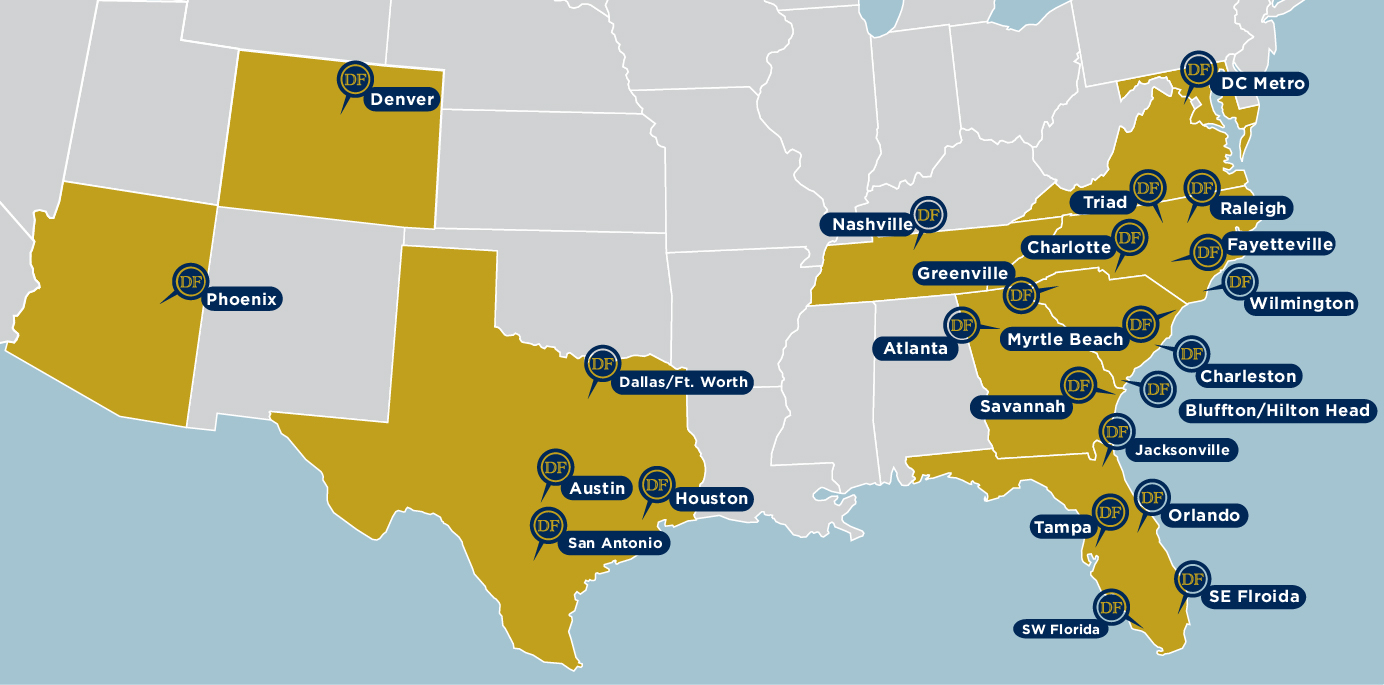
Dream Finders Homes (NYSE: DFH), headquartered in Jacksonville, Florida, was recognized as the 2025 National Builder of the Year by Builder magazine. Dream Finders Homes builds single-family homes throughout the Southeast, Mid-Atlantic and Midwest, including Florida, Texas, Tennessee, North Carolina, South Carolina, Georgia, Colorado, Arizona, and the Washington, D.C. metropolitan area, which comprises Washington D.C., Northern Virginia and Maryland. As the Official Home Builder of the PGA TOUR, the Jacksonville Jaguars and the Tampa Bay Rays, Dream Finders Homes is deeply committed to excellence beyond homebuilding and into the communities it serves. Through its wholly owned subsidiaries, DFH also provides mortgage financing as well as title agency and underwriting services to homebuyers. Dream Finders Homes achieves its growth and returns by maintaining an asset-light homebuilding model. As of April 10, 2026, DFH operated in 10 states, as depicted below.
PRELIMINARY PROXY STATEMENT, SUBJECT TO CHANGE
14701 Philips Highway, Suite 300
Jacksonville, Florida 32256
NOTICE OF 2026 ANNUAL MEETING OF STOCKHOLDERS
to be held on:
June 8, 2026
10:00 a.m. Eastern Time
Dear Stockholder:
You are cordially invited to attend our 2026 Annual Meeting of Stockholders, which will be held at 10:00 a.m., Eastern Time, on Monday, June 8, 2026 (the “Annual Meeting”), at our headquarters located at 14701 Philips Highway, Jacksonville, Florida 32256 in Suite 300.
We are holding the Annual Meeting for the following purposes, which are more fully described in the accompanying proxy statement:
1.To elect the nominees named in the accompanying proxy statement to our Board of Directors;
2.To ratify the appointment of PricewaterhouseCoopers LLP as our independent registered public accounting firm for the fiscal year ending December 31, 2026;
3.To approve a non-binding advisory resolution approving executive compensation for fiscal year 2025;
4.To approve the reincorporation of Dream Finders Homes, Inc. to the State of Texas by conversion (the “Reincorporation Proposal”);
5.To approve the potential conversion of our Series A Preferred Stock into shares of Class A common stock in accordance with New York Stock Exchange (“NYSE”) rules (the “Series A Proposal”); and
6.To transact such other business as may properly come before the Annual Meeting, or any adjournment or postponement thereof.
Only stockholders of record as of the close of business on April 10, 2026 are entitled to notice and to vote at the Annual Meeting or any adjournment or postponement thereof. A list of stockholders entitled to vote at the Annual Meeting will be available for inspection at our headquarters during the 10-day period prior to the Annual Meeting. If you would like to view this stockholder list at our headquarters, please contact Investor Relations at investors@dreamfindershomes.com.
Each share of our Class A common stock entitles the holder thereof to cast one vote on each matter brought before the Annual Meeting and each share of our Class B common stock entitles the holder thereof to cast three votes on each matter brought before the Annual Meeting. Your vote as a stockholder of Dream Finders Homes, Inc. is very important. If you are a registered stockholder and have questions regarding your stock ownership, you may contact our transfer agent, Broadridge Corporate Issuer Solutions, Inc., by email at shareholder@broadridge.com, through its website at www.broadridge.com or by phone at 1-844-998-0339 (within the U.S. and Canada) or 1-303-562-9304 (outside the U.S. and Canada).
Our Board of Directors has approved the proposals described in the accompanying proxy statement and recommends that you vote:
FOR the election of all nominees for director in Proposal 1;
FOR the ratification of the appointment of PricewaterhouseCoopers LLP as our independent registered public accounting firm for the fiscal year ending December 31, 2026 in Proposal 2;
FOR the approval of the advisory resolution on executive compensation for fiscal year 2025 in Proposal 3;
FOR the approval of the Reincorporation Proposal in Proposal 4; and
FOR the approval of the Series A Proposal in Proposal 5.
BY ORDER OF THE BOARD OF DIRECTORS
Robert E. Riva
Vice President, General Counsel and Corporate Secretary
Jacksonville, Florida
April 16, 2026
YOUR VOTE IS IMPORTANT
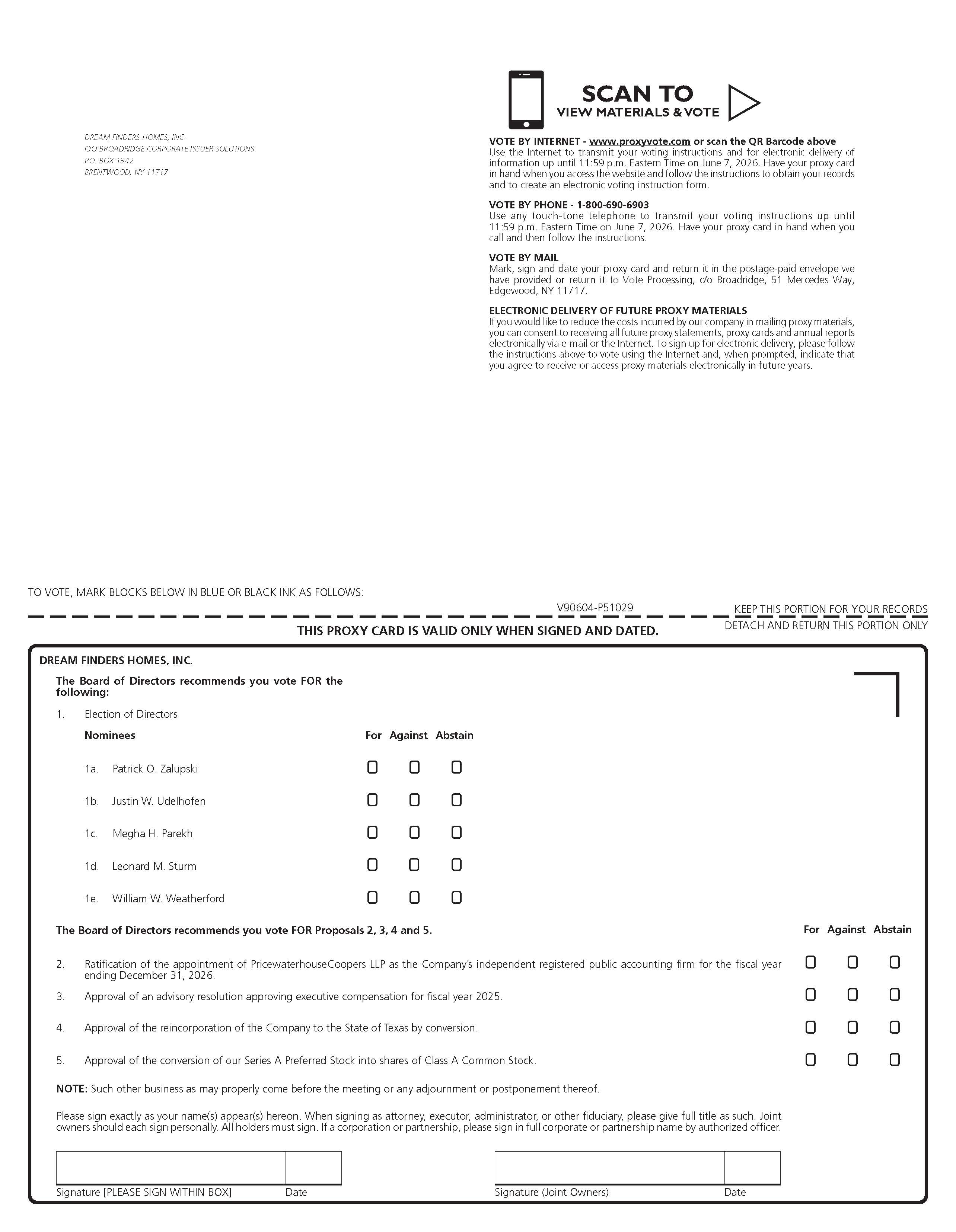
Instructions for submitting your proxy are provided in the Notice of Internet Availability of Proxy Materials, the accompanying proxy statement and your proxy card. It is important that your shares of our common stock be represented and voted at the Annual Meeting. Please submit your proxy through the Internet, by telephone or by completing the proxy card. You may revoke your proxy at any time prior to its exercise at the Annual Meeting. Please do not return the proxy card if you are voting through the Internet or by telephone.
Important Notice Regarding the Availability of Proxy Materials for the Annual Stockholder Meeting to be Held on June 8, 2026:
The accompanying proxy statement and our Annual Report on Form 10-K for the year ended December 31, 2025 are available for review online at www.proxyvote.com or https://investors.dreamfindershomes.com.
TABLE OF CONTENTS
DREAM FINDERS HOMES, INC.
2026 ANNUAL MEETING OF STOCKHOLDERS
PROXY STATEMENT
INFORMATION CONCERNING VOTING AND SOLICITATION
The accompanying proxy is solicited on behalf of the Board of Directors (the “Board” or “Board of Directors”) of Dream Finders Homes, Inc. (“Dream Finders,” “DFH”, the “Company”, “we”, “us”, and “our”) for use at the Company’s 2026 Annual Meeting of Stockholders (the “Annual Meeting”) to be held at the Company’s headquarters located at 14701 Philips Highway, Jacksonville, Florida 32256, in Suite 300 on June 8, 2026, at 10:00 a.m., Eastern Time, and any adjournment or postponement thereof.
On or about April 16, 2026, we will mail to our stockholders of record and beneficial owners a Notice of Internet Availability of Proxy Materials (the “Notice of Internet Availability”) containing instructions on how to access this proxy statement (this “Proxy Statement”) and our Annual Report on Form 10-K for the year ended December 31, 2025 (our “2025 Annual Report”), and how to vote online via the Internet. The Notice of Internet Availability contains instructions on how you can receive a paper copy of the proxy materials. Our 2025 Annual Report, Notice of Internet Availability, Proxy Statement and the proxy card are first being made available online on or about April 16, 2026.
QUESTIONS AND ANSWERS ABOUT THE ANNUAL MEETING AND VOTING
What proposals are scheduled to be voted on at the Annual Meeting?
Our stockholders will be asked to vote on the following proposals:
| | | | | |
| Proposal 1: | To elect Patrick O. Zalupski, Justin W. Udelhofen, Megha H. Parekh, Leonard M. Sturm and William W. Weatherford to the Board until our next annual meeting of stockholders, until such director’s successor is elected or appointed and qualified, or until such director’s earlier death, resignation or removal; |
| Proposal 2: | To ratify the appointment of PricewaterhouseCoopers LLP (“PwC”) as the Company’s independent registered public accounting firm for the fiscal year ending December 31, 2026; |
| Proposal 3: | To approve, in a non-binding vote, an advisory resolution approving executive compensation for fiscal year 2025; |
Proposal 4: | To approve the reincorporation of the Company to the State of Texas by conversion; and |
Proposal 5: | To approve the potential conversion of our Series A Preferred Stock into shares of Class A common stock in accordance with NYSE rules. |
To transact such other business as may properly come before the Annual Meeting, or any adjournment or postponement thereof.
We are not aware of any other business to be brought before the Annual Meeting. If any additional business is properly brought before the Annual Meeting, proxies will be voted on those matters in accordance with the judgment of the person or persons acting under the proxies.
What is the recommendation of the Board on each of the proposals scheduled to be voted on at the Annual Meeting?
The Board recommends that you vote:
•FOR the election of each of the nominees for director named in Proposal 1;
•FOR the ratification of the appointment of PwC as the Company’s independent registered public accounting firm for the fiscal year ending December 31, 2026 in Proposal 2;
•FOR the approval of the advisory resolution on executive compensation for fiscal year 2025 in Proposal 3;
•FOR the approval of the Reincorporation Proposal in Proposal 4; and
•FOR the approval of the Series A Proposal in Proposal 5.
How will the proxies vote my shares?
When you vote by proxy, you authorize the proxies, L. Anabel Ramsay and Robert E. Riva (or their duly appointed substitutes), to vote your shares of our common stock on your behalf as you direct. In the absence of such direction, your shares will be voted:
•FOR the election of each of the nominees for director named in Proposal 1;
•FOR the ratification of the appointment of PwC as the Company’s independent registered public accounting firm for the fiscal year ending December 31, 2026 in Proposal 2;
•FOR the approval of the advisory resolution on executive compensation for fiscal year 2025 in Proposal 3;
•FOR the approval of the Reincorporation Proposal in Proposal 4; and
•FOR the approval of the Series A Proposal in Proposal 5.
What is the vote required to approve each proposal?
At the close of business on the record date, April 10, 2026, the Company had [34,083,246] shares of Class A common stock outstanding and entitled to vote (representing an equal number of votes) and 57,726,153 shares of Class B common stock outstanding and entitled to vote (representing three votes per share outstanding). Each share of our Class A common stock is entitled to one vote, and each share of our Class B common stock is entitled to three votes, on each matter brought before the Annual Meeting. The Class A common stock and Class B common stock vote together as a single class on all matters. The following votes are required to approve each of the proposals at the Annual Meeting.
•Election of Directors. Proposal 1 regarding the election of directors requires the approval of a plurality of the shares of our common stock entitled to vote at the Annual Meeting that are present in person, by remote communication or by proxy at the Annual Meeting. This means that the five nominees receiving the highest number of affirmative FOR votes will be elected as directors.
•Ratification of the Appointment of Independent Registered Public Accounting Firm. Proposal 2 regarding the ratification of the appointment of PwC as the Company’s independent registered public accounting firm requires the approval of a majority of the shares of our common stock entitled to vote at the Annual Meeting that are present in person, by remote communication or by proxy at the Annual Meeting.
•Non-binding Advisory Vote on Executive Compensation for Fiscal Year 2025. Proposal 3 regarding the non-binding advisory resolution approving executive compensation for fiscal year 2025 requires the approval of a majority of the shares of our common stock entitled to vote at the Annual Meeting that are present in person, by remote communication or by proxy at the Annual Meeting. Although this advisory vote is non-binding, our Board and Compensation Committee will review the voting results and take them into account when considering future executive compensation arrangements.
•Reincorporation Proposal. Proposal 4 regarding the reincorporation of the Company to the State of Texas by conversion requires the affirmative vote of a majority of the voting power of the outstanding shares of our common stock entitled to vote at the Annual Meeting that are present in person, by remote communication or by proxy at the Annual Meeting. Abstentions, broker non-votes, and other failures to vote will have the effect of a vote against the Reincorporation Proposal.
•Series A Proposal. Proposal 5 regarding the approval of the potential conversion of our Series A Preferred Stock into shares of Class A common stock in accordance with NYSE rules requires the approval of a majority of the shares of our common stock entitled to vote at the Annual Meeting that are present in person, by remote communication or by proxy at the Annual Meeting.
Who can vote at the Annual Meeting?
Stockholders as of the close of business on the record date for the Annual Meeting (April 10, 2026) are entitled to vote at the Annual Meeting. At the close of business on the record date, there were [34,083,246] shares of our Class A common stock outstanding and entitled to vote and 57,726,153 shares of our Class B common stock outstanding and entitled to vote.
Stockholder of Record: Shares Registered in Your Name
If, at the close of business on the record date for the Annual Meeting (April 10, 2026), your shares of our common stock were registered directly in your name with our transfer agent, Broadridge Corporate Issuer Solutions, Inc. (“Broadridge”), then you are considered the stockholder of record with respect to those shares.
As a stockholder of record, you may vote at the Annual Meeting or vote by proxy. Regardless of whether you plan to attend the Annual Meeting, we urge you to vote over the Internet, by telephone or, if you request paper proxy materials, by filling out and returning the proxy card.
Beneficial Owner: Shares Registered in the Name of a Broker or Nominee
If, at the close of business on the record date for the Annual Meeting (April 10, 2026), your shares of our common stock were held in an account with a brokerage firm, bank or other nominee, then you are the beneficial owner of the shares of our common stock held in street name. As a beneficial owner, you have the right to direct your nominee on how to vote the shares of our common stock held in your account, and your nominee has enclosed or provided voting instructions for you to use in directing it on how to vote your shares of our common stock. However, the organization that holds your shares of our common stock is considered the stockholder of record for purposes of voting at the Annual Meeting. Because you are not the stockholder of record, you may not vote your shares of our common stock at the Annual Meeting unless you request and obtain a valid proxy from the organization that is the record stockholder of your shares of our common stock giving you the right to vote the shares of our common stock at the Annual Meeting.
How do I vote?
If you are a stockholder of record at the close of business on the record date for the Annual Meeting (April 10, 2026), you may:
•Vote in person—we will provide a ballot to any such stockholders who attend the Annual Meeting and wish to vote in person;
•Vote by mail—if you request a paper proxy card, simply complete, sign and date the proxy card, then follow the instructions on the proxy card; or
•Vote via the Internet or via telephone—follow the instructions on the Notice of Internet Availability or proxy card and have the Notice of Internet Availability or proxy card available when you access the website or place your telephone call.
Votes submitted via the Internet or by telephone must be received by 11:59 p.m., Eastern Time, on June 7, 2026. Submitting your proxy, whether via the Internet, by telephone or by mail if you requested a paper proxy card, will not affect your right to vote at the Annual Meeting if you were a stockholder of record as of the close of business on the record date for the Annual Meeting (April 10, 2026), should you decide to attend the Annual Meeting and vote your shares of our common stock.
If you are not a stockholder of record as of the close of business on the record date for the Annual Meeting (April 10, 2026), please refer to the voting instructions provided by your nominee to direct it how to vote your shares of our common stock.
Your vote is important. Regardless of whether you plan to attend the Annual Meeting, we urge you to vote by proxy to ensure that your vote is counted.
How do I revoke my proxy?
A stockholder giving a proxy has the power to revoke it at any time before it is voted by providing written notice to the Corporate Secretary of the Company, by delivering a later-dated proxy or by voting during the Annual Meeting.
What is the quorum requirement for the Annual Meeting?
A majority in voting power of the outstanding shares of our Class A and B common stock (as a single class) as of the record date must be present in person, by remote communication or by proxy at the Annual Meeting in order to hold the Annual Meeting and conduct business. This presence is called a quorum.
How are votes counted?
Broadridge has been engaged to tabulate stockholder votes. An automated system administered by Broadridge will tabulate stockholder votes submitted by proxy instructions submitted by beneficial owners over the Internet, by telephone or by proxy cards mailed to Broadridge. Broadridge will also tabulate stockholder votes submitted by proxies submitted by stockholders of record. An agent of Broadridge will act as our independent inspector of elections and will tabulate votes cast at the 2026 Annual Meeting.
How are abstentions and broker non-votes treated?
Abstentions (shares of our common stock present at the Annual Meeting that voted “abstain”) are counted for purposes of determining whether a quorum is present at the Annual Meeting. However, an abstention is deemed not to have been voted on such matter and will have no effect on any of the proposals other than the Reincorporation Proposal (which will have the effect of a vote against such proposal).
Broker non-votes occur when shares of our common stock held by a broker, bank or other nominee for a beneficial owner are not voted either because (i) the broker, bank or other nominee did not receive voting instructions from the beneficial owner or (ii) the broker, bank or other nominee lacked discretionary authority to vote such shares. Broker non-votes are counted for purposes of determining whether a quorum is present and will have no effect on the matters voted upon, except for the Reincorporation Proposal. Abstentions, broker non-votes, and other failures to vote will have the effect of a vote against for the Reincorporation Proposal. Note that if you are a beneficial holder and do not provide specific voting instructions to your broker, bank or other nominee, the broker, bank or other nominee that holds your shares of our common stock will not be authorized to vote on the election of directors (Proposal 1), on the advisory vote on 2025 executive compensation (Proposal 3), on the Reincorporation Proposal (Proposal 4) or on the Series A Proposal (Proposal 5). Ratification of the appointment of auditors (Proposal 2) is considered to be a routine matter and, accordingly, if you do not instruct your broker, bank or other nominee on how to vote the shares of our common stock in your account for Proposal 2, such broker, bank or other nominee will be permitted to exercise its discretionary authority to vote on the ratification of the appointment of auditors. Accordingly, we encourage you to provide voting instructions to your broker, bank or other nominee, regardless of whether you plan to attend the Annual Meeting.
What if I return a proxy card, but do not make specific choices?
All proxies will be voted in accordance with the instructions specified on the proxy card. If you sign a physical proxy card and return it without instructions as to how your shares of our common stock should be voted on a particular proposal at the Annual Meeting, your shares of our common stock will be voted in accordance with the recommendations of the Board of Directors stated above.
If you do not vote and you hold your shares of our common stock in street name, and your broker, bank or other nominee does not have discretionary power to vote your shares of our common stock, your shares may constitute “broker non-votes” (as described above).
Shares that constitute broker non-votes will be counted for the purpose of establishing a quorum for the Annual Meeting. Voting results will be tabulated and certified by the inspector of elections appointed for the Annual Meeting.
Why did I receive a notice in the mail regarding the Internet availability of proxy materials instead of a full set of proxy materials?
Pursuant to rules adopted by the Securities and Exchange Commission (“SEC”), the Company uses the Internet as the primary means of furnishing proxy materials to stockholders of record as of the record date for the Annual Meeting (April 10, 2026). Accordingly, on or about April 16, 2026, the Company will mail a Notice of Internet Availability to the Company’s stockholders. All stockholders will have the ability to access the proxy materials on the website referred to in the Notice of Internet Availability or request a printed set of the proxy materials. Instructions on how to access the proxy materials over the Internet or to request a printed copy may be found in the Notice of Internet Availability and www.proxyvote.com. The Notice of Internet Availability also contains instructions on how to receive, free of charge, paper copies of the proxy materials. If you received the Notice of Internet Availability, then you will not receive paper copies of the proxy materials unless you request them. The Company encourages stockholders to take advantage of the availability of the proxy materials on the Internet to help reduce the environmental impact and cost to the Company associated with the physical printing and mailing of proxy materials.
How can I get electronic access to the proxy materials?
The Notice of Internet Availability will provide you with instructions regarding how to use the Internet to:
•View the Company’s proxy materials for the Annual Meeting; and
•Instruct the Company to send future proxy materials to you by email.
The Company’s proxy materials are also available at https://investors.dreamfindershomes.com. This website address is included for reference only. The information contained on the Company’s website is not incorporated by reference into this Proxy Statement.
Choosing to receive future proxy materials by email will save the Company the cost of printing and mailing documents to you. If you choose to receive future proxy materials by email, you will receive an email message next year with instructions containing a link to those materials and a link to the proxy voting website. Your election to receive proxy materials by email will remain in effect until you terminate it.
Who is paying for this proxy solicitation?
The Company is paying the costs of the solicitation of proxies. Proxies may be solicited on behalf of the Company by our directors, officers, employees or agents in person or by telephone or other electronic means. We will also reimburse brokerage firms and other custodians, nominees and fiduciaries, upon request, for their reasonable expenses incurred in sending proxies and proxy materials to beneficial owners of our common stock. We have not retained an outside proxy solicitation firm to assist us with the solicitation of proxies.
PROPOSAL 1 - ELECTION OF DIRECTORS
Our Amended and Restated Certificate of Incorporation (our “Certificate of Incorporation”) provides that the number of directors on the Board will be no less than three, as established from time to time by resolution of the Board. The Board currently has set the size of the Board at five members. Each person listed below has been nominated to be re-elected to hold office as a director for a one-year term ending at the Company’s 2027 Annual Meeting of Stockholders (the “2027 Annual Meeting”) and until his or her successor is duly elected or appointed and qualified or, if earlier, such nominee’s death, resignation or removal.
Each nominee listed below currently serves on the Board, has consented to being named as a nominee for election and has indicated an intention to continue to serve on the Board if re-elected. The Board does not anticipate that any nominee will be unable to serve as a director, but, in the event that any such nominee is unable to serve as a director or should otherwise become unavailable, the Board may either elect to reduce the size of the Board or propose an alternate nominee, in which case the proxies will be voted for the alternate nominee unless directed to withhold from voting.
There are no familial relationships among our directors and executive officers.
Director Nominees
The Board of Directors believes that it is necessary for its members to possess qualities, attributes and skills that contribute to a diverse range of views and perspectives among the directors and enhance the overall effectiveness of the Board. As prescribed in its committee charter and described further under “Corporate Governance and Director Independence—Selection and Evaluation of Director Candidates,” our Nominating and Governance Committee considers all factors it deems relevant when evaluating prospective candidates or current board members for nomination to the Board of Directors. The Board is comprised of highly qualified individuals with unique and special skills that assist in effective management of the Company for the benefit of our stockholders.
Each of our directors possesses certain experience, qualifications, attributes and skills, as further described below, that led to our conclusion that he or she should serve as a member of the Board.
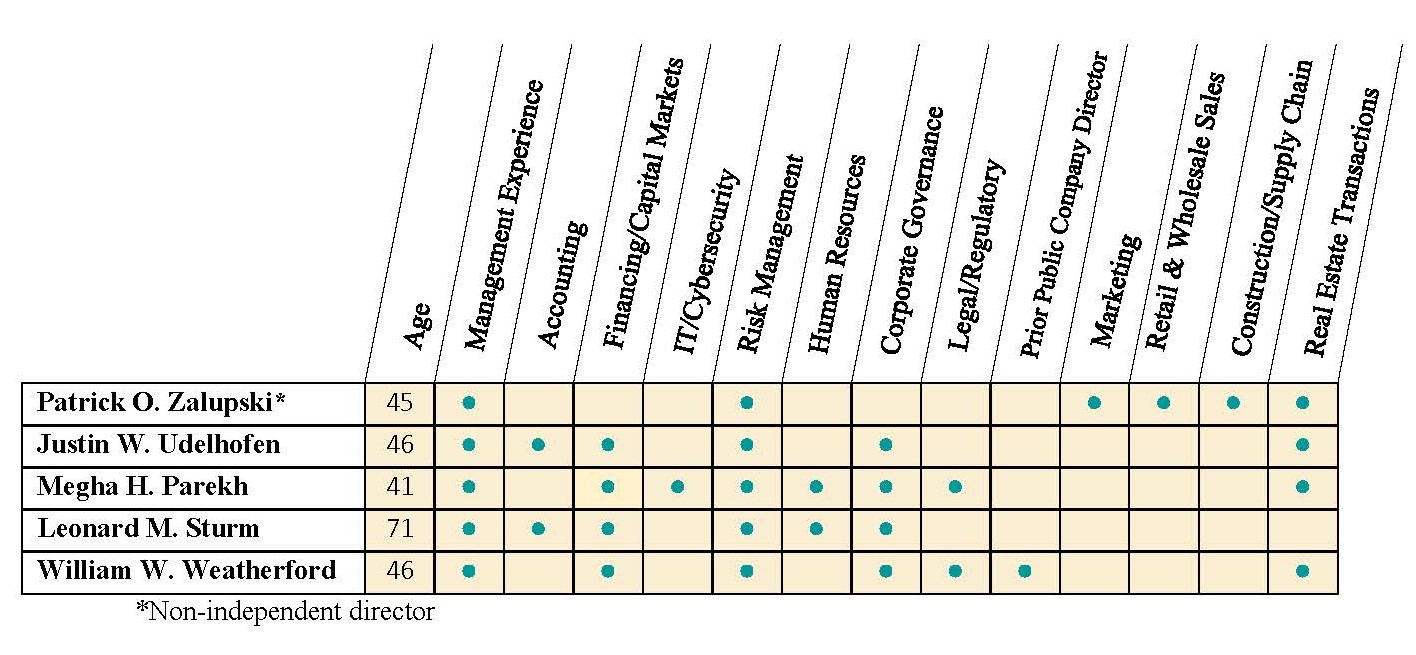
Directors’ Experience and Skills
Directors’ Biographies
| | | | | |
Patrick O. Zalupski | President, Chief Executive Officer, and Chairman of the Board of Directors |
Mr. Zalupski, age 45, is our President and Chief Executive Officer (“CEO”) and has served as Chairman of the Board of Directors since January 2021. He has served as the CEO of our primary operating subsidiary, Dream Finders Homes LLC (“DFH LLC”), since its formation in December 2008, and as the CEO and a member of the board of managers of DFH LLC since its formation in 2014. He is responsible for our overall operations and management and is heavily involved in the origination, underwriting and structuring of all land investment activities. Under Mr. Zalupski’s leadership, we have grown from closing 27 homes in Jacksonville, Florida during our inaugural year in 2009 to establishing operations in markets across the Southeast, Mid-West and Mid-Atlantic regions of the United States, and have closed over 46,500 homes since our inception through the end of 2025. Prior to founding DFH LLC, Mr. Zalupski was a Financial Auditor for FedEx Corporation’s Internal Audit Department in Memphis, Tennessee and worked in the real estate sales and construction industry as Managing Partner of Bay Street Condominiums, LLC from 2006 to 2008. He previously served on the investment committee of DF Capital Management, LLC, an investment manager focused on investments in land banks and land development joint ventures to deliver finished lots to us and other homebuilders for the construction of new homes. Mr. Zalupski currently serves as a member of the University of Florida’s board of trustees. In September 2025, Mr. Zalupski further expanded his leadership in professional sports by becoming the majority owner, managing partner, and co-chair of the Tampa Bay Rays Major League Baseball franchise, as well as the principal owner of the Tampa Bay Rowdies professional soccer team; these roles are expected to provide opportunities in our new Tampa Bay market and other Florida communities, including expanding DFH’s marketing footprint.
Mr. Zalupski brings extensive leadership, along with industry and operational experience, to the Board of Directors. Through his experience, his knowledge of our operations and our markets and his professional relationships within the homebuilding industry, Mr. Zalupski is highly qualified to identify important matters for review and deliberation by the Board of Directors and is instrumental in determining our corporate strategy. In addition, by serving as both the Chairman of the Board and our CEO, Mr. Zalupski serves as an invaluable bridge between our management and the Board of Directors and ensures that both parties act with a common purpose.
Mr. Zalupski’s financial acumen, extensive industry experience and demonstrated leadership capabilities through the growth of our Company make him highly qualified to continue to serve as our Chairman of the Board.
| | | | | |
Justin W. Udelhofen | Director |
Mr. Udelhofen, age 46, has served as a member of the Board of Directors since January 2021. He also served on the board of managers of DFH LLC from December 2014 to January 2021. Mr. Udelhofen has been a private investor since July 2020. He previously founded Durant Partners LLC in October 2016, an investment fund that focuses on small-to-mid-capitalization equities, and served as Principal until June 2020. He also served on the board of managers of Durant Partners LLC. Prior to founding Durant Partners LLC, Mr. Udelhofen worked from 2006 to April 2016 at Water Street Capital, a multi-billion-dollar private investment firm in Jacksonville, Florida. Prior to joining Water Street Capital, Mr. Udelhofen researched businesses at growth-oriented mutual fund, Fred Alger Management. Prior to his services at Fred Alger Management, Mr. Udelhofen worked at Needham & Company, where he provided strategic insights to publicly traded companies, several initial public offerings and secondary offerings.
Mr. Udelhofen’s extensive leadership experience, his investment expertise, his background of providing strategic insights to publicly traded companies and his involvement with initial public offerings and secondary offerings make him qualified to continue to serve on the Board of Directors. Mr. Udelhofen is a member of our Audit Committee, Nominating and Governance Committee and Compensation Committee. The Board of Directors has determined that Mr. Udelhofen qualifies as an “audit committee financial expert,” as such term is defined in Item 407(d) of Regulation S-K.
Ms. Parekh, age 41, has served as a member of the Board of Directors since January 2021. In 2013, Ms. Parekh joined the Jacksonville Jaguars, a professional football franchise based in Jacksonville, Florida, as vice president and general counsel and, in 2016, was promoted to her current position as senior vice president and chief legal officer. Ms. Parekh manages the legal, technology, security, capital improvements and people development teams at the Jacksonville Jaguars. Since joining the Jacksonville Jaguars, Ms. Parekh has also worked on a number of other acquisitions and business ventures for Mr. Shad Khan, Jacksonville Jaguars’ owner, including serving as chief legal officer for Iguana Investments Florida, LLC and chief legal officer for All Elite Wrestling, LLC. Prior to joining the Jacksonville Jaguars, Ms. Parekh worked in the New York office of the international law firm Proskauer Rose LLP where she practiced corporate law and worked on public and private acquisitions, and financings and securities offerings. Ms. Parekh currently serves on the board of directors of the Jacksonville Jaguars Foundation, Inc. and the Florida Sports Foundation, Inc., and on the board of managers of the Black News Channel, an American broadcast television news channel based in Tallahassee, Florida targeting the African American demographic.
Ms. Parekh’s 14 years of experience in acquisitions and business ventures and her legal expertise make her qualified to continue to serve on the Board of Directors. Ms. Parekh is a member of our Audit Committee and Nominating and Governance Committee.
Mr. Sturm, age 71, has served as a member of the Board of Directors since September 2022. Mr. Sturm retired at the end of 2014 as an audit partner in the New York office of KPMG LLP (“KPMG”) after a 37 year career conducting financial statement audits of primarily public companies and audits of internal controls under Section 404 of the Sarbanes-Oxley Act. He was a member of the New York audit leadership team for a number of years through 2012, and subsequently joined KPMG’s department of professional practice, assuming certain national responsibilities for KPMG’s quality review process until his retirement. Mr. Sturm also served as a member of KPMG’s audit committee for three years. During his tenure at KPMG, Mr. Sturm authored the annual “Metropolitan New York Regional Software Industry Outlook”, which provided comprehensive industry analysis and benchmarking data. Mr. Sturm was also a founder and treasurer on the board of directors of LISTnet, was the chairman of the board of directors for the Long Island Software and Technology Incubator, served as the treasurer on the board of directors of Gold Coast Villas Association, served as a member on the board of directors of the Huntington Chamber of Commerce, and served on the board of directors of Esplanade Lake Club Homeowners Association, Inc. He also served as president of the New York Chapter of the Association of Government Accountants, was a member on the defense contractor committee of the American Institute of CPA's and co-authored the “Government Contractors Industry Audit and Accounting Guide.”
Mr. Sturm currently serves as a member of the board of directors and chairman of the audit committee of Jolley Holding Aruba, which consists of numerous private companies that primarily operate in commercial real estate, car dealership, car rental, retail and wholesale businesses. In that capacity, Mr. Sturm assists in board oversight of the integrity of the financial statements, the monitoring and management of financial risks, the effectiveness of internal financial controls, compliance with regulatory requirements and the work of the independent auditors and the internal audit function.
Mr. Sturm's extensive leadership experience, his audit experience and his experience as a member of, or advisor to, boards, makes him qualified to continue to serve on the Board of Directors. Mr. Sturm is the Chair of our Audit Committee and the Chair of our Compensation Committee, and a member of our Nominating and Governance Committee. The Board of Directors has determined that Mr. Sturm qualifies as an “audit committee financial expert,” as such term is defined in Item 407(d) of Regulation S-K.
| | | | | |
| William W. Weatherford | Director |
Mr. Weatherford, age 46, brings more than two decades of governance, financial and risk management expertise to the Company’s Board. He currently serves as Chairman of the University of South Florida’s Board of Trustees, and also recently served as Co-Chairman of the Host Committee for Super Bowl LV in Tampa, Florida. In addition to chairing the board at the University of South Florida, Mr. Weatherford currently serves on the boards of Kitson & Partners, PayIt, Utility, Inc., and The American Enterprise Institute. Mr. Weatherford is the managing partner of Weatherford Capital.
Prior to the founding of Weatherford Capital, Mr. Weatherford made history when he was sworn in as the 84th Speaker of the Florida House of Representatives in 2012, becoming the youngest presiding officer of any state legislative chamber in the United States at the time. He served in the Florida Legislature from 2006 until 2014 and used his position as Speaker to advocate for social mobility through free enterprise and education reform. Following his time in office, he founded Weatherford Capital with his brothers Drew and Sam to build and invest in world-class businesses that positively impact the world. Beyond Weatherford Capital, he has continued to serve his community by working to improve Florida’s business and educational climate. Mr. Weatherford serves on several additional boards, including GuideWell and The Florida Council of 100, among others. Mr. Weatherford also has previous public company board experience from his directorships with Sunshine Bancorp, Inc. from 2015 to 2018 and Mallard Acquisition Corp. from 2020 to 2022. Mr. Weatherford earned his B.S. degree in International Business from the Davis College of Business at Jacksonville University, where he was recruited to play football.
Mr. Weatherford’s extensive political, investment and management expertise and his previous experience of serving on public boards make him qualified to continue to serve on the Board of Directors. Mr. Weatherford is the Chair of our Nominating and Governance Committee.
Required Vote
The proposal regarding the election of directors requires the approval of a plurality of the shares of our common stock entitled to vote at the Annual Meeting that are present in person, by remote communication or by proxy at the Annual Meeting that are voted on this proposal. This means that the five nominees receiving the highest number of affirmative FOR votes will be elected as directors of the Company. Broker non-votes will have no effect on the outcome of the vote on this proposal. If you own shares of our common stock through a broker, bank or other nominee, you must instruct your broker, bank or other nominee how to vote in order for such broker, bank or other nominee to vote your shares so that your vote can be counted on this proposal.
THE BOARD RECOMMENDS THAT STOCKHOLDERS VOTE FOR EACH OF THE NOMINATED DIRECTORS.
PROPOSAL 2 - RATIFICATION OF THE APPOINTMENT OF INDEPENDENT
REGISTERED PUBLIC ACCOUNTING FIRM
PwC was the Company’s independent registered public accounting firm for the year ended December 31, 2025. At the Annual Meeting, our stockholders will be asked to ratify the appointment of PwC as the Company’s independent registered public accounting firm for the fiscal year ending December 31, 2026, or until such firm’s earlier resignation or removal. While stockholder ratification of the appointment of the Company’s independent registered public accounting firm is not required, we value the opinions of our stockholders and believe that stockholder ratification of our appointment is a good corporate governance practice. Even if the appointment of PwC is ratified, our Audit Committee retains the discretion to select and appoint a different independent registered public accounting firm at any time if it determines that such a change would be in the best interest of the Company.
We have been advised that a representative of PwC will be present at the Annual Meeting to answer appropriate questions and to have an opportunity to make a statement, if desired.
Fees Paid to PwC
The following table shows the aggregate fees paid or accrued by the Company for the audit and other services provided by PwC for the years ended December 31, 2025 and 2024:
| | | | | | | | | | | |
| 2025 | | 2024 |
Audit Fees(1) | $ | 1,874,209 | | | $ | 1,845,471 | |
Audit-Related Fees(2) | 98,000 | | | — | |
All Other Fees(3) | 2,000 | | | 2,000 | |
| Total | $ | 1,974,209 | | | $ | 1,847,471 | |
(1)Audit fees include the annual audit of the consolidated financial statements, the audit of the Company’s internal controls over financial reporting, services related to the review of quarterly financial information, and acquisition-related audit procedures.
(2)Audit-related fees include attestation services related to our 2025 notes issuance.
(3)All other fees consist of the annual subscription to PwC’s Disclosure Checklist tool.
Policy on Audit Committee Pre-Approval of Audit and Permissible Non-Audit Services
It is our Audit Committee’s policy to pre-approve all audit, audit-related and permissible non-audit services rendered to us by our independent registered public accounting firm. The fees set forth in the tables above were pre-approved by our Audit Committee in accordance with our Audit Committee pre-approval policy (the “Pre-Approval Policy”). In order to facilitate pre-approvals, the Audit Committee requires that services to be pre-approved are provided to the Audit Committee in sufficient detail on a case-by-case basis, outside of certain pre-approved services, with associated fees not to exceed $25,000 on an individual basis and $75,000 on an aggregate yearly basis, as detailed in the Pre-Approval Policy.
Additionally, in accordance with the Pre-Approval Policy, the Audit Committee delegates pre-approval authority to the Chair of the Audit Committee or, if the Chair is not available, to any one of its independent members. Pre-approval by the Chair or any such member within the parameters of the Pre-Approval Policy shall constitute approval of the Audit Committee thereunder. The Chair or member to whom such authority is delegated shall report any pre-approval decisions to the Audit Committee at its next scheduled meeting.
Report of the Audit Committee
Our Audit Committee meets the definition of an audit committee as set forth in the Securities Exchange Act of 1934, as amended (the “Exchange Act”), and operates under a written charter adopted by the Board. Each member of our Audit Committee is independent and financially literate in the judgment of the Board as required by the Sarbanes-Oxley Act of 2002, as amended, and applicable SEC and NYSE rules. The Board has also determined that Mr. Udelhofen and Mr. Sturm qualify as “audit committee financial experts,” as defined under SEC regulations.
Management is responsible for our internal controls and the financial reporting process. Our Audit Committee is responsible for the appointment, compensation and oversight of the Company’s independent registered public accounting firm. PwC, the Company’s independent registered public accounting firm, is responsible for performing an independent audit of the Company’s consolidated financial statements and internal controls in accordance with standards of the Public Company Accounting Oversight Board (the “PCAOB”) and for issuing reports thereon.
Our Audit Committee has reviewed and discussed with management the Company’s audited consolidated financial statements included in the Form 10-K for the year ended December 31, 2025. Further, our Audit Committee has discussed with PwC the matters required to be discussed by Auditing Standard No. 16, Communications with Audit Committees, including the Company’s audited consolidated financial statements included in the Form 10-K for the year ended December 31, 2025, the Company’s independent registered public accounting firm’s responsibility under generally accepted auditing standards, significant accounting policies, management’s judgments and accounting estimates, any audit adjustments, related party transactions, other unusual transactions, other information in documents containing audited financial statements and other matters.
Finally, our Audit Committee has received and reviewed the written disclosures and the letter from PwC in accordance with the applicable requirements of the PCAOB regarding PwC’s communications with our Audit Committee concerning independence and has discussed the topic of independence with PwC.
Based on its review and discussion described above, our Audit Committee recommended to the Board that the audited consolidated financial statements be included in the 2025 Annual Report on Form 10-K, which was filed with the SEC on February 23, 2026.
| | | | | | | | |
| Leonard M. Sturm (Chair) | |
| Justin W. Udelhofen | |
| Megha H. Parekh | |
Required Vote
Ratification of the appointment of PwC as the Company’s independent registered public accounting firm for the fiscal year ending December 31, 2026 requires the affirmative vote of a majority of the shares of our common stock entitled to vote at the Annual Meeting that are present in person, by remote communication or by proxy at the Annual Meeting.
THE BOARD RECOMMENDS THAT STOCKHOLDERS VOTE FOR THE RATIFICATION OF THE APPOINTMENT OF PRICEWATERHOUSECOOPERS LLP AS THE COMPANY’S INDEPENDENT REGISTERED PUBLIC ACCOUNTING FIRM FOR THE FISCAL YEAR ENDING DECEMBER 31, 2026.
PROPOSAL 3 - NON-BINDING, ADVISORY VOTE ON
EXECUTIVE COMPENSATION
We are asking our stockholders to cast a non-binding advisory vote on the Company’s 2025 executive compensation as reported in this proxy statement.
We urge stockholders to read the “Compensation Discussion and Analysis” and “Executive Compensation” sections, the Summary Compensation Table and other related compensation tables and narrative in this proxy statement, which provide detailed information on the compensation of our named executive officers (“NEOs”).
In accordance with Section 14A of the Exchange Act, as amended, and as a matter of good corporate governance, we are asking stockholders to approve the following advisory resolution:
RESOLVED, that the stockholders of DFH approve, on an advisory basis, the 2025 compensation of the Company’s NEOs disclosed in the Proxy Statement for the Company’s 2026 Annual Meeting.
Required Vote
Approval of the non-binding advisory resolution on executive compensation for 2025 requires the affirmative vote of a majority of the shares of our common stock entitled to vote at the Annual Meeting that are present in person, by remote communication or by proxy at the Annual Meeting. Because this vote is advisory only, it will not be binding on the Compensation Committee. Although this advisory vote is non-binding, our Compensation Committee will review the voting results and take them into account when considering future executive compensation arrangements. If you own shares of our common stock through a broker, bank or other nominee, you must instruct your broker, bank or other nominee how to vote in order for such broker, bank or other nominee to vote your shares so that your vote can be counted on this proposal.
THE BOARD RECOMMENDS THAT STOCKHOLDERS VOTE FOR THE APPROVAL, ON AN ADVISORY BASIS, OF THE 2025 EXECUTIVE COMPENSATION.
PROPOSAL 4 - REINCORPORATION PROPOSAL
Our Board of Directors, based on the recommendation of the Special Committee (as defined below), has unanimously approved, and recommends that our stockholders approve and adopt, (i) a reincorporation (the “Reincorporation”), pursuant to which the Company would be converted from a corporation organized under the laws of the State of Delaware (the “Delaware Corporation”) to a corporation organized under the laws of the State of Texas (the “Texas Corporation”), (ii) the plan of conversion included as Appendix A to this Proxy Statement (the “Plan of Conversion”), and (iii) the reincorporation resolutions included as Appendix B to this Proxy Statement (the “Reincorporation Resolutions”).
Principal Terms of the Reincorporation
The Reincorporation will be effected through a conversion pursuant to Section 266 of the General Corporation Law of the State of Delaware (the “DGCL”), and Title 1, Chapter 10, Subchapter C of the Texas Business Organizations Code (the “TBOC”), as set forth in the Plan of Conversion.
Through the adoption of the Plan of Conversion, upon the effective time of the Reincorporation (the “Effective Time”):
•The Company will continue in existence as a Texas corporation and will continue to operate its business under the current name, “Dream Finders Homes, Inc.” The corporate existence of Dream Finders Homes, Inc. will not cease at any time.
•The internal affairs of the Company will cease to be governed by Delaware law and will instead be subject to Texas law. See “What Changes After Reincorporation? — Certain Differences in Stockholder Rights under Delaware and Texas Law” below.
•The Company will cease to be governed by our current Certificate of Incorporation (also referred to herein as the “Delaware Charter”), which is included as Appendix C to this Proxy Statement, and the current Bylaws of the Company (also referred to herein as the “Delaware Bylaws”), which are included as Appendix D to this Proxy Statement, and will instead be subject to the provisions of the Texas certificate of formation (the “Texas Charter”) and the Texas bylaws (the “Texas Bylaws”), forms of which are included as Appendix E and Appendix F, respectively, to this Proxy Statement. See “What Changes After Reincorporation? — Certain Differences Between the Delaware Charter and Bylaws and the Texas Charter and Bylaws” below.
•The Reincorporation will not result in any change in business, jobs, management, properties, location of any of our offices or facilities, number of employees, obligations, assets or liabilities.
•Each outstanding share of our Class A and B common stock will be automatically converted into one outstanding share of Class A and B common stock, respectively, of the Texas Corporation pursuant to the Plan of Conversion.
•Each outstanding share of our Series A convertible preferred stock (the “Series A preferred stock”) will be automatically converted into one outstanding share of Series A preferred stock of the Texas Corporation pursuant to the Plan of Conversion, governed by terms that are substantively identical with those of the Delaware Corporation’s certificate of designations for the Series A preferred stock.
•Stockholders will not need to exchange their existing stock certificates or book entry entitlements for new stock certificates or book entry entitlements, respectively.
•Each outstanding share of restricted stock, equity or equity-based award, or other right to acquire, or any instrument to convert into or exchange for, or that is based on the value of, the Class A common stock or other equity securities of the Company, whether vested or unvested, which is outstanding immediately prior to the Reincorporation, will continue in existence and constitute a share of restricted stock, equity or equity-based award or other right to acquire, or any instrument to convert into or exchange for, or that is based on the value of, the same amount of Class A common stock or other equity securities of the Texas Corporation, respectively, and, if applicable, with the same exercise, purchase or conversion price per share, and will, to the extent permitted by law and otherwise reasonably practicable, have the same term, exercisability, vesting schedule, status and all other terms and conditions as in effect immediately prior to the Reincorporation.
•Our Class A common stock will continue to be traded on the NYSE under the symbol “DFH.” We do not expect any interruption in the trading of our Class A common stock as a result of the Reincorporation.
In connection with the Reincorporation, the Company intends to make filings with the Secretary of State of Texas and the Secretary of State of Delaware and does not anticipate making any other filings to effect the Reincorporation. The Reincorporation may be delayed by the Board of Directors, or the Plan of Conversion may be terminated and abandoned by action of the Board of Directors, at any time prior to the Effective Time, if the Board of Directors determines for any reason that such delay or abandonment would be in the best interests of the Company and all of its stockholders.
Background of the Reincorporation
The Company was incorporated in Delaware in September 2020 in connection with its initial public offering. Delaware was historically the jurisdiction of choice for U.S. corporations, in part based on views that the Delaware courts had extensive experience in adjudicating corporate and business-related matters, and, as a result, actions in Delaware would have predictable legal outcomes and speedy resolutions. The competitive landscape among states has changed significantly in recent years, with both Texas and Nevada taking significant actions designed to attract corporations to incorporate in their states.
In light of recent state-level efforts to modernize corporate law, particularly in Texas and Nevada, the Board of Directors initiated a formal review to assess whether relocating the Company’s state of incorporation would benefit stockholders.
The Board of Directors’ Evaluation of the Reincorporation
At a regular meeting held on July 25, 2025, the Board of Directors, among other items, discussed the recent trend of companies reincorporating from Delaware to Nevada and Texas. As a result of such discussions, the Board determined to explore and evaluate whether it would be advisable for the Company to reincorporate from Delaware to another state. The Board’s initial focus was on Nevada and Texas, two states which had been active in innovating in corporate law. The Board directed Rob Riva, the Company’s General Counsel and Vice President, to review the matter initially and to engage outside legal counsel to assist.
Following the meeting, Mr. Riva discussed the matter with attorneys from Foley & Lardner LLP (“Foley”), outside legal counsel to the Company, regarding the process and whether it would be advisable for the Company to reincorporate from Delaware to another state. Thereafter, Foley prepared comprehensive background materials regarding a potential reincorporation, including the process involved in a reincorporation, various trends with respect to the matter, a comparison of the corporate laws of Delaware, Texas and Nevada and other materials. These materials were distributed to the members of the Board for their review and consideration in advance of the next regular meeting.
Following the distribution of the materials to the Board, Mr. Riva, Leonard M. Sturm, an independent member of the Board, and Foley met to have informal discussions regarding the reincorporation materials that had been provided to the Board, including addressing questions related to the comparative legal frameworks of Delaware, Texas and Nevada in advance of the next meeting of the Board.
Board Meeting Held on October 24, 2025
At a regular meeting of the Board held on October 24, 2025, attorneys from Foley attended the meeting and presented the reincorporation background materials in detail to the Board, including a background on recent trends and case law as a result of other companies reincorporating, the process to reincorporate and a discussion of the differences among Delaware, Texas and Nevada corporate law and related considerations relevant to a potential change in the Company’s state of incorporation. The attorneys from Foley answered various questions posed by the members of the Board. The Board discussed the potential for the Company to reincorporate to Texas or Nevada and continued its evaluation of a potential reincorporation. No decisions were made at the time of the meeting.
Special Board Meeting Held on January 8, 2026
On January 8, 2026, the Board held a special meeting to continue its consideration of a potential reincorporation, with attorneys from Foley in attendance, including a corporate attorney licensed to practice law in Delaware, a corporate attorney licensed to practice law in Texas and a corporate attorney that previously was registered as in-house counsel with the Nevada Bar and served as general counsel and executive vice president to a company that reincorporated from Delaware to Nevada during his time of employment. At the meeting, the Board and attorneys from Foley discussed recent developments in case law as it related to a reincorporation, comparisons among the laws and judicial systems of Delaware, Texas and Nevada corporate law, including the establishment and performance of the Texas Business Court and Nevada’s business docket, the appropriate process and current legal requirements for a potential reincorporation, the identification of material decisions to be made in connection with any such transaction, and other related matters. Members of the Board asked the Foley attorneys various questions regarding the various jurisdictions, pros and cons with respect to each, and engaged in a general discussion.
Following this discussion, the Board authorized the Company to move forward with a plan to reincorporate the Company from Delaware to Texas, subject to the approval of the Company’s stockholders at the next annual meeting. In connection with this authorization, the Board established a special committee of independent directors (the “Special Committee”) to evaluate and oversee the reincorporation process on behalf of the Board and delegated to the Special Committee, to the fullest extent permitted by the Delaware General Corporation Law, the full power and authority of the Board in the management of the business and affairs of the Company with respect to such matters, including authority to take any and all actions that it deems necessary or advisable in connection therewith. The Board appointed directors Megha H. Parekh (Chair), Leonard M. Sturm and Justin W. Udelhofen to serve as members of the Special Committee. The Special Committee’s recommendations would be presented to the full Board for final approval of the reincorporation.
Special Committee Meeting Held on February 13, 2026
On February 13, 2026, the Special Committee met with representatives of management, with attorneys from Foley in attendance, to begin its review of the proposed Reincorporation. At the meeting, the Special Committee reviewed and discussed drafts of the proposed Texas Charter, Texas Bylaws and a draft proxy proposal relating to the Reincorporation. The Special Committee discussed the principal changes reflected in the draft Texas Charter and Texas Bylaws with attorneys from Foley and provided input on various changes and decision points.
Special Committee Meeting Held on March 6, 2026
On March 6, 2026, the Special Committee met again with representatives of management, with attorneys from Foley in attendance, to further review the proposed Reincorporation. At the meeting, the Special Committee reviewed and discussed the revised drafts of the proposed Texas Charter, Texas Bylaws and a draft proxy proposal relating to the Reincorporation. The Special Committee discussed the additional changes reflected in the draft Texas Charter and Texas Bylaws with attorneys from Foley. At the meeting, the Special Committee unanimously recommended that the Board of Directors approve the Reincorporation, the Plan of Conversion and the Reincorporation Resolutions, and that the Board recommend that the Company’s stockholders vote “FOR” approval of the Reincorporation, the Plan of Conversion and the Reincorporation Resolutions.
Recommendation of the Board of Directors
The Board, acting on the recommendation of the Special Committee, acting by written consent, approved the Reincorporation, the Plan of Conversion and the Reincorporation Resolutions, and the Board recommends that the Company’s stockholders vote “FOR” approval of the Reincorporation, the Plan of Conversion and the Reincorporation Resolutions.
Reasons for the Reincorporation
Texas’ Innovative Approach to Corporate Law and Business Friendly Mindset
After careful consideration, the Board of Directors have determined that Texas provides the best legal framework for the Company. We believe that Texas has emerged as a leading innovator in corporate law, demonstrated by recent amendments to the TBOC that modernize governance, increase statutory clarity, and codify key protections for boards and shareholders. One such example is the codification of the business judgment rule, which reinforces that directors may exercise their business judgment free from unnecessary judicial intervention when acting lawfully and in good faith. These and other TBOC enhancements reflect Texas’ commitment to creating a code-based, forward-looking governance regime that provides greater certainty for corporate decision-making, particularly for mission-driven and innovative companies.
While Delaware has historically been known for its developed body of case law, the Board of Directors views Texas’ increasingly code-based approach and adoption of a dedicated Business Court as better supporting the Company’s strategic planning in today’s competitive environment. Texas’ legal framework is intended to reduce reliance on judicial discretion and offers potentially more predictable statutory standards. While Nevada also has a strong corporate code, the Board of Directors considered the development of the Texas Business Court and Nevada’s business docket and believed that the Texas Business Court would provide for greater stability in decision-making and a more streamlined process for litigation.
Aside from Texas’ code-based approach to corporate law, Texas has built a reputation as one of the most business-friendly states in the country, making it an attractive place to incorporate. The state’s pro-business regulatory climate favors private ordering, limits unnecessary compliance obligations, and minimizes administrative costs. We also have substantial homebuilding operations in Texas, while we have no operations in Delaware or Nevada at this time.
Cost Savings
The Reincorporation will also eliminate our obligation to pay annual Delaware franchise tax. For the most recent franchise tax period, the Company paid $250,000 in franchise taxes to the state of Delaware.
Texas does not have a comparable annual tax based on outstanding equity. Rather, Texas’ franchise tax is based on taxable margin and is imposed on taxable entities formed in Texas or doing business in Texas. The Company already pays the Texas franchise tax (based on the Company’s gross receipts apportioned to Texas). This tax is not expected to increase or decrease based on the Company’s state of incorporation.
Certain Risks Associated with the Reincorporation
Although the Board of Directors believes that the Reincorporation is in the best interests of the Company and its stockholders, there can be no assurance that the Reincorporation will result in all or any of the benefits described in this Proxy Statement, including the benefits of or resulting from incorporation in Texas or the application of Texas law to the internal affairs of the Company.
Certain Differences Between Delaware and Texas Law
Although the Board of Directors believes that the rights of stockholders under the DGCL and the TBOC are relatively similar, the DGCL and Delaware case law collectively are different in certain respects than the TBOC and existing Texas case law in ways that may affect the rights of our stockholders.
Please see the Company’s summary of certain differences in the section titled “What Changes After the Reincorporation? — Certain Differences in Stockholder Rights under Delaware and Texas Law.”
For example, under the TBOC, a shareholder may inspect a Texas corporation’s books and records, subject to certain limitations, if such shareholder holds at least 5% of the outstanding shares of stock of the Texas corporation or has been a holder of shares for at least six months. The DGCL, on the other hand, does not require that a stockholder hold a certain number of shares or hold such shares for a stated period of time prior to exercising their books and records inspection rights. Thus, some of our stockholders entitled to make a books and records demand today (as stockholders in a Delaware corporation) will not be able to make a similar demand following the Reincorporation.
In addition, under Delaware law, there is no express statutory authority for fiduciaries to consider factors other than long-term stockholder value maximization, unless the corporation is specifically incorporated as a public benefit corporation. As a Texas corporation, under the TBOC, our directors would not be prohibited from considering the interests of other constituents.
The Board of Directors identified certain other areas where the law in Texas differs in some respect from the law in Delaware. These were generally procedural to the Company in the view of the Board of Directors. The most potentially important area is related to anti-takeover protections. Both Delaware and Texas permit a range of anti-takeover defenses, including poison pills. Both have business combination provisions, though they apply at different ownership thresholds: 20% in Texas and 15% in Delaware. Both allow boards of directors to create new directorships and fill vacancies, though Texas law prevents a board of directors from filling more than two vacancies caused by an increase in the size of the board of directors between any two annual meetings of shareholders. Another potential area of difference involves change of control transactions and “Revlon duties.” Texas law allows directors to take into account “the long-term and short-term interests of the corporation and the shareholders of the corporation, including the possibility that those interests may be best served by the continued independence of the corporation.” Similarly, under Delaware law, the decision whether to sell the Company or “just say no” is a business judgment for the board of directors in which they can take into account the corporation’s long-term interests. But once the board of directors determines to pursue a change of control transaction, Delaware law requires the directors to act reasonably to obtain the best price available.
Texas recently adopted significant amendments to the TBOC (the “TBOC Amendments”), as noted above. Perhaps most significantly, the TBOC Amendments codified the business judgment rule. Under the TBOC Amendments, a breach of duty claim may be brought against a director only if the plaintiff can prove intentional misconduct, fraud, an ultra vires act or a knowing violation of law, and the plaintiff always bears the burden of proof in asserting a fiduciary duty claim. In addition, under the TBOC Amendments, emails, texts, social media posting and similar electronic communications are not generally considered books and records of a corporation unless such items effectuate a corporate act. Under the analogous DGCL books and records statute, these materials are available if either (a) the corporation does not have board/stockholder minutes or written consents, annual financial statements, or (for public companies) independence questionnaires and such materials are necessary and essential to fulfill the inspecting stockholder’s proper purpose or (b) the stockholder proves that it has a compelling need for such records, supported by clear and convincing evidence that such records are necessary and essential to its proper purposes, with limited case law identifying what constitutes such a compelling need. The TBOC Amendments also allow certain Texas corporations, including the Texas Corporation, to include in their governing documents a provision establishing a minimum ownership threshold, not higher than 3% of the outstanding stock, that must be held by one or more shareholders in order to bring a derivative claim, and now permit Texas corporations to include in their governing documents an enforceable waiver of the right to a jury trial concerning any internal entity claim. The TBOC defines an “internal entity claim” as a claim of any nature, including a derivative claim in the right of an entity, that is based on, arises from, or relates to the “internal affairs” of the entity, meaning the rights, powers, and duties of its governing authority, governing persons, officers, owners, and members; and matters relating to its membership or ownership interests. The Texas Bylaws provide that a shareholder or group of shareholders desiring to bring a derivative proceeding on behalf of the Texas Corporation against any director and/or officer of the Texas Corporation in his or her official capacity must beneficially own a number of shares of common stock sufficient to meet an ownership threshold of at least 1% of the total outstanding shares of the Texas Corporation.
It is possible that the Company may face criticism over its decision to reincorporate in Texas from shareholders or advisory services such as Institutional Shareholder Services Inc. (“ISS”) and Glass Lewis & Co. (“Glass Lewis”). ISS and Glass Lewis are currently involved in litigation challenging a Texas law that would require them to disclose when their voting recommendations concerning Texas companies are not based solely on shareholder financial interest, which may affect their recommendations concerning decisions to reincorporate in Texas.
Extensive Delaware Case Law and Established Court System
There are various important common law doctrines under Delaware law that have not been adopted by Texas courts or adopted in the Texas statutes. The Delaware Court of Chancery and Delaware Supreme Court are experienced business courts which have produced extensive case law interpreting Delaware law, often in the context of extremely expedited litigation. Trials in the Chancery Court are before judges who are experts in corporate law and appointed for 12-year terms. Delaware statutory law is regularly updated by the legislature, which meets at least once every year to consider amendments to the DGCL. While Texas has adopted comprehensive, modern, and flexible statutes, the Texas Legislature meets every other year to update and revise the Texas statutes to meet changing business needs. In addition, Texas case law concerning the effects of its statutes and regulations is more limited than Delaware due in part to Texas’ recent shift to a more code-based approach and in part due to Texas’ lack of a statewide business court until 2024, which allowed for state circuit splits to develop under Texas common law. Additionally, while Texas has established dedicated Business Courts to hear corporate cases, these courts have only been in existence since September 2024, and there has not yet developed extensive case law generated by the Texas Business Court. As a result, the Company would not have the benefit of Delaware’s breadth of precedent to anticipate the legality of certain corporate affairs and transactions and shareholders’ rights to challenge them, particularly on any matters as to which Texas’ statutes do not provide a definitive answer and a Texas court must decide as a matter of first impression. The familiarity with Delaware law and courts and the breadth and long history of Delaware corporate law may impact the views of certain investors or certain members of the financial services industry, as well as potential director and officer candidates, with respect to the Texas Corporation. This view regarding Delaware law may impact the behaviors of such third parties which could have an adverse effect on our business.
The Courts Have Not Applied the TBOC Amendments
The TBOC Amendments became effective between May and September of 2025, and there is not a significant body of case law interpreting, clarifying, validating or supporting the TBOC Amendments. There is ongoing litigation challenging certain of the TBOC Amendments. One case involves a challenge to a board’s ability to adopt a minimum ownership threshold for derivative claims with such threshold to be effective against a shareholder who made a demand on, but did not institute a proceeding against, the corporation prior to the adoption of the bylaw. Certain other cases involve challenges to the requirement that proxy advisors provide additional disclosure to shareholders of Texas-based corporations when their recommendations are not made solely in the financial interests of shareholders. On August 30, 2025, the United States District Court for the Western District of Texas entered a preliminary injunction, enjoining the Texas Attorney General and his agents, employees and persons acting under his direction or control, but not other potential plaintiffs, from taking any action to enforce the proxy advisory services disclosure requirements against ISS and Glass Lewis. Other cases could challenge the validity of the TBOC Amendments, apply them in ways that are inconsistent with how we understand the language of the TBOC Amendments, or qualify them in unforeseen ways, any of which could have an adverse effect on our business.
Transaction Costs and Litigation Risk
We have incurred and will incur certain costs in connection with the Reincorporation, including certain filing fees and legal and other transaction costs. We believe a majority of the costs related to the Reincorporation have already been incurred or will be incurred in connection with the delivery of this Proxy Statement to stockholders regardless of whether the Reincorporation is ultimately completed. Many of the expenses that will be incurred and other potential transaction costs are difficult to accurately estimate at the present time, and additional unanticipated costs may be incurred in connection with the Reincorporation.
It is also possible that the Reincorporation, regardless of merit, results in litigation, with additional expense and distraction for the Company. Further, if a court determines that any such litigation has merit, we may be required to pay substantial monetary damages or attorneys’ fees.
What Changes After The Reincorporation?
The Reincorporation will effect a change in the state of incorporation of the Company and other changes, the most significant of which are described below. Following the Reincorporation, we will be governed by the TBOC instead of the DGCL, and we will be governed by the Texas Charter and the Texas Bylaws instead of the Delaware Charter and the Delaware Bylaws. Copies of the Delaware Charter and Delaware Bylaws are included as Appendix C and Appendix D, respectively, to this Proxy Statement, and copies of the Texas Charter and Texas Bylaws are included as Appendix E and Appendix F, respectively, to this Proxy Statement.
Certain Differences Between the Delaware Charter and Bylaws and the Texas Charter and Bylaws
The Texas Charter and the Texas Bylaws have been drafted with an intent to parallel the Delaware Charter and the Delaware Bylaws to the extent practicable. In addition, there are differences between the Delaware Charter and Delaware Bylaws and the Texas Charter and Texas Bylaws as they will be in effect after the Reincorporation, particularly with respect to changes (i) that are required by Texas law, (ii) that are necessary in order to preserve certain rights of stockholders and powers of the Board of Directors following the Reincorporation, or (iii) that the Board of Directors has determined are otherwise in the best interests of the Company and its stockholders.
The following discussion is a summary of certain differences between the Texas Charter and the Delaware Charter and between the Texas Bylaws and the Delaware Bylaws. This summary does not cover all the differences between the Delaware Charter and Delaware Bylaws and the Texas Charter and Texas Bylaws. This summary is subject to the complete text of the relevant provisions of the Texas Charter and Texas Bylaws and the Delaware Charter and Delaware Bylaws. We encourage you to read those documents carefully.
| | | | | | | | | | | | | | |
| Issue | | Delaware Charter | | Texas Charter |
| Acts Requiring Stockholder Approval | | Certain matters requiring stockholder approval under the DGCL, including certain fundamental business transactions and amendments to the certificate of incorporation, require a default vote of the holders of a majority of the voting power of the outstanding shares entitled to vote thereon, unless the charter specifies a higher voting threshold. The Delaware Charter does not include a higher voting threshold so the default voting standard for such business transactions applies. | | Under the TBOC, certain matters subject to a shareholder vote, including “fundamental business transactions” such as mergers, sales of substantially all assets, and other transactions, require a default vote of 2/3 of the shareholders of each class, unless the charter specifies a lower voting threshold. In order to align with the current Delaware Charter and as permitted under the TBOC, the Texas Charter provides that to the maximum extent permitted by the TBOC, but subject to the rights, if any, of the holders of common stock or preferred stock as specified in the Texas Charter or in any Certificate of Designation, and further subject to the Texas Bylaws and the provisions of the Texas Charter, the vote of shareholders holding a majority of the voting power of all of the then-outstanding issued and outstanding shares of stock entitled to vote on the matter shall be sufficient to approve, authorize, adopt, or to otherwise cause the Texas Corporation to take, or affirm the taking of, any action, including any “fundamental business transaction” and “fundamental action” as defined in the TBOC. |
| Board of Directors Vacancies | | The Delaware Charter and Bylaws provide that any vacancy occurring in the Board of Directors for any cause, and any newly created directorship resulting from any increase in the authorized number of directors, shall be filled only (1) by the vote of a majority of the directors then in office, even if less than a quorum, or (2) by a sole remaining director. Any director elected to fill a vacancy shall hold office for a term expiring at the annual meeting of stockholders and until such director’s successor shall have been duly elected and qualified, or until such director’s earlier, death, resignation, disqualification or removal. | | The TBOC provides that director vacancies may be filled (1) by a vote of a majority of the remaining members of the board of directors, (2) by a sole remaining director, or (3) by a vote of holders of a majority of the outstanding shares of stock. Additionally, the TBOC prevents a board of directors from filling more than two vacancies caused by an increase in the size of the board of directors between any two annual meetings of shareholders, and any directors appointed or elected by the board of directors or shareholders to fill a vacancy can only serve until the next annual meeting of the shareholders (or special meeting called to elect directors). The Texas Charter and Bylaws provide that director vacancies may be filled in any manner permitted by the TBOC, including by (1) a majority of the remaining directors then in office, although less than a quorum, or (2) the sole remaining director, in each case to the extent permitted by the TBOC. The Texas Charter and Bylaws provide that any director elected to fill a vacancy shall hold office for the remainder of the unexpired term of the director’s predecessor; provided, however, that a director appointed by the Board of Directors to fill a vacancy resulting from an increase in the number of directors shall serve only until the next election of one or more directors by the shareholders at an annual or special meeting of shareholders or until such director’s earlier death, resignation, disqualification or removal. |
| | | | | | | | | | | | | | |
| Issue | | Delaware Charter | | Texas Charter |
| Director and Officer Liability | | Under Delaware law, a corporation may include in its certificate of incorporation a provision eliminating or limiting the personal liability of a director or officer to the corporation or its stockholders for monetary damages for breach of fiduciary duty as a director or officer, provided that such provision shall not eliminate or limit the liability of: (1) a director or officer for any breach of the director’s or officer’s duty of loyalty to the corporation or its stockholders; (2) a director or officer for acts or omissions not in good faith or which involve intentional misconduct or a knowing violation of law; (3) a director for the unlawful payment of dividends or unlawful stock purchases or redemptions; (4) a director or officer for any transaction from which the director or officer derived an improper personal benefit; or (5) an officer in any action by or in the right of the corporation. The Delaware Charter and Bylaws eliminate the personal liability of the Corporation’s directors to the Corporation or its stockholders for monetary damages for any breach of fiduciary duties as a director, to the fullest extent permitted by the DGCL as now in effect or as it may be amended in the future. | | Under the TBOC, a corporation may include in its certificate of formation a provision eliminating or limiting the personal liability of a director or officer to the corporation or its shareholders for monetary damages for breach of fiduciary duty as a director or officer, provided that such provision shall not eliminate or limit the liability of: (1) a director or officer for any breach of the director’s or officer’s duty of loyalty to the corporation or its shareholders; (2) a director or officer for acts or omissions not in good faith that (A) constitutes a breach of duty of the director or officer to the corporation or (B) involves intentional misconduct or a knowing violation of law; (3) a director or officer for any transaction from which the director or officer derived an improper personal benefit; or (4) an officer or director for any act or omission for which the liability of a director or officer is expressly provided by an applicable statute. The Texas Charter and Bylaws eliminate the personal liability of the Texas Corporation’s directors and officers to the Texas Corporation or its shareholders for monetary damages for any breach of fiduciary duties as a director or officer, as applicable, to the fullest extent permitted by Texas law (now or in the future). |
| Stockholder Action by Written Consent | | The Delaware Charter provides that for so long as the Corporation qualifies as a “controlled company” under the rules of The Nasdaq Global Select Market (or its successor) (“NASDAQ”), any action permitted or required by the General Corporation Law of Delaware, the Certificate of Incorporation or the Bylaws to be taken at a meeting of the stockholders of the Corporation may be taken without a meeting, without prior notice and without a vote, if a consent in writing, setting forth the action so taken, shall be signed by the holders of outstanding capital stock having not less than the minimum number of votes that would be necessary to authorize or take such action at a meeting at which all shares entitled to vote thereon were present and voted. Notwithstanding the foregoing, from and after the date that the Corporation fails to qualify as a “controlled company” under the rules of NASDAQ, no action shall be taken by the stockholders of the Corporation by written consent in lieu of a meeting. | | Under the TBOC, shareholders are required to have the option to act by written consent in lieu of a meeting so long as the consent is unanimous; provided that a corporation may adopt the lesser majority of outstanding voting power standard. We have acknowledged this statutory right in the Texas Charter. The Texas Charter provides that for so long as the Corporation qualifies as a “controlled company” under the rules of the NYSE, any action permitted or required by the TBOC, the Certificate of Formation or the Bylaws to be taken at a meeting of the shareholders of the Corporation may be taken without a meeting, without prior notice and without a vote, if a consent in writing, setting forth the action so taken, shall be signed by the holders of outstanding capital stock having not less than the minimum number of votes that would be necessary to authorize or take such action at a meeting at which all shares entitled to vote thereon were present and voted. Notwithstanding the foregoing, from and after the date that the Corporation fails to qualify as a “controlled company” under the rules of the NYSE, any action by written consent may only be taken if such written consent is signed by the holders of all then-outstanding shares entitled to vote on such action. |
| | | | | | | | | | | | | | |
| Issue | | Delaware Charter | | Texas Charter |
| Jury Trial Waivers | | The Delaware Charter does not include a waiver of the right to jury trials. Were a shareholder to file suit in the Delaware Court of Chancery, there would be no right to a jury trial as the Court of Chancery, as a court of equity, does not conduct jury trials. | | In Texas, jury trials are available under certain circumstances. However, under the TBOC, a corporation may include a waiver of the right to a jury trial in its governing documents concerning any internal entity claim. The Texas Charter includes a waiver of the right to jury trial concerning any “internal entity claim” (as defined in the TBOC). |
| Choice of Forum; Exclusive Forum; Personal Jurisdiction | | The Delaware Charter includes an exclusive forum provision, designating the Court of Chancery of the State of Delaware as the sole and exclusive forum for (1) derivative claims, (2) claims for breach of fiduciary duty, (3) claims against the Corporation arising under the DGCL, the Delaware Charter or the Delaware Bylaws, or (4) claims against the Corporation governed by the internal affairs doctrine jurisdiction (each, a “Chancery Proceeding”). Notwithstanding the foregoing, unless the Corporation consents in writing to the selection of an alternative forum, the federal district courts of the United States of America shall be the exclusive forum for the resolution of (1) any claims subject to exclusive jurisdiction in the federal courts of the United States (a “Federal Proceeding,” and together with the Chancery Proceedings, each a “DE Covered Proceeding”) and (2) any complaint asserting a cause of action arising under the Securities Act, or any successor thereto or, to the fullest extent permitted by law, under the Exchange Act, or any successor thereto.
The Delaware Charter further provides that any person or entity who files a DE Covered Proceeding outside the applicable exclusive forum without the Corporation's prior approval is deemed to have consented to (1) personal jurisdiction in the Court of Chancery (or, where applicable, the federal district courts) for any such DE Covered Proceeding to enforce the exclusive forum provision and (2) service of process through such person's counsel. | | The Texas Charter provides, unless the Texas Corporation consents in writing to the selection of an alternative forum, the exclusive venue and forum for any of the filing, adjudication, and trial of (1) derivative claims, (2) claims for breach of fiduciary duty, including any claim alleging conspiracy to commit, knowing participation in, or aiding and abetting a breach of fiduciary duty, (3) claims against the Corporation or any current or former director or officer or other employee of the Corporation arising under the TBOC, the Texas Charter or the Texas Bylaws, (4) claims against the Texas Corporation governed by the internal affairs doctrine, (5) actions asserting “internal entity claims,” or (6) any other action or proceeding in which the Business Court has jurisdiction (each, a “Business Court Proceeding”), shall be the Business Court in the First Business Court Division of the State of Texas (the “Business Court”), or, in each case, if such court lacks jurisdiction, the U.S. District Court for the Northern District of Texas (the “Federal Court”), or, if both such courts lack jurisdiction, the state district courts of Texas located in Dallas County (the “State Court”). Notwithstanding the foregoing, unless the Texas Corporation consents in writing to the selection of an alternative forum, the federal district courts of the United States of America shall be the exclusive forum for the resolution of (1) any claims subject to exclusive jurisdiction in the federal courts of the United States (a “Federal Proceeding,” and together with the Business Court Proceedings, each a “TX Covered Proceeding”) and (2) any complaint asserting a cause of action arising under the Securities Act, or any successor thereto or, to the fullest extent permitted by law, under the Exchange Act, or any successor thereto. The Texas Charter further provides that any person or entity who files a TX Covered Proceeding outside the applicable exclusive forum without the Corporation's prior approval is deemed to have consented to (1) personal jurisdiction in the Business Court (or, if the Business Court lacks jurisdiction, the Federal Court, or if both such courts lack jurisdiction, the State Court) for any such TX Covered Proceeding to enforce the exclusive forum provision and (2) service of process through such person's counsel. |
| | | | | | | | | | | | | | |
| Issue | | Delaware Charter | | Texas Charter |
| Single Class Voting | | The DGCL does not expressly authorize a corporation to generally waive the requirement for separate class voting in situations where the DGCL would otherwise mandate class-by-class voting nor does it permit a corporation to elect that all classes of its stock vote as a single class on such matters. The Delaware Charter and Bylaws do not address whether any requirements for separate class voting are waived. Accordingly, DGCL default rules requiring separate class voting apply unless otherwise expressly provided in the Delaware Charter or Bylaws, as permitted by the DGCL. | | The TBOC expressly authorizes a corporation to (1) generally waive the requirement for separate class voting in situations where the TBOC would otherwise mandate class-by-class voting and (2) elect that all classes of its stock vote as a single class on such matters. Accordingly, the Texas Charter provides that, to the maximum extent permitted by the TBOC, but subject to the rights, if any, of the holders of Common Stock or Preferred Stock as specified in the Certificate of Formation or in any certificate of designation, all shares of stock of any class then outstanding shall vote as a single class or series on, and separate voting by class or series shall not be required for the purpose of approving, any matter, including, without limitation, in connection with any “fundamental business transaction” or “fundamental action” as defined in the TBOC. |
| Board of Directors Committees | | The Delaware Bylaws provide that each committee of the Board of Directors, to the extent provided in a resolution of the Board of Directors, shall have and may exercise all the powers and authority of the Board of Directors in the management of the business and affairs of the Corporation; but no such committee shall have the power or authority in references to the following matters: (1) approving, adopting or recommending to the stockholders any action or matter expressly required by the DGCL to be submitted to stockholders for approval, or (2) adopting, amending, or repealing the Bylaws of the Corporation. | | Similar to the Delaware Bylaws, the Texas Bylaws provide that each committee of the Board of Directors, to the extent provided in a resolution of the Board of Directors, shall have and may exercise all the powers and authority of the Board of Directors in the management of the business and affairs of the Texas Corporation; but no such committee shall have the power or authority in reference to the following matters: (1) approving, adopting, or recommending to the shareholders any action or matter that the TBOC expressly requires to be submitted to shareholders for approval or expressly prohibits being delegated to a committee, or (2) adopting, amending, or repealing the Bylaws of the Texas Corporation. The Texas Bylaws, by reference to the TBOC, acknowledge that a board committee (including any board committee of the Texas Corporation) is prohibited from taking certain actions under the TBOC. |
| Advancement of Expenses | | The Delaware Charter and Bylaws provide that as a condition to the advancement of expenses, if the DGCL then so requires, an indemnitee must deliver to the Corporation an undertaking to repay such amounts if it shall ultimately be determined by final judicial decision from which there is no appeal that such indemnitee is not entitled to be indemnified. | | In addition to the undertaking described in the Delaware Bylaws, the TBOC requires an indemnitee to deliver to the corporation a good faith statement that the indemnitee believes that he or she is entitled to indemnification for funds to be advanced. Accordingly, the Texas Charter and Bylaws require the indemnitee to provide, in addition to the undertaking required by the Delaware Charter and Bylaws, “any other documentation that may be required by the TBOC,” which would include the good faith statement described above. |
| | | | | | | | | | | | | | |
| Issue | | Delaware Charter | | Texas Charter |
| Notice to Stockholders | | The Delaware Bylaws provide that written notice of every meeting of stockholders shall be given in accordance with applicable law. The DGCL permits the corporation to deliver a single written notice to stockholders who share an address if consented to by the stockholders at that address to whom such notice is given. The DGCL further provides that any stockholder who fails to object within 60 days of having been given written notice by the corporation of the intention to send the single notice shall be deemed to have consented to receiving such single notice. The Delaware Bylaws also permit notice to be given by electronic transmission to a stockholder’s electronic mail address under certain conditions, unless the stockholder has notified the Corporation in writing or by electronic transmission of its objection to this method of delivery or if such notice is otherwise prohibited by the DGCL. | | The Texas Bylaws, like the Delaware Bylaws, provide that written notice of every meeting of shareholders shall be given in accordance with applicable law. Unlike the DGCL, the TBOC does not currently include provisions allowing for a single notice to be delivered to multiple shareholders at the same address. Also, under the TBOC, shareholders must give affirmative consent to receive electronic transmissions. Accordingly, the Texas Bylaws provide that notice may be given by electronic transmission in accordance with Section 21.3531 of the TBOC, which would require the shareholder to consent to electronic transmission as a method of delivery for any notices. |
| Ownership Threshold for Derivative Proceedings | | The DGCL does not expressly authorize any minimum ownership threshold for stockholders who wish to bring derivative suits.
The Delaware Bylaws provide that, except where a lower threshold is expressly authorized by the DGCL, a current or prior stockholder or group of stockholders (each, a “Claiming Stockholder”) may not initiate a claim in a court of law on behalf of (1) the Corporation and/or (2) any class of current and/or prior stockholders against the Corporation and/or against any Director and/or officer of the Corporation in his or her official capacity, unless the Claiming Stockholder, no later than the date the claim is asserted, delivers to the Secretary of the Corporation written consents by beneficial stockholders owning capital stock representing at least 1% of the voting power of the issued and outstanding capital stock of the Corporation as of (X) the date the claim was discovered (or should have been discovered) by the Claiming Stockholder or (Y) if on behalf of a class consisting only of prior stockholders, the last date on which a stockholder must have held shares to be included in such class. | | The TBOC allows certain corporations, including corporations listed on a national securities exchange, to impose a minimum ownership threshold for shareholders who wish to bring derivative suits (up to 3% of the corporation’s issued and outstanding shares).
The Texas Bylaws provide that a shareholder or group of shareholders desiring to bring a derivative proceeding on behalf of the Texas Corporation against any director and/or officer of the Texas Corporation in his or her official capacity must beneficially own a number of shares of common stock sufficient to meet an ownership threshold of at least 1% of the total outstanding shares of the Texas Corporation. |
| | | | | | | | | | | | | | |
| Issue | | Delaware Charter | | Texas Charter |
| Proxies | | Under the DGCL, no proxy authorized by a stockholder is valid after three years from the date of its execution, unless the proxy provides for a longer period.
The Delaware Bylaws provide that no proxy shall be voted or acted upon after three years from its date, unless the proxy provides for a longer period. | | Under the TBOC, a proxy is not valid for more than eleven months after the date the proxy is executed, unless otherwise provided by the proxy,
Accordingly, the Texas Bylaws provide that no proxy shall be voted or acted upon after eleven months from its date, unless the proxy provides for a longer period. |
| Partly Paid Stock | | The issuance of partly paid stock is permitted under the DGCL.
The Delaware Bylaws do not expressly address the issuance of partly paid stock and therefore the foregoing rule under the DGCL applies. | | Under the TBOC, partly paid stock is prohibited due to the TBOC’s requirement that full consideration for shares be paid before issuance.
Accordingly, the Texas Bylaws do not provide for the issuance of partly paid stock. |
Certain Differences in Stockholder Rights under Delaware and Texas Law
The statutory corporate laws of Texas, as governed by the TBOC, are similar in many respects to those of Delaware, as governed by the DGCL. However, there are differences between what your rights are under Delaware law and what they will be under Texas law. The following are brief summaries of certain legal considerations relating to the current rights of stockholders of a Delaware corporation and the rights of shareholders of a Texas corporation and the corporate governance of a corporation in Delaware and in Texas. Certain differences in the legal considerations described below may not affect you in light of the Corporation’s decision to include certain optional provisions in the Texas Charter and the Texas Bylaws, as permitted by the TBOC.
The following discussion does not provide a complete description of the differences that may affect you. This summary is qualified in its entirety by reference to the TBOC and DGCL, the Delaware Charter and Delaware Bylaws, the Texas Charter and Texas Bylaws, and the body of case law in both jurisdictions, and some of the differences in the legal considerations below may not affect you in light of the provisions of the Texas Charter and Texas Bylaws, which opt in to certain determinations as permitted under the TBOC.
| | | | | | | | | | | | | | |
| Issue | | Delaware | | Texas |
| Fiduciary Duties | | In Delaware, fiduciary duties are generally developed by case law.
In general, directors and officers owe the fiduciary duties of care and loyalty (which further include the duties of good faith, oversight, and disclosure) to the corporation and its stockholders.
The duty of care requires directors not to act with gross negligence, including, depending on the facts and circumstances, by being well-informed and considering reasonably available relevant information.
The duty of loyalty requires directors to act in good faith and under the belief that their actions will be best for the corporation and its stockholders.
Directors are “fully protected” if they rely in good faith upon the records of the corporation and upon such information, opinions, reports or statements presented to the corporation by any of the corporation’s officers or employees, or committees of the board of directors, or by any other person as to matters the member reasonably believes are within such other person’s professional or expert competence and who has been selected with reasonable care by or on behalf of the corporation.
In addition, under Delaware law, controlling stockholders of a corporation may owe fiduciary duties to the corporation and its minority stockholders in certain circumstances, including when engaging in conflict transactions or when the controlling stockholder is selling its shares or seeking to change the status quo using its voting power. However, the recent amendments to the DGCL provide that controlling stockholders and control groups, in their capacity as such, cannot be liable for monetary damages for breach of the duty of care.
| | In Texas, fiduciary duties are generally developed by case law.
Directors and officers owe fiduciary duties of loyalty, due care, and obedience (i.e., duty to follow the law and the governing agreements of the corporation) to the corporation.
Directors and officers may rely on information, opinions, reports, or statements, including financial statements and other financial data, prepared or presented by an officer or employee of the entity, legal counsel, a certified public accountant, an investment banker, a person who the director or officer reasonably believes possesses professional expertise in the matter, or a committee of the corporation on which the director or officer does not serve.
Texas case law has not defined the concept of a “controlling shareholder” in a publicly traded corporation, but Texas case law holds that controlling shareholders do not generally owe formal fiduciary duties to their fellow shareholders. While a few cases have recognized that a relationship between particular shareholders may constitute a “confidential relationship,” which could give rise to informal fiduciary duties, Texas law generally allows shareholders to act in their own interests.
|
| | | | | | | | | | | | | | |
| Issue | | Delaware | | Texas |
| Business Judgment Rule | | Under Delaware law, directors and officers are generally protected by the business judgment rule, which is a presumption that in making a business decision, the directors of a corporation acted on an informed basis, in good faith and in the honest belief that the action taken was in the best interests of the corporation. Under the business judgment rule, a court will generally not second-guess directors’ decisions unless the business judgment rule’s presumptions have been rebutted for a majority of directors who made the challenged decision. If the business judgment rule’s presumptions have been rebutted for a majority of directors, directors will not be personally liable absent a finding of non-exculpated fiduciary misconduct. Personal liability for breach of the duty of care cannot occur unless (1) the director acted with gross negligence and (2) the certificate of incorporation lacks an applicable exculpation provision. The Delaware Charter has an exculpation provision which forecloses personal liability for monetary damages for breach of fiduciary duty as a director. Delaware courts apply enhanced scrutiny in certain scenarios involving the adoption of defensive measures, certain change of control transactions, and certain scenarios involving interference with stockholders’ voting rights. If enhanced scrutiny applies, the court generally reviews directors’ actions for reasonableness. Delaware courts apply the entire fairness standard of review where either (1) a majority of directors who made the challenged decision were interested or lacked independence or (2) the transaction involved a conflicted controlling stockholder. Under the entire fairness standard, the burden is generally on the defendant fiduciaries to demonstrate that the act or transaction was a product of fair dealing and resulted in a fair price. However, the DGCL provides that if a statutory safe harbor applies, the act or transaction cannot be the subject of equitable relief or give rise to an award of money damages against directors, officers, or controlling stockholders. | | Under Texas law, directors and officers are generally protected by the business judgment rule, which protects directors and officers from liability for decisions that may be considered negligent or unwise if made in good faith and within their discretion in furtherance of the corporation’s interests. In particular, a corporation with a series or class of stock listed on a national securities exchange or one which has opted in (in either case, a “21.419 Corporation”) is protected by a codified business judgment rule which establishes a presumption that directors and officers, in deciding upon matters of business, are presumed to act in good faith, on an informed basis, in furtherance of the interests of the corporation, and in obedience to the law and the corporation’s governing law. This presumption governs director and officer liability in all matters of the corporation’s business (including transactions with interested persons), and neither the corporation nor any shareholder has a claim against a director or officer unless they (1) rebut the presumption and (2) prove an act or omission that both (A) is a breach of a duty and (B) constitutes intentional misconduct, fraud, an ultra vires act or a knowing violation of law. By requiring intentional misconduct, Texas law prevents a claim of breach of duty arising out of negligence or gross negligence. In addition, the Texas Charter has an exculpation provision which forecloses personal liability for duty of care breaches. |
| | | | | | | | | | | | | | |
| Issue | | Delaware | | Texas |
| Increasing or Decreasing Authorized Capital Stock, Including Number of Unissued Shares of a Series of Preferred Stock | | Under the DGCL, the board of directors cannot increase or decrease the amount of authorized capital stock without stockholder approval. Notwithstanding the foregoing, if the corporation only has one class of stock outstanding and such class is not divided into series, then unless otherwise expressly required by the certificate of incorporation, stockholder approval is not required to adopt an amendment to the certificate of incorporation that effects a forward stock split and, in connection therewith, such amendment may also increase the number of authorized shares up to an amount proportionate to the subdivision without stockholder approval. See “Charter Amendments” below. | | Under the TBOC, once stock has been issued, the board of directors cannot unilaterally increase or decrease the authorized capital stock without shareholder approval unless the increase in the number of authorized shares is in connection with a forward stock split, in which case the number of authorized shares can be increased up to an amount proportionate to the subdivision without stockholder approval, provided that the corporation only has one class of stock outstanding and such class is not divided into series (unless stockholder approval is expressly required by the certificate of incorporation). With respect to a series of shares of preferred stock established by the board of directors if authorized by the corporation’s certificate of formation (and subject thereto), unless the certificate of formation expressly restricts the board of directors from increasing or decreasing the number of unissued shares of a series to be established by the board of directors, the board of directors may increase or decrease the number of shares in each series to be established, except that the board of directors may not decrease the number of shares in a particular series to a number that is less than the number of shares in that series that are issued at the time of the decrease. |
| Number of Directors | | Under the DGCL, the number of directors shall be fixed by, or in the manner provided in, the bylaws, unless the certificate of incorporation fixes the number of directors. If the certificate of incorporation fixes the number of directors, then a change in the number of directors shall be made only by amendment of the certificate of incorporation. | | Under the TBOC, the number of directors shall be set by, or in the manner provided by, the certificate of formation or bylaws, except that the number of directors on the initial board of directors must be set by the certificate of formation. The number of directors may be increased or decreased by amendment to, or as provided by, the certificate of formation or bylaws. If the certificate of formation or bylaws do not set the number constituting the board of directors or provide for the manner in which the number of directors must be determined, the number of directors is the same as the number constituting the initial board of directors as set by the certificate of formation. |
| | | | | | | | | | | | | | |
| Issue | | Delaware | | Texas |
| Procedures for Filling Vacant Directorships | | Under the DGCL, unless otherwise provided in the certificate of incorporation or bylaws: (1) vacancies and newly created directorships resulting from any increase in the authorized number of directors elected by all of the stockholders having the right to vote as a single class may be filled by a majority of the directors then in office, although less than a quorum, or by a sole remaining director; and (2) whenever the holders of any class or classes of stock or series thereof are entitled to elect one or more directors by the certificate of incorporation, vacancies and newly created directorships of such class or classes or series may be filled by a majority of the directors elected by such class or classes or series thereof then in office, or by a sole remaining director so elected. In the case of a Delaware corporation the directors of which are divided into classes, any directors chosen under (1) of the above shall hold office until the next election of the class for which such directors shall have been chosen, and until their successors shall be elected and qualified. Directors chosen under (2) above shall serve for such a term as shall be stated in the certificate of incorporation. | | Under the TBOC, except as provided below with respect to class voting, vacancies may be filled by the affirmative vote of the majority of the remaining directors, even if less than a quorum, or by the election at an annual or special meeting of shareholders called for that purpose. The term of a director elected to fill a vacancy occurring in the board of directors is the unexpired term of the director’s predecessor in office and until the director’s successor is elected and qualified. Except as provided below with respect to class voting, a directorship to be filled because of an increase in the number of directors may be filled by the shareholders or by the board of directors for a term of office continuing only until the next election of one or more directors by the shareholders. The board of directors may not fill more than two such directorships during the period between any two successive annual meetings of shareholders. Unless otherwise authorized by a corporation’s certificate of formation, a vacancy or a newly created vacancy in a director position that the certificate of formation entitles the holders of a class or series of shares or group of classes or series of shares to elect may be filled only: (1) by the affirmative vote of the majority of the directors then in office elected by the class, series, or group; (2) by the sole remaining director elected in that manner; or (3) by the affirmative vote of the holders of the outstanding shares of the class, series, or group. |
| | | | | | | | | | | | | | |
| Issue | | Delaware | | Texas |
| Removal of Directors | | Under the DGCL, subject to the exceptions discussed below, holders of a majority of the voting power of the shares then entitled to vote at an election of directors may remove a director or the entire board of directors with or without cause. Unless the certificate of incorporation provides otherwise, where the board of directors of a Delaware corporation is classified (i.e., elected for staggered terms), a director may only be removed by stockholders for cause. If a Delaware corporation uses cumulative voting and less than the entire board is to be removed, a director may not be removed without cause if the votes cast against his or her removal would be sufficient to elect him or her if then cumulatively voted at an election of the entire board of directors or, if the board of directors is classified, at an election of the class of directors of which such director is a part. Where the certificate of incorporation provides that separate classes or series of stockholders are entitled, as such a class or series, to elect separate directors, in calculating the sufficiency of votes for removal without cause of such a director, only the votes of the holders of such a class or series are considered. | | Under the TBOC, subject to the exceptions discussed below or as otherwise provided by the certificate of formation or bylaws of a corporation, the holders of a majority of shares then entitled to vote at an election of directors may remove a director or the entire board of directors with or without cause. Unless the certificate of formation provides otherwise, if a Texas corporation’s directors serve staggered terms, as ours may from time to time, a director may only be removed for cause. If the certificate of formation expressly permits cumulative voting and less than the entire board is to be removed, a director may not be removed if the votes cast against the removal would be sufficient to elect him or her if cumulatively voted at an election of the entire board of directors, or if there are classes of directors, at an election of the class of directors of which the director is a part. Where the certificate of formation provides that separate classes or series of shareholders are entitled, as such a class or series, to elect separate directors, in calculating the sufficiency of votes for the removal of such a director, only the votes of the holders of such a class or series are considered. |
| | | | | | | | | | | | | | |
| Issue | | Delaware | | Texas |
| Committees | | Under the DGCL, the board of directors may, by resolution, designate one or more committees, each consisting of one or more directors. The board of directors may also designate one or more director(s) as alternate committee members who can replace any absent or disqualified member. The board of directors can authorize any committee to have and to exercise all the powers and authority of the board in the management of the business, but no committee of a corporation (like the Corporation) formed after July 1, 1996 can: (1) approve, adopt, or recommend to the stockholders any action or matter (other than election or removal of directors) expressly required by statute to be submitted to stockholders for approval; or (2) adopt, amend, or repeal any bylaw. | | Under the TBOC, the board of directors may designate committees composed of one or more directors if authorized by the certificate of formation or the bylaws of the corporation. Once appointed, a committee has the full authority of the board of directors, though such authority may be limited by the resolution that created the committee, the certificate of formation, the bylaws, or the TBOC. A committee cannot (1) amend the certificate of formation, except to establish a series of shares, change the number of shares in a series, or eliminate a series of shares; (2) propose a reduction of stated capital; (3) approve a plan of merger, share exchange, or conversion; (4) recommend to the shareholders the sale, lease, or exchange of all or substantially all of the property and assets of the corporation not made in the ordinary course of business; (5) recommend to the shareholders a voluntary winding up and termination or revocation of such action; (6) amend, adopt, or repeal bylaws; (7) fill board vacancies; (8) fill committee vacancies or designate alternate committee members; (9) fill vacancies due to an increase in the number of directors; (10) elect or remove officers or committee members; (11) set committee member compensation; or (12) alter or repeal a board resolution that states that the board resolution cannot be amended or repealed by a committee. The board of directors of a public corporation may adopt resolutions that authorize the formation of a committee of independent and disinterested directors to review and approve transactions, whether or not contemplated at the time of the committee’s formation or a petition under Section 21.4161, involving the corporation or any of its subsidiaries and a controlling shareholder, director, or officer. A public corporation may also petition a court having jurisdiction to hold an evidentiary hearing to determine whether the directors appointed to such committee are independent and disinterested with respect to any transactions involving the corporation or any of its subsidiaries and a controlling shareholder, director, or officer. |
| Action by Written Consent of Directors | | Under the DGCL, unless otherwise restricted by the certificate of incorporation or bylaws, the board of directors of a Delaware corporation may act without a meeting if all of the directors consent in writing. | | Under the TBOC, unless otherwise provided by the certificate of formation or bylaws, a written consent stating the action taken and signed by all members of the board of directors of a Texas corporation is also an act of the board of directors. |
| | | | | | | | | | | | | | |
| Issue | | Delaware | | Texas |
| Action by Written Consent of Stockholders | | Under the DGCL, unless otherwise provided in the certificate of incorporation, stockholders may act without a meeting, without prior notice and without a vote, with the written consent of the stockholders having not less than the minimum number of votes that would be necessary to authorize or take such action at a meeting at which all shares entitled to vote thereon were present and voted. If less than unanimous written consent is given, the corporation generally must give prompt notice of the action taken to the nonconsenting stockholders. | | Under the TBOC, shareholders may act without a meeting, without prior notice and without a vote, with the written consent of (1) all shareholders or (2) if authorized by the certificate of formation, the shareholders having at least the minimum number of votes that would be necessary to take the action that is the subject of the consent at a meeting, in which each owner or member entitled to vote on the action is present and votes. If less than unanimous written consent is given, the corporation must give prompt notice of the action taken to the non-consenting shareholders. |
| Special Meetings of the Stockholders | | Under the DGCL, the board of directors, or any other one or more persons authorized in the certificate of incorporation or bylaws, may call a special meeting. Stockholders do not have a statutory right to call a special meeting, but the certificate of incorporation or bylaws for the corporation may provide for such right. Under the DGCL, the only business that may be conducted at a special meeting of the stockholders is business that is stated in the notice of meeting. | | Under the TBOC, special meetings of the shareholders of a corporation may be called by: (1) the president, the board of directors, or any other person authorized to call special meetings by the certificate of formation or bylaws of the corporation; or (2) the holders of the percentage of shares specified in the certificate of formation, not to exceed 50% of the shares entitled to vote or, if no percentage is specified, at least 10% of all of the shares of the corporation entitled to vote at the proposed special meeting. Under the TBOC, a corporation cannot prohibit its shareholders from calling a special meeting of shareholders. |
| Adjournment of Stockholder Meetings | | Under the DGCL, unless the bylaws provide otherwise, a meeting of stockholders may be adjourned to another time or place without notice if the time, place, if any, and the means of remote communications, if any, by which stockholders and proxy holders may be deemed to be present in person and vote at such adjourned meeting are: (1) announced at the meeting at which the adjournment is taken; (2) displayed, during the time scheduled for the meeting, on the same electronic network used to enable stockholders and proxy holders to participate in the meeting by means of remote communication; or (3) set forth in the notice of meeting. Under the DGCL, if a meeting of stockholders is adjourned for more than 30 days, or if after the adjournment a new record date for stockholders entitled to vote is fixed for the adjourned meeting, notice of the adjourned meeting must be given to each stockholder of record entitled to vote at the meeting, or each stockholder of record entitled to vote at the adjourned meeting as of the new record date set for notice of the adjourned meeting, respectively. At the adjourned meeting the corporation may transact any business that might have been transacted at the original meeting. | | Under the TBOC, unless the certificate of formation or bylaws provide otherwise, a meeting of shareholders may be adjourned due to lack of quorum until the time and to the place as may be determined by a vote of the holders of the majority of the shares who are present or represented by proxy at the meeting. The TBOC does not have a specific provision on the notice for an adjourned meeting or the business that may be transacted at an adjourned meeting. Generally, under the TBOC, the only business that may be conducted at a special meeting of the shareholders is business that is within the purposes described in the notice. |
| | | | | | | | | | | | | | |
| Issue | | Delaware | | Texas |
| Voting by Proxy | | Under the DGCL, a stockholder may authorize another person or persons to act for such stockholder by proxy. A proxy is valid for three years from its date unless a longer period is provided in the proxy. | | Under the TBOC, a shareholder may authorize another person or persons to act for such shareholder by proxy. A proxy is valid for eleven months from its date of execution unless otherwise provided in the proxy. |
| | | | | | | | | | | | | | |
| Issue | | Delaware | | Texas |
| Quorum and Required Vote for Stock Corporations | | Under the DGCL, the certificate of incorporation or bylaws of a Delaware corporation may specify the number of shares and/or the amount of other securities having voting power the holders of which must be present or represented by proxy at any meeting in order to constitute a quorum for, and the votes that shall be necessary for, the transaction of any business, but in no event shall a quorum consist of less than one-third of the shares entitled to vote at the meeting, except that, where a separate vote by a class or series or classes or series is required, a quorum shall consist of no less than one-third of the shares of such class or series or classes or series. In the absence of such specification in the certificate of incorporation or bylaws of the corporation: (1) a majority of the voting power of the shares entitled to vote, present in person or represented by proxy, shall constitute a quorum at a meeting of stockholders; (2) in all matters other than the election of directors, the affirmative vote of the majority of the voting power of the shares present in person or represented by proxy at the meeting and entitled to vote on the subject matter shall be the act of the stockholders; (3) directors shall be elected by a plurality of the votes of the shares present in person or represented by proxy at the meeting and entitled to vote on the election of directors; and (4) where a separate vote by a class or series or classes or series is required, a majority of the outstanding shares of such class or series or classes or series, present in person or represented by proxy, shall constitute a quorum entitled to take action with respect to that vote on that matter and, in all matters other than the election of directors, the affirmative vote of the majority of shares of such class or series or classes or series present in person or represented by proxy at the meeting shall be the act of such class or series or classes or series. A bylaw amendment adopted by stockholders which specifies the votes that shall be necessary for the election of directors shall not be further amended or repealed by the board of directors. | | Under the TBOC, subject to the following sentence, the holders of the majority of the shares entitled to vote at a meeting of the shareholders of a Texas corporation that are present or represented by proxy at the meeting are a quorum for the consideration of a matter to be presented at that meeting. The certificate of formation of a corporation may provide that a quorum is present only if: (1) the holders of a specified portion of the shares that is greater than the majority of the shares entitled to vote are represented at the meeting in person or by proxy; or (2) the holders of a specified portion of the shares that is less than the majority but not less than one-third of the shares entitled to vote are represented at the meeting in person or by proxy. The certificate of formation or bylaws of a corporation may provide that a director of a corporation shall be elected only if the director receives: (1) the vote of the holders of a specified portion, but not less than the majority, of the shares entitled to vote in the election of directors; (2) the vote of the holders of a specified portion, but not less than the majority, of the shares entitled to vote in the election of directors and represented in person or by proxy at a meeting of shareholders at which a quorum is present; or (3) the vote of the holders of a specified portion, but not less than the majority, of the votes cast by the holders of shares entitled to vote in the election of directors at a meeting of shareholders at which a quorum is present. If no standard is specified, directors of a corporation shall be elected by a plurality of the votes cast. Subject to the following sentence, with respect to a matter other than the election of directors or a matter for which the affirmative vote of the holders of a specified portion of the shares entitled to vote is required by the TBOC, the affirmative vote of the holders of the majority of the shares entitled to vote on, and who voted for, against, or expressly abstained with respect to, the matter at a shareholders’ meeting of a corporation at which a quorum is present is the act of the shareholders. With respect to a matter other than the election of directors or a matter for which the affirmative vote of the holders of a specified portion of the shares entitled to vote is required by the TBOC, the certificate of formation or bylaws of a corporation may provide that the act of the shareholders of the corporation is: . |
| | | | | | | | | | | | | | |
| Issue | | Delaware | | Texas |
| Quorum and Required Vote for Stock Corporations (continued) | | | | (1) the affirmative vote of the holders of a specified portion, but not less than the majority, of the shares entitled to vote on that matter; (2) the affirmative vote of the holders of a specified portion, but not less than the majority, of the shares entitled to vote on that matter and represented in person or by proxy at a shareholders’ meeting at which a quorum is present; (3) the affirmative vote of the holders of a specified portion, but not less than the majority, of the shares entitled to vote on, and who voted for or against, the matter at a shareholders’ meeting at which a quorum is present; or (4) the affirmative vote of the holders of a specified portion, but not less than the majority, of the shares entitled to vote on, and who voted for, against, or expressly abstained with respect to, the matter at a shareholders’ meeting at which a quorum is present. If the certificate of formation provides for more or less than one vote per share on a matter for all of the outstanding shares or for the shares of a class or series, each reference in the TBOC or in the certificate of formation or bylaws, unless expressly stated otherwise, to a specified portion of the shares with respect to that matter refers to the portion of the votes entitled to be cast with respect to those shares under the certificate of formation. |
| | | | | | | | | | | | | | |
| Issue | | Delaware | | Texas |
| Stockholder Vote for Fundamental Business Transactions | | Under the DGCL, a majority of the outstanding stock of the corporation entitled to vote thereon generally must approve fundamental changes, such as: (1) certain mergers or consolidations; (2) a sale, lease, or exchange of all or substantially all of the corporation’s assets (as described below); (3) dissolution; (4) conversion of a domestic corporation to other entities; and (5) transfer, domestication or continuance of a domestic corporation to a foreign jurisdiction. The certificate of incorporation may contain provisions requiring for any corporate action the vote of a larger portion of the stock or of any class or series thereof than is required by the DGCL. | | Under the TBOC, unless otherwise provided for in the TBOC or the certificate of formation of a corporation, shareholders holding at least two-thirds of the outstanding shares of a class entitled to vote on the matter must typically approve fundamental business transactions such as: (1) a merger; (2) an interest exchange; (3) a conversion; or (4) a sale of all or substantially all of the corporation’s assets that is not made in the usual and regular course of the corporation’s business. The certificate of formation can provide for a different threshold of approval, but not less than a majority of the shares entitled to vote.
Except as provided by the TBOC, if a class or series of shares is entitled to vote as a class or series on a fundamental business transaction, the affirmative vote of the holders of at least two-thirds of the outstanding shares in each such class or series of shares entitled to vote on the transaction as a class or series is also required to approve the fundamental business transaction, unless a different threshold, not less than a majority, is specified in the certificate of formation. Shares entitled to vote as a class or series shall only be entitled to vote as a class or series on the fundamental business transaction unless that class or series is otherwise entitled to vote on each matter submitted to the shareholders generally or is otherwise entitled to vote under the certificate of formation. Notwithstanding the foregoing, a corporation may include in its certificate of formation a provision that all shares vote as a single class in all instances, even in such fundamental business transactions.
|
| | | | | | | | | | | | | | |
| Issue | | Delaware | | Texas |
| Stockholder Vote for Sales, Leases, Exchanges or Other Dispositions | | Under the DGCL, a Delaware corporation may sell, lease or exchange all or substantially all of its property and assets (provided that no stockholder authorization or consent is required (1) to mortgage or pledge the corporation’s property and assets unless the certificate of incorporation so requires or (2) where the property or assets in the sale, lease or exchange is collateral that secures a mortgage or is pledged to a secured party and certain additional conditions are met) upon such terms and conditions and for such consideration as the board of directors deems expedient and for the best interests of the corporation, when and as authorized by a majority of the outstanding stock of the corporation entitled to vote thereon. No such approval is required, however, if the assets being sold, leased or exchanged are not all or substantially all of the corporation’s assets. There is no specific quantity or percentage that definitively governs whether the asset(s) to be sold, leased or exchanged constitute(s) substantially all of the corporation’s assets. Instead, the inquiry hinges on a fact-intensive evaluation of whether the assets to be sold are quantitatively and qualitatively vital to the business of the corporation. For purposes of determining whether assets to be sold, leased or exchanged constitute substantially all of the corporation’s assets, the assets of the corporation include the assets of the corporation’s director and indirect wholly-owned and controlled subsidiaries. | | Under the TBOC, generally the sale, lease, exchange or other disposition of all, or substantially all, of the property and assets of a Texas corporation requires the approval of the holders of at least two-thirds of the outstanding shares of the corporation entitled to vote, unless the corporation’s certificate of formation sets a lower threshold (which may not be less than a majority of the voting shares). No such approval is required, however, if the transaction is made in the usual and regular course of a Texas corporation’s business. Under Texas law, even the transfer of substantially all of a corporation’s assets in such a manner that the corporation continues directly or indirectly to engage in one or more businesses is deemed not to be a transaction requiring shareholder approval under the TBOC. Except as provided by the TBOC, if a class or series of shares is entitled to vote as a class or series on a sale, lease, exchange or other disposition of all, or substantially all, of the property and assets, the affirmative vote of the holders of at least two-thirds of the outstanding shares in each such class or series of shares entitled to vote on the transaction as a class or series is also required to approve the sale, lease, exchange or other disposition of all, or substantially all, of the property and assets, unless a different threshold, not less than a majority, is specified in the certificate of formation. Shares entitled to vote as a class or series shall only be entitled to vote as a class or series on the fundamental business transaction unless that class or series is otherwise entitled to vote on each matter submitted to the shareholders generally or is otherwise entitled to vote under the certificate of formation, although a corporation may provide that all shares vote as a single class even in such transactions. |
| | | | | | | | | | | | | | |
| Issue | | Delaware | | Texas |
| Business Combinations Statute | | Under the DGCL, unless a Delaware corporation’s certificate of incorporation or bylaws (original, or approved by stockholders) provide otherwise, Delaware corporations that have a class of voting stock listed on a national securities exchange or held of record by 2,000 or more persons are generally prohibited from entering into any “business combination” with any “interested stockholder” for a period of three years following the time that such stockholder became an interested stockholder. The DGCL generally defines a “business combination” as (1) certain mergers and consolidations; (2) sales leases, exchanges, mortgages, pledges, transfers or other dispositions of assets having an aggregate market value of 10% or more of either the consolidated assets or the outstanding stock of a corporation; (3) certain transactions that would result in the issuance or transfer of stock of the corporation to an interested stockholder; (4) certain transactions that have the effect, directly or indirectly, of increasing the proportionate share of stock of the corporation which is owned by the interested stockholder, subject to exceptions; and (5) any receipt by the interested stockholder of the benefit, directly or indirectly, of any loans, advances, guarantees, pledges or other financial benefits provided by or through the corporation, subject to certain exceptions. “Interested stockholder” is generally defined as a person that directly or indirectly owns (together with its affiliates and associates) 15% or more of the outstanding voting stock of a Delaware corporation or is an affiliate or associate of the corporation and was the owner (together with its affiliates and associates) of 15% or more of the outstanding voting stock of the corporation at any time within the 3- year period before the date on which it is sought to be determined whether such person is an interested stockholder, in each case subject to certain exceptions.
| | Under the TBOC, a Texas “issuing public corporation” is generally prohibited from, directly or indirectly, entering into (1) mergers, share exchanges or conversions with an affiliated shareholder or other entity that after such transaction would be an affiliate or associate of an affiliated shareholder, and certain other entities, (2) sales, leases, exchanges, mortgages, pledges, transfers or other dispositions of assets having an aggregate market value of 10% or more of (A) the aggregate market value of the consolidated assets of such Texas public corporation, (B) the aggregate market value of the outstanding voting stock of such Texas public corporation or (C) the earning power or net income of such Texas public corporation on a consolidated basis, (3) certain transactions that would result in the issuance or transfer of shares of such Texas public corporation to an affiliated shareholder or an affiliate or associate, (4) liquidation or dissolution plans or proposals with an affiliated shareholder or an associate or an affiliate of an associate of an affiliated shareholder, (5) certain transactions, including reclassifications of securities or other share distributions or recapitalizations, that have the effect, directly or indirectly, of increasing the proportionate ownership percentage of the outstanding shares of a class or series of voting shares or securities convertible into voting shares of the issuing public corporation that is beneficially owned by the affiliated shareholder or an affiliate or associate of the affiliated shareholder, except as a result of immaterial changes due to fractional share adjustments or (6) loans, advances, guarantees, pledges, or other financial assistance or a tax credit or other tax advantages the recipient of which is an affiliated shareholder or an affiliate or associate of an affiliated shareholder, in each case, with an “affiliated shareholder” or any affiliate or associate of the “affiliated shareholder” for a period of three years after the date the shareholder obtained “affiliated shareholder” status. “Affiliated shareholder” is generally broadly defined as a person who beneficially owns (or has owned within the preceding three-year period) 20% or more of the outstanding voting stock of a Texas public corporation. “Issuing public corporation” means a Texas corporation that has: (1) 100 or more shareholders of record as shown by the share transfer records of the corporation; (2) a class or series of the corporation’s voting shares registered under the Exchange Act; or (3) a class or series of the corporation’s voting shares qualified for trading on a national securities exchange.
|
| | | | | | | | | | | | | | |
| Issue | | Delaware | | Texas |
| Business Combinations Statute (continued) | | The DGCL provides an exception to this prohibition if: (1) the corporation’s board of directors approved either the business combination or the transaction in which the stockholder became an interested stockholder prior to the date the interested stockholder became an interested stockholder; (2) the interested stockholder acquired at least 85% of the voting stock of the corporation (excluding for purposes of determining the voting stock outstanding, but not the outstanding voting stock owned by the interested stockholder, shares owned by persons who are directors and also officers, and employee stock plans in which participants do not have the right to determine whether shares will be tendered in a tender or exchange offer) in the transaction in which it became an interested stockholder; or (3) the business combination is approved by the board of directors and the affirmative vote of at least two-thirds of the votes entitled to be cast by disinterested stockholders at an annual or special meeting (and not by written consent). A corporation may expressly elect in its certificate of incorporation to not be governed by this statute. | | The TBOC provides an exception to this prohibition if: (1) the board of directors of the corporation approves the transaction or the acquisition of shares by the affiliated shareholder prior to the affiliated shareholder becoming an affiliated shareholder; or (2) the holders of at least two-thirds of the outstanding voting shares not beneficially owned by the affiliated shareholder or an affiliate or associate of the affiliated shareholder approve the transaction at a meeting held no earlier than six months after the shareholder acquires such ownership. The TBOC expressly provides that the foregoing shareholder approval may not be by written consent. A corporation may expressly elect in its certificate of formation to not be governed by this statute. |
| | | | | | | | | | | | | | |
| Issue | | Delaware | | Texas |
| Charter Amendments | | Under the DGCL, subject to limited exceptions, an amendment to the certificate of incorporation must be approved (1) by the board of directors and (2) then, by the holders of a majority of the voting power of a Delaware corporation’s outstanding stock entitled to vote thereon, unless the certificate of incorporation provides for a greater number. Whether or not entitled to vote by the certificate of incorporation, the holders of the outstanding shares of a class are entitled to vote as a class on a proposed amendment, if the amendment would (1) increase or decrease the aggregate number of authorized shares of such class; (2) increase or decrease the par value of the shares of such class; or (3) alter or change the powers, preferences, or special rights of the shares of such class so as to affect them adversely. However, the DGCL permits corporations to provide in their certificate of incorporation that no separate class vote(s) shall be required to increase or decrease the aggregate number of authorized shares of such class, in which case a share increase/decrease amendment would instead be approved by the holders of all outstanding shares, voting together as a single class. In addition, unless otherwise expressly required by the certificate of incorporation: (1) no meeting or vote of stockholders is required to adopt an amendment that reclassifies by subdividing the issued shares of a class of stock into a greater number of issued shares of the same class of stock (and, in connection therewith, such amendment may increase the number of authorized shares of such class of stock up to an amount proportionate to the subdivision), provided the corporation has only one class of stock outstanding and such class is not divided into series; and (2) an amendment to increase or decrease the authorized number of shares of a class of capital stock or an amendment to reclassify by combining the issued shares of a class of capital stock into a lesser number of issued shares of the same class of stock may be made and effected, without obtaining the vote or votes of stockholders described in the preceding paragraph if: | | Under the TBOC, subject to limited exceptions, an amendment to the certificate of formation requires the approval of (1) the board of directors and (2) the holders of at least two-thirds of the outstanding shares of a Texas corporation, unless a different threshold, not less than a majority, is specified in the certificate of formation. If a class or series of shares is entitled to vote as a class or series on an amendment to the certificate of formation, the affirmative vote of the holders of at least two-thirds, unless a different threshold, not less than a majority, is specified in the certificate of formation, of the outstanding shares in each such class or series of shares entitled to vote on the amendment as a class or series is also required to approve an amendment to the certificate of formation, although the TBOC allows corporations to provide in their certificate of formation that all shares vote as a single class for such an amendment. In addition, the TBOC also allows corporations to provide in their certificate of formation that no separate class vote(s) shall be required to increase or decrease the aggregate number of authorized shares of a class, in which case a share increase/decrease amendment would instead be approved by the holders of all outstanding shares, voting together as a single class. |
| | | | | | | | | | | | | | |
| Issue | | Delaware | | Texas |
| Charter Amendments (continued) | | (A) the shares of such class are listed on a national securities exchange immediately before such amendment becomes effective and meet the listing requirements of such national securities exchange relating to the minimum number of holders immediately after such amendment becomes effective, (B) at a properly called meeting, a vote of the stockholders entitled to vote thereon, voting as a single class, is taken for and against the proposed amendment, and the votes cast for the amendment exceed the votes cast against the amendment, and (C) if the amendment increases or decreases the authorized number of shares of a class of capital stock for which no provision in the certificate of incorporation has been made in accordance with the DGCL, the votes cast for the amendment by the holders of such class exceed the votes cast against the amendment by the holders of such class. | | |
| Bylaw Amendments | | Under the DGCL, stockholders of a Delaware corporation entitled to vote thereon have the right to amend, repeal or adopt the bylaws. If a Delaware corporation’s certificate of incorporation so provides, the Delaware corporation’s board of directors may also have the right to amend, repeal or adopt the bylaws. | | Generally, under the TBOC, the board of directors may amend, repeal or adopt a Texas corporation’s bylaws. However, (1) the shareholders may amend, repeal or adopt bylaws even if the directors also have that power and (2) a Texas corporation’s certificate of formation may wholly or partly reserve the power to amend, repeal or adopt bylaws exclusively to the shareholders. Similarly, the shareholders, in amending, repealing or adopting a particular bylaw, may expressly provide that the board of directors may not amend, readopt or repeal that bylaw. |
| Dividends and Distributions | | Under the DGCL, a Delaware corporation may, subject to any restrictions contained in its certificate of incorporation, pay dividends out of surplus or, if there is no surplus, out of net profits for the current and/or the preceding fiscal year, unless the capital of the corporation is less than the capital represented by issued and outstanding stock having preferences on asset distributions. In addition, a Delaware corporation may not pay dividends if doing so would render the corporation insolvent in the sense that it could not pay its debts as they come due or it would have an unreasonably small amount of capital for the business in which it is engaged or intends to engage, and also may not pay dividends if doing so would impair the corporation’s ability to continue as a going concern. | | Under the TBOC, a distribution is defined as a transfer of cash or other property (except a corporation’s own shares or rights to acquire its shares or a split-up or division of the issued shares of a class of a corporation into a larger number of shares within the same class that does not increase the stated capital of the corporation), or an issuance of debt, by a corporation to its shareholders in the form of: (1) a dividend on any class or series of a Texas corporation’s outstanding shares; (2) a purchase or redemption, directly or indirectly, of its shares; or (3) a payment in liquidation of all or a portion of its assets. Under the TBOC, a Texas corporation may not make a distribution if such distribution violates its certificate of formation, if the corporation’s surplus is less than the amount of the corporation’s stated capital (as determined by the TBOC) or, unless a Texas corporation is in receivership or the distribution is made in connection with the winding up and termination of the Texas corporation, if it either renders a Texas corporation unable to pay its debts as they become due in the course of its business or affairs, or exceeds, depending on the type of distribution, either the net assets or the surplus of the Texas corporation, or, subject to certain exceptions, if the distribution will be made to shareholders of another class or series. |
| | | | | | | | | | | | | | |
| Issue | | Delaware | | Texas |
| Stock Redemption and Repurchase | | Under the DGCL, a Delaware corporation may purchase or redeem shares of any class unless its capital is impaired or would be impaired by such purchase or redemption, except that the corporation may, however, purchase or redeem out of capital, shares that are entitled upon any distribution of its assets to a preference over another class or series of its stock, or, if no shares entitled to such a preference are outstanding, any of its own shares, if such shares are to be retired and the capital reduced. However, a corporation may not purchase redeemable shares for a price greater than that at which they would be redeemed. In addition, a Delaware corporation may not effect a repurchase or redemption if doing so would render the corporation insolvent in the sense that it could not pay its debts as they come due or it would have an unreasonably small amount of capital for the business in which it is engaged or intends to engage, and also may not repurchase or redeem shares if doing so would impair the corporation’s ability to continue as a going concern. | | As noted above, under the TBOC, the purchase or redemption by a Texas corporation of its shares constitutes a distribution. Accordingly, the discussion above relating to distributions is applicable to stock redemptions and repurchases. |
| Ratification | | Under the DGCL, there is a codified ratification process for defective corporate acts. The board of directors must adopt a resolution that, among other things, ratifies the defective corporate act and, if stockholder approval would have been required for the defective corporate act to have been taken, the defective corporate act must be submitted to stockholders for approval (subject to exceptions). In addition to the foregoing, under the DGCL, the corporation, any successor entity to the corporation, any director, or certain stockholders can apply to the Delaware Court for an order determining the validity and effectiveness of defective corporate acts, including without limitation to confirm whether a prior ratification was effective and whether a defective corporate act can be validated even if not previously ratified. In connection with such applications, the Delaware Court has broad discretion to fashion appropriate relief, including without limitation declaring ratifications effective, validating and declaring effective any defective corporate act, and making such other orders regarding such matters as it deems proper under the circumstances. | | Under the TBOC, there is a codified ratification process for defective corporate acts. The board of directors must adopt a resolution and then submit the ratified defective corporate act for shareholder approval (shareholder approval is subject to certain exceptions). In the absence of actual fraud in the transaction, the judgment of the board of directors of a Texas corporation that shares of the Texas corporation are valid shares or putative shares is conclusive, unless otherwise determined by a Texas district court or the Texas Business Court. |
| | | | | | | | | | | | | | |
| Issue | | Delaware | | Texas |
| Inspection of Books and Records | | Under the DGCL, any stockholder may inspect, and make copies and extracts from, a Delaware corporation’s books and records during normal business hours for any proper purpose (defined to mean a purpose reasonably related to the stockholder’s interest as a stockholder) upon written demand under oath stating if (1) the demand is made in good faith and for a proper purpose, (2) the demand describes with reasonable particularity the stockholder’s purpose and the books and records the stockholder seeks to inspect and (3) the books and records sought are specifically related to the stockholder’s purpose.
The DGCL generally defines “books and records” to mean (1) the certificate of incorporation and bylaws (and documents incorporated therein by reference); (2) the annual financial statements for the preceding three years; (3) stockholder meeting minutes, stockholder consents and communications to stockholders generally within the preceding three years; (4) minutes and records of actions of the board of directors or a committee thereof and any materials provided to the board of directors or a committee in connection with actions taken thereby; (5) agreements between the corporation and one or more current or prospective stockholders (including beneficial owners) entered into under Section 122(18) of the DGCL; and (6) director and officer questionnaires.
The DGCL provides that the corporation may impose reasonable restrictions on the confidentiality, use, and distribution of books and records and may require the stockholder to stipulate that any books and records received are deemed incorporated by reference in any follow-on complaint in a plenary action relating to the subject matter of the demand. The corporation may redact portions of any books and records produced to a stockholder to the extent the portions so redacted are not specifically related to the stockholder’s purpose.
If a Delaware corporation refuses to permit inspection or does not reply to the demand within five business days after the demand has been made, the stockholder may apply to the Delaware Court for an order to compel such inspection.
| | Under the TBOC, a shareholder may inspect a Texas corporation’s books and records for a proper purpose during normal business hours upon written demand stating a proper purpose if such shareholder holds at least 5% of the outstanding shares of stock of the Texas corporation or has been a holder of shares for at least six months prior to such demand. Books and records do not include emails, text messages, social media information and similar electronic communications unless such communications effectuate a corporate action. If a Texas corporation refuses to allow a person to examine and make copies of account records, minutes, and share transfer records under the TBOC, the Texas corporation is liable to the shareholder for any cost or expense, including attorney’s fees, incurred in enforcing the shareholder’s rights under the TBOC. A Texas corporation may defend against an inspection action by establishing that the shareholder: (1) has sold or offered for sale, or has aided or abetted a person in procuring a list of shareholders or of holders of voting trust certificates for the purpose of selling, a list of shareholders or of holders of voting trust certificates for shares of the Texas corporation or any other corporation within the two years preceding the date the action is brought; (2) has improperly used information obtained through prior examination of the books, account records, minutes, or share transfer records of the corporation or any other corporation; or (3) was not acting in good faith or for a proper purpose in making the request. A shareholder request for corporate records is not made for a proper purpose if the corporation reasonably determines that the request relates to an active or pending derivative suit or litigation that is or is expected to be instituted by such shareholder or that involves or is expected to involve the corporation as an adversarial party. |
| | | | | | | | | | | | | | |
| Issue | | Delaware | | Texas |
| Inspection of Books and Records (continued) | | Generally, the stockholder bears the burden of showing that each category of requested records is essential to accomplish the stockholder’s stated purpose for the inspection. When a stockholder, however, seeks to inspect a corporation’s list of stockholders or stock ledger, the burden of proof is on the corporation to establish that the inspection is for an improper purpose. The Delaware Court may not order inspection of any documents beyond those defined as “books and records” unless either of two exceptions applies. First, if the corporation does not have certain materials defined as “books and records,” the Delaware Court may order the production of their functional equivalent only if and to the extent the stockholder has met other requirements of the books and records statute and only to the extent necessary and essential to fulfill the stockholder’s proper purpose. Second, the Delaware Court may order production of additional materials only if (1) the stockholder has met other requirements of the books and records statute, (2) the stockholder made a showing of compelling need for such materials, and (3) the stockholder has demonstrated by clear and convincing evidence that such materials are necessary and essential to further their proper purpose. | | |
| Insurance | | Under the DGCL, a Delaware corporation is allowed to purchase and maintain insurance on behalf of any person who is or was a director, officer, employee or agent of the corporation, or is or was serving at the request of the corporation as a director, officer, employee or agent of another corporation, partnership, joint venture, trust, or other enterprise against any liability asserted against such person and incurred by such person in any such capacity, or arising out of such person’s status as such, whether or not the corporation would have the power to indemnify such person against such liability under the DGCL. The DGCL also authorizes a Delaware corporation to self-insure its directors, officers, employees or agents through captive insurance, subject to certain requirements and limitations. The DGCL does not prohibit a Delaware corporation from establishing and maintaining arrangements, other than insurance, to protect such persons, including a trust fund or surety arrangement. | | Under the TBOC, a Texas enterprise is allowed to purchase or procure or establish and maintain insurance or another arrangement to indemnify or hold harmless an existing or former governing person, delegate, officer, employee, or agent against any liability: (1) asserted against and incurred by the person in that capacity or (2) arising out of the person’s status in that capacity. The insurance or other arrangement established may insure or indemnify against the liability described above without regard to whether the enterprise otherwise would have had the power to indemnify the person against that liability under the TBOC. Under the TBOC, for the benefit of persons to be indemnified by the enterprise, an enterprise may, in addition to purchasing or procuring or establishing and maintaining insurance or another arrangement: (1) create a trust fund; (2) establish any form of self-insurance, including a contract to indemnify; (3) secure the enterprise’s indemnity obligation by grant of a security interest or other lien on the assets of the enterprise; or (4) establish a letter of credit, guaranty, or surety arrangement. |
| | | | | | | | | | | | | | |
| Issue | | Delaware | | Texas |
| Interested Party Transaction Approvals | | Section 144 of the DGCL provides safe harbor procedures for acts or transactions in which one or more directors or officers as well as controlling stockholders and members of control groups have interests or relationships that might render them interested or not independent with respect to the act or transaction. If one of the statutory safe harbors applies, the act or transaction at issue may not be the subject of equitable relief or give rise to an award of damages against a director or officer. Section 144 of the DGCL provides that certain acts or transactions involving interested directors or officers will be protected if the act or transaction is (1) approved or recommended by a majority of the disinterested directors, either serving on a board of directors or a committee of the board of directors acting with knowledge as to the material facts, (2) approved or ratified by an informed, uncoerced, affirmative vote of a majority of the votes cast by the disinterested stockholders entitled to vote thereon, or (3) fair to the corporation. If a majority of the directors are not disinterested directors with respect to the act or transaction, any such disinterested director approval or recommendation must be provided through a disinterested director committee that consists of two or more directors, each of whom the board of directors has determined to be a disinterested director with respect to the act or transaction. Under the DGCL, a controlling stockholder transaction that does not constitute a “going private transition” would be entitled to the statutory safe harbor protection if it is (1) approved or recommended by a fully empowered committee of disinterested directors acting with knowledge of the material facts, (2) approved or ratified by the informed and uncoerced vote of a majority of the votes cast by the disinterested stockholders entitled to vote thereon, or (3) fair to the corporation. A controlling stockholder transaction that constitutes a “going private transaction” may be entitled to the statutory safe harbor protection if items (1) and (2) of the foregoing sentence are both obtained or the act or transaction is fair to the corporation. For a corporation, like the Corporation, with a class of equity securities subject to Section 12(g) or 15(d) of the Exchange Act or listed on a national securities exchange, a “going private transaction” means a Rule 13e-3 transaction, as defined in Rule 13e-3(a)(3) promulgated under the Exchange Act. | | The TBOC provides that an otherwise valid and enforceable contract or transaction between a corporation and (1) one or more directors or officers, or one or more affiliates or associates of one or more directors or officers, of the corporation; or (2) an entity or other organization in which one or more directors or officers, or one or more affiliates or associates of one or more directors or officers, of the corporation: (A) is a managerial official; or (B) has a financial interest is valid and enforceable, and is not void or voidable, notwithstanding such relationship or interest if any one of the following conditions is satisfied: (i) the material facts as to the applicable relationship or interest and as to the contract or transaction are disclosed to or known by: (a) the corporation’s board of directors or a committee of the board of directors, and the board of directors or committee in good faith authorizes the contract or transaction by the approval of the majority of the disinterested directors or committee members, regardless of whether the disinterested directors or committee members constitute a quorum; or (b) the shareholders entitled to vote on the authorization of the contract or transaction, and the contract or transaction is specifically approved in good faith by a vote of the shareholders; or (ii) the contract or transaction is fair to the corporation when the contract or transaction is authorized, approved, or ratified by the board of directors, a committee of the board of directors, or the shareholders. The TBOC differs from the DGCL’s interested party transaction statute in that it does not focus on whether the interested party is a controlling shareholder. It also clarifies that the statutory business judgment rule applies to such transactions. |
| | | | | | | | | | | | | | |
| Issue | | Delaware | | Texas |
| Interested Party Transaction Approvals (continued) | | Under the DGCL, a “controlling stockholder” is defined as any person who, together with that person’s affiliates and associates, either (1) owns or controls a majority in voting power of the outstanding stock of the corporation entitled to vote generally in the election of directors or in the election of directors who have a majority in voting power of the votes of all directors on the board of directors, (2) has the right, by contract or otherwise, to cause the election of nominees who are selected at the discretion of such person and who constitute either a majority of the members of the board of directors or directors entitled to cast a majority in voting power of the votes of all directors on the board of directors, or (3) has the power functionally equivalent to that of a stockholder that owns or controls a majority in voting power of the outstanding stock of the corporation entitled to vote generally in the election of directors by virtue of ownership or control of at least one-third in voting power of the outstanding stock of the corporation entitled to vote generally in the election of directors or for the election of directors who have a majority in voting power of the votes of all directors on the board of directors and power to exercise managerial authority over the business and affairs of the corporation. A “control group” is defined under the DGCL to mean two or more persons who are not controlling stockholders who, by virtue of an agreement, arrangement or understanding between or among those persons, constitute a controlling stockholder. A “disinterested director” is defined as a director who is not party to the act or transaction being considered and who does not have a material interest in that act or transaction or a material relationship with a person that has a material interest in the act or transaction. A “material relationship” is defined as a familial, financial, professional, employment or other relationship that would be reasonably expected to impair the objectivity of the director’s judgment when participating in the negotiation, authorization or approval of the act or transaction at issue. A “material interest” is defined as an actual or potential benefit, including the avoidance of a detriment, other than one which would devolve on the corporation or the stockholders generally, that (1) in the case of a director, would reasonably be expected to impair the objectivity of the director’s judgment when participating in the negotiation, authorization or approval of the act or transaction at issue and (2) in the case of a stockholder or any other person (other than a director), would be material to such stockholder or such other person. | | |
| | | | | | | | | | | | | | |
| Issue | | Delaware | | Texas |
| Interested Party Transaction Approvals (continued) | | In addition, under the DGCL, any director of a corporation that has a class of stock listed on a national securities exchange is presumed to be a disinterested director with respect to an act or transaction to which that director is not a party if the board of directors has determined that the director satisfies the relevant criteria for determining director independence from the corporation and, if applicable, the controlling stockholder or control group, under any rules promulgated by the applicable exchange. This presumption may only be rebutted by substantial and particularized facts that the director has a material interest in the act or transaction or has a material relationship with a person with a material interest in the act or transaction. | | |
| Limitation of Liability of Stockholders | | Under the DGCL, unless the certificate of incorporation otherwise provides, the stockholders of a corporation shall not be personally liable for the payment of the corporation’s debts except as they may be liable by reason of their own conduct or acts. Delaware law permits stockholders to be liable under the doctrine of veil piercing, which allows the court to apply a multi-factor test to determine whether to hold a stockholder liable for obligations of a corporation. | | A shareholder is not liable to the corporation or its creditors for: (1) the shares, other than the obligation to pay to the corporation the full amount of consideration; (2) the corporation’s contractual obligations based on an alter ego theory, a theory of fraud, or other similar theories; or (3) the corporation’s obligations due to a failure to follow corporate formalities required by the TBOC or the corporation’s governing documents. Notwithstanding the foregoing, a shareholder may be liable to a creditor of the corporation if: (1) the shareholder used or caused the corporation to commit actual fraud primarily for the shareholder’s direct personal benefit; (2) the shareholder expressly assumes, guarantees, or agrees to be personally liable; or (3) the TBOC or another applicable statute imposes liability on the shareholder. |
| | | | | | | | | | | | | | |
| Issue | | Delaware | | Texas |
| Limitation of Personal Liability of Directors and Officers and Controlling Stockholders | | Under the DGCL, a Delaware corporation is permitted to adopt a provision in its certificate of incorporation eliminating or limiting the personal liability of a director or officer to the corporation or its stockholders for monetary damages for breach of fiduciary duty as a director or officer, provided that such provision does not eliminate or limit the liability of: (1) a director or officer breaching the duty of loyalty to the corporation or its stockholders; (2) a director or officer failing to act in good faith, engaging in intentional misconduct or a knowing violation of law; (3) a director declaring an illegal dividend or approving an illegal stock purchase or redemption; (4) a director or officer obtaining an improper personal benefit from the corporation; or (5) an officer in any action by or in the right of a Delaware corporation. The DGCL further provides that controlling stockholders and control groups, in their capacity as such, cannot be liable for monetary damages for breach of the fiduciary duty of care. | | Under the TBOC, a Texas corporation is permitted to provide that a director or officer is not liable, or is liable only to the extent provided by the certificate of formation, to the corporation or its shareholders for monetary damages for an act or omission by the person in the person’s capacity as a director or officer. The TBOC does not, however, permit any limitation of the liability of a director or officer for: (1) a breach of the duty of loyalty to the corporation or its shareholders; (2) an act or omission not in good faith that constitutes a breach of duty of the person to the corporation or involves intentional misconduct or a knowing violation of law; (3) a transaction from which the director or officer obtains an improper benefit, regardless of whether the benefit resulted from an action taken within the scope of the person’s duties; or (4) an act or omission for which the liability of a director or officer is expressly provided by an applicable statute (such as wrongful distributions). Further, 21.419 Corporations and their shareholders will not have a cause of action against a director or officer of the 21.419 Corporation as a result of any act or failure to act, unless: (1) the presumption of the business judgment rule is rebutted; (2) the director’s or officer’s act or failure to act constituted a breach of a fiduciary duty; and (3) such breach involved fraud, intentional misconduct, an ultra vires act, or a knowing violation of law. This standard governs director and officer liability in all circumstances for 21.419 Corporations. |
| Considerations by Directors Permitted by Statute | | Under the DGCL, except for corporations that have opted to become public benefit corporations, directors of Delaware corporations do not have any express statutory authority to consider constituencies beyond stockholders when discharging their fiduciary duties. Delaware case law provides that fiduciary duties generally require directors to seek to maximize the value of the corporation for the long-term benefit of the stockholders and that directors can consider the interests of other constituencies so long as doing so serves the ultimate goal of value maximization. | | Under the TBOC, in discharging the duties of a director and in considering the best interests of the corporation, a director is entitled to consider the long-term and short-term interests of the corporation and the shareholders of the corporation, including the possibility that those interests may be best served by the continued independence of the corporation. In discharging the duties of a director or officer under the TBOC or otherwise, a director or officer of a corporation is entitled to consider any social purpose specified in the corporation’s certificate of formation. In addition, the TBOC provides that nothing in the applicable section thereof prohibits or limits a director or officer of a corporation that does not have a social purpose specified as a purpose in the corporation’s certificate of formation from considering, approving, or taking an action that promotes or has the effect of promoting a social, charitable, or environmental purpose. Texas also has a public benefit corporation statute. |
| | | | | | | | | | | | | | |
| Issue | | Delaware | | Texas |
| Business Opportunities | | Under Delaware law, the corporate opportunity doctrine holds that a corporate officer or director may not generally and unilaterally take a business opportunity for his or her own. Factors to be considered include: (1) whether the corporation is financially able to exploit the opportunity; (2) if the opportunity is within the corporation’s line of business; (3) whether the corporation has an interest or expectancy in the opportunity; and (4) whether by taking the opportunity for his or her own, the corporate fiduciary will thereby be placed in a position inimical to his duties to the corporation. The DGCL permits a Delaware corporation to renounce, in its certificate of incorporation or by action of the board of directors, any interest or expectancy of the corporation in, or being offered an opportunity to participate in, specified business opportunities or specified classes or categories of business opportunities that are presented to the corporation or one or more of its officers, directors or stockholders. | | Texas law is generally similar to the Delaware corporate opportunity doctrine. The TBOC permits a Texas entity to renounce, in its certificate of formation or by action of its board of directors, an interest or expectancy of the entity in, or an interest or expectancy of the entity in being offered an opportunity to participate in, specified business opportunities or a specified class or category of business opportunities presented to the entity or one or more of its directors, officers or owners. |
| | | | | | | | | | | | | | |
| Issue | | Delaware | | Texas |
| Indemnification of Directors and Officers | | Under the DGCL, a Delaware corporation is permitted to indemnify any person who is or was a director, officer, employee, or agent of the corporation, or is or was serving at the request of the corporation as a director, officer, employee or agent of another corporation, partnership, joint venture, trust or other enterprise, against expenses (including attorneys’ fees), judgments, fines and amounts paid in settlement actually and reasonably incurred by the person in connection with any threatened, pending or completed action, suit or proceeding, other than an action by or in the right of the corporation, to which such director, officer, employee or agent may be a party or threatened to be made a party, provided such person acted in good faith and in a manner the person reasonably believed was in or not opposed to the best interests of the corporation, and in the case of a criminal proceeding, that he or she had no reasonable cause to believe his or her conduct was unlawful. In connection with any threatened, pending or completed action by or in the right of the corporation involving a person who is or was a director, officer, employee or agent, or is or was serving at the request of the corporation as a director, officer, employee or agent of another corporation, partnership, joint venture, trust or other enterprise, a Delaware corporation has the power to indemnify such a person who is a party or is threatened to be made a party for expenses (including attorneys’ fees) actually and reasonably incurred in connection with the defense or settlement of such action or suit: (1) if such person acted in good faith and in a manner the person reasonably believed to be in or not opposed to the best interests of the corporation; and (2) if such person is found liable to the corporation, only to the extent the Court of Chancery or the court in which such action or suit was brought determined that in view of all the circumstances of the case, such person is fairly and reasonably entitled to indemnity for such expenses which the Court of Chancery or such other court shall deem proper. This is not exclusive of any other indemnification rights, which may be granted by a Delaware corporation to its directors, officers, employees or agents. | | Under the TBOC, a Texas corporation is permitted to indemnify a director, former director, or delegate who was, is, or is threatened to be made a respondent in a proceeding, against (1) judgments and (2) expenses (other than a judgment) reasonably and actually incurred by the person in connection with a proceeding if the person: (A) acted in good faith; (B) reasonably believed, in the case of conduct in the person’s official capacity, that the person’s conduct was in the corporation’s best interests, and in any other case, that the person’s conduct was not opposed to the corporation’s best interests; and (C) in the case of a criminal proceeding, did not have a reasonable cause to believe the person’s conduct was unlawful. In addition, the TBOC permits indemnification of other persons as described in the section entitled “Persons Covered” below. If, however, the person is found liable to a Texas corporation, or is found liable on the basis that he or she received an improper personal benefit, then indemnification under the TBOC is limited to the reimbursement of reasonable expenses actually incurred in connection with the proceeding, and which excludes a judgment, a penalty, a fine, and an excise or similar tax, including an excise tax assessed against the person with respect to an employee benefit plan. Furthermore, no indemnification will be available if the person is found liable for: (1) willful or intentional misconduct in the performance of the person’s duty to the corporation; (2) breach of the person’s duty of loyalty owed to the corporation; or (3) an act or omission not committed in good faith that constitutes a breach of a duty owed by the person to the corporation. |
| | | | | | | | | | | | | | |
| Issue | | Delaware | | Texas |
| Advancement of Expenses | | Under the DGCL, expenses (including attorneys’ fees) incurred by a current or former officer or director of the corporation in defending any civil, criminal, administrative or investigative action, suit or proceeding may be paid by the corporation in advance of the final disposition of such action, suit or proceeding; provided that, in the case of a current director or officer, any such advancement shall be conditioned upon receipt of an undertaking by or on behalf of such director or officer to repay such amount if it shall ultimately be determined that such person is not entitled to be indemnified by the corporation as authorized in Section 145 of the DGCL. | | Under the TBOC, a corporation may pay or reimburse reasonable expenses incurred by a present director or delegate who was, is, or is threatened to be made a respondent in a proceeding in advance of the final disposition of the proceeding without making the determinations required for permissive indemnification after the corporation receives: (1) a written affirmation by the person of the person’s good faith belief that the person has met the standard of conduct necessary for indemnification; and (2) a written undertaking by or on behalf of the person to repay the amount paid or reimbursed if the final determination is that the person has not met that standard or that indemnification is prohibited by the TBOC. A corporation may indemnify and advance expenses to a person who is not a director, including an officer, employee or agent, as provided by: (1) the corporation’s governing documents; (2) general or specific action of the corporation’s board of directors; (3) resolution of the shareholders; (4) contract; or (5) common law. |
| Procedure for Indemnification | | Under the DGCL, a determination that indemnification of a current director or officer is appropriate generally must be made: (1) by a majority vote of directors who are not party to the proceeding, even though less than a quorum; (2) by a committee of such directors designated by majority vote of such directors, even though less than a quorum; (3) if there are no such directors or if such directors so direct, by independent legal counsel in a written opinion; or (4) by the stockholders. | | Under the TBOC, a determination that indemnification is appropriate generally must be made: (1) by a majority vote of the directors who, at the time of the vote, are disinterested and independent, regardless of whether such directors constitute a quorum; (2) by a majority vote of a special committee of the board of directors if the committee is designated by a majority vote of the directors who at the time of the vote are disinterested and independent, regardless of whether such directors constitute a quorum, and is composed solely of one or more directors who are disinterested and independent; (3) by special legal counsel selected by majority vote under (1) or (2) above; (4) by the shareholders in a vote that excludes those shares held by directors who, at the time of the vote, are not disinterested and independent; or (5) by a unanimous vote of the shareholders of the corporation. |
| Mandatory Indemnification | | The DGCL requires a Delaware corporation to indemnify current directors and certain officers against expenses (including attorneys’ fees) actually and reasonably incurred in successfully defending, on the merits or otherwise, against any action, suit or proceeding described above, or any claim, issue or matter therein. | | The TBOC requires indemnification for reasonable expenses actually incurred only if the director is wholly successful on the merits or otherwise, in the defense of the proceeding. |
| Persons Covered | | Under the DGCL, directors and officers, but not employees, agents, or others, are entitled to mandatory indemnification for expenses incurred when successful on the merits or otherwise in defense of litigation. Other than in that instance, the DGCL authorizes a Delaware corporation to provide the same indemnification rights to directors, officers, employees, agents of the corporation, and those serving at the request of the corporation as a director, officer, employee or agent of another corporation, partnership, joint venture, trust or other enterprise. | | Under the TBOC, a corporation may indemnify and advance expenses to a person who is not a director, including an officer, employee or agent, as provided by: (1) the corporation’s governing documents; (2) general or specific action of the corporation’s board of directors; (3) resolution of the shareholders; (4) contract; or (5) common law. A corporation must indemnify an officer to the same extent that indemnification is required under the TBOC for a director. A determination of indemnification for a person who is not a director of a corporation, including an officer, employee, or agent, is not required to be made in accordance with the procedures set out in the relevant sections of the TBOC. |
| | | | | | | | | | | | | | |
| Issue | | Delaware | | Texas |
| Rights Plans | | Stockholder rights plans have generally been upheld by Delaware courts. Adoption of stockholder rights plans is viewed as a defensive action and is subject to enhanced scrutiny by the Delaware courts, with the burden initially on the board of directors to demonstrate that the adoption of the rights plan is reasonable in response to a reasonably identified threat posed. | | Texas case law has generally upheld shareholder rights plans, but indicates that rights plans will be scrutinized for validity at the time of adoption and for continued validity in the face of changing circumstances. In addition, the TBOC expressly permits directors to look to the “longterm” benefit to shareholders in taking action. |
| Selection of Forum/Venue | | Under the DGCL, a Delaware corporation’s certificate of incorporation or bylaws may require, consistent with applicable jurisdictional requirements, that any or all internal corporate claims shall be brought solely and exclusively in any or all of the courts in Delaware, and no provision of a Delaware corporation’s certificate of incorporation or bylaws may prohibit bringing such claims in the courts of Delaware. “Internal corporate claims” means claims, including claims in the right of the corporation, (1) that are based upon a violation of a duty by a current or former director or officer or stockholder in such capacity; or (2) as to which the DGCL confers jurisdiction upon the Delaware Court. With respect to claims that are not internal corporate claims, a Delaware corporation’s certificate of incorporation or bylaws may require stockholders, when acting in their capacity as stockholders or in the right of the corporation, to bring any or all such claims only in one or more prescribed forums or venues, if such claims relate to the business of the corporation, the conduct of its affairs, or the rights or powers of the corporation or its stockholders, directors or officers; provided that such requirement is consistent with applicable jurisdictional requirements and allows a stockholder to bring such claims in at least one court in Delaware that has jurisdiction over such claims. | | Under the TBOC, the governing documents of a Texas entity may require, consistent with applicable state and federal jurisdictional requirements, that any internal entity claims shall be brought only in a court in Texas and that one or more courts in Texas having jurisdiction shall serve as the exclusive forum and venue in such disputes. Further, a Texas corporation may include a waiver of jury trial concerning internal entity claims in its bylaws. “Internal entity claim” means a claim of any nature, including a derivative claim in the right of an entity, that is based on, arises from, or relates to the internal affairs of the entity. Internal affairs include the rights, powers, and duties of the entity’s governing persons, officers, owners, and members, and matters relating to the entity’s membership or ownership interests. |
| | | | | | | | | | | | | | |
| Issue | | Delaware | | Texas |
| Pre-Suit Demand in Derivative Suits | | Under Delaware court rules and case law, in order for a stockholder to commence a derivative action on behalf of the corporation, the stockholder must: (1) make a demand on the corporation’s board of directors; or (2) show that demand would be futile. Demand will be deemed futile if at least half the members of the board in receipt of the demand: (1) received a material personal benefit from the alleged misconduct that is the subject of the litigation demand; (2) faces a substantial likelihood of liability on any of the claims that would be the subject of the litigation demand; or (3) lacks independence from someone who received a material personal benefit from the alleged misconduct that would be the subject of the litigation demand or who would face a substantial likelihood of liability on any of the claims that are the subject of the litigation demand. If demand is excused, the board of directors of Delaware corporation can form an independent special litigation to take control of the litigation. If such a committee determines dismissal is appropriate and moves to dismiss the derivative suit, the court will evaluate the independence and good faith of the committee, the reasonableness of its investigation into the subject of the demand, and the proffered reasons for dismissing the demand. The court will then apply its own judgment to determine whether the dismissal was in fact in the best interests of the corporation. If a demand is received and the board or a board committee refuses to pursue litigation, the business judgment rule applies to the board or committee’s decision, and a plaintiff claiming wrongful demand refusal must allege particularized facts that raise a reasonable doubt as to whether the board’s determination to refuse the demand was the product of valid business judgment. | | Texas is a universal demand jurisdiction. Under the TBOC, the focus is on harm to the corporation rather than the Delaware standard of futility. A shareholder may not institute a derivative proceeding until the 91st day after the date a written demand is filed with the corporation stating with particularity the act, omission, or other matter that is the subject of the claim or challenge and requesting that the corporation take suitable action. The foregoing waiting period is not required or, if applicable, shall terminate if: (1) the shareholder has been notified that the demand has been rejected by the corporation; (2) the corporation is suffering irreparable injury; or (3) irreparable injury to the corporation would result by waiting for the expiration of the 90-day period. |
| | | | | | | | | | | | | | |
| Issue | | Delaware | | Texas |
| Stock Ownership Requirement for Derivative Suits; Jury Trials | | Under the DGCL, subject to limited exceptions, a stockholder may not institute or maintain a derivative suit unless the plaintiff was a stockholder of the corporation at the time of the transaction of which such stockholder complains or that such stockholder’s stock thereafter devolved upon such stockholder by operation of law, and the plaintiff maintains such ownership throughout the litigation. The Corporation understands that certain Delaware corporations have included an ownership threshold for derivative claims in their bylaws; however, the Delaware Courts have not opined on the enforceability of these provisions. Jury trials are generally not available in the Delaware Court of Chancery, which is the Court in which stockholder suits relating to the internal affairs of a Delaware corporation must be filed. | | Under the TBOC, a shareholder may not institute or maintain a derivative proceeding unless: (1) the shareholder was a shareholder of the corporation at the time of the transaction in question, or became a shareholder by operation of law originating from a person that was a shareholder at the time of the transaction in question; and (2) the shareholder fairly and adequately represents the interests of the corporation in enforcing the right of the corporation. Further, publicly traded corporations and corporations with over 500 shareholders that have elected to be governed by Section 21.419 of the TBOC, may set an ownership threshold in their governing documents (not to exceed 3%) that shareholders must satisfy to bring a derivative claim. Under Texas law, in civil cases, a party generally has a right to a jury trial to determine questions of fact if the party timely demands a jury and pays the jury fee. A corporation may include a waiver of jury trial in its certificate of formation or bylaws, and such waiver will constitute an intentional consent to waiver if enforced against a party approving the certificate of formation or bylaws or acquiring a security after such certificate of formation or bylaws are adopted, continuing to hold a security of a public company after the certificate of formation or bylaws are adopted, or by other methods permitted under law. |
| | | | | | | | | | | | | | |
| Issue | | Delaware | | Texas |
| Dissent and Appraisal Rights | | Under the DGCL, a stockholder of a corporation that is a constituent in a merger, consolidation, conversion, domestication, transfer, or continuance may, under certain circumstances, be entitled to appraisal rights pursuant to which the stockholder may receive cash in the fair value of their shares as determined by the Delaware Court of Chancery. Under the DGCL, stockholders have no appraisal rights in the event of a merger, consolidation, conversion, domestication, transfer or continuance if (1) prior to the effective time of the transaction the stock of the corporation is listed on a national securities exchange or is held of record by more than 2,000 stockholders, and (2) in the merger, consolidation conversion, domestication, transfer or continuance they receive solely shares of stock of the surviving corporation or entity or of any other corporation which shares at the effective date of the merger or consolidation will be either listed on a national securities exchange or held of record by more than 2,000 stockholders. | | Under the TBOC, except for the limited classes of mergers, consolidations, sales and asset dispositions for which no shareholder approval is required under Texas law, shareholders of Texas corporations with voting rights have dissenters’ rights in the event of a merger, consolidation, interest exchange, conversion, sale, lease, exchange or other disposition of all, or substantially all, the property and assets of the corporation. However, a shareholder of a Texas corporation has no dissenters’ rights with respect to any plan of merger or conversion in which there is a single surviving or new domestic or foreign corporation, or with respect to any plan of exchange if: (1) the ownership interest, or a depository receipt in respect of the ownership interest, held by the owner is part of a class or series of ownership interests, or depository receipts in respect of ownership interests, that are, on the record date set for purposes of determining which owners are entitled to vote on the plan of merger, conversion, or exchange, as appropriate: (A) listed on a national securities exchange; or (B) held of record by at least 2,000 owners; (2) the owner is not required by the terms of the plan of merger, conversion, or exchange, as appropriate, to accept for the owner’s ownership interest any consideration that is different from the consideration to be provided to any other holder of an ownership interest of the same class or series as the ownership interest held by the owner, other than cash instead of fractional shares or interests the owner would otherwise be entitled to receive; and (3) the owner is not required by the terms of the plan of merger, conversion, or exchange, as appropriate, to accept for the owner’s ownership interest any consideration other than: (A) ownership interests, or depository receipts in respect of ownership interests, of another entity of the same general organizational type that, immediately after the effective date of the merger, conversion, or exchange, as appropriate, will be part of a class or series of ownership interests, or depository receipts in respect of ownership interests, that are: (i) listed on a national securities exchange or authorized for listing on the exchange on official notice of issuance; or (ii) held of record by at least 2,000 owners; (B) cash instead of fractional ownership interests the owner would otherwise be entitled to receive; or (C) any combination of the ownership interests and cash above. |
| | | | | | | | | | | | | | |
| Issue | | Delaware | | Texas |
| Dissent and Appraisal Rights (continued) | | | | Under the TBOC, an owner of an ownership interest in a Texas domestic entity subject to dissenters’ rights is entitled to dissent from an amendment to a Texas for-profit corporation’s certificate of formation to add required provisions to elect to be a public benefit corporation or delete required provisions, which in effect cancels the corporation’s election to be a public benefit corporation if the owner owns shares that were entitled to vote on the amendment; except if the shares held by the owner are part of a class or series of shares listed on a national securities exchange or held of record by at least 2,000 owners. |
| Independence of Corporate Code | | Delaware does not have an applicable statute. | | The TBOC provides that the plain meaning of its terms may not be supplanted, contravened, or modified by the laws or judicial decisions of any other jurisdiction; however, an officer or director is not in breach of their duties if they consider other jurisdictions. |
| Judicial Certification of Committees and Panels | | Delaware does not have an applicable statute. | | A corporation may request that a court, at the start of a transaction or investigation of a derivative claim, judicially certify the independence and disinterestedness of directors on special committees reviewing transactions or individuals on panels reviewing derivative claims. Future challenges to independence or disinterestedness would require new facts. |
| Regulation of Proxy Advisors | | Delaware does not have an applicable statute. | | A proxy advisor that makes a voting recommendation concerning the shares of a Texas corporation, or a corporation headquartered in Texas, must either make such recommendation solely in the financial interests of shareholders or disclose the non-financial factors that subordinate shareholder financial interest. |
| Threshold for Stockholder Proposals | | Delaware does not have an applicable statute. | | A Texas public corporation that is either headquartered in Texas or that is listed on a Texas stock exchange may prohibit shareholders from including proposals on the corporation’s proxy unless they have held more than the lesser of (1) $1,000,000 of stock or (2) at least 3% of the corporation’s voting shares, for a continuous period of at least six months before the date of the meeting and throughout the entire duration of the meeting. The proposing shareholder must also solicit the holders of shares representing at least 67% of the voting power of shares entitled to vote on the proposal. |
Certain Matters That Will Not Change After Reincorporation
Apart from being governed by the Texas Charter, Texas Bylaws and the TBOC, upon completion of the Reincorporation, the Company will continue to exist, without interruption, in the form of a Texas corporation. By virtue of the Reincorporation, all of the rights, privileges and powers of the Company, and all property, real, personal and mixed, and all debts due to the Company, as well as all other things and causes of action belonging to the Company, will remain vested in the Texas Corporation and will be the property of the Texas Corporation. In addition, the Texas Corporation will have all debts, liabilities and duties of the Company and the same may be enforced against the Texas Corporation.
Eligible Derivative Actions
In addition, the Plan of Conversion provides that the Reincorporation will not extinguish the standing of any person or entity who is a plaintiff in any derivative action or suit brought on behalf of the Delaware Corporation (including any appeal therefrom) that is pending at the Effective Time regarding acts, omissions or transactions occurring prior to the Effective Time; provided that, in each case, such person or entity shall maintain his or her status as a stockholder or beneficial owner of the Texas Corporation through the pendency of any such derivative action or suit (any such person or entity, a “Plaintiff,” and any such derivative action or suit, a “Derivative Action”). Following the Effective Time, the Texas Corporation will not assert that the Reincorporation, or the application of the laws of the State of Texas to the Texas Corporation, extinguished the standing of any such Plaintiff to initiate or maintain any such Derivative Action.
No Change in Business, Jobs or Physical Location
The Reincorporation will not result in any change in business, jobs, management, properties, location of any of our offices or facilities, number of employees, obligations, assets, liabilities, net worth (other than as a result of the costs related to the Reincorporation and the prospective elimination of Delaware franchise taxes), or state of incorporation of any subsidiary of the Company.
Our management, including all directors and officers and the positions they respectively hold, will be unchanged as a result of the Reincorporation. To the extent that the Reincorporation will require the consent or waiver of a third party, the Company will use commercially reasonable efforts to obtain such consent or waiver before completing the Reincorporation. The Company does not expect that any such required consent will impede its ability to reincorporate to Texas. The Reincorporation will not otherwise adversely affect any of the Company’s material contracts with any third parties, and the Company’s rights and obligations under such material contractual arrangements will continue as rights and obligations of the Texas Corporation.
Multi-Class Capital Structure
The Delaware Charter sets forth the terms and conditions for the termination of the Company’s multi-class capital structure. Each share of the Company’s Class B common stock will automatically convert into one share of the Company’s Class A common stock at such time that, the holders of Class B common stock cease to hold shares of Class B common stock representing, in the aggregate, at least ten percent or more of the total number of shares of common stock issued and outstanding (the “Ownership Trigger”). At such time, all outstanding shares of Class B common stock will automatically be converted into shares of Class A common stock (the date and time of such Ownership Trigger, the “Mandatory Conversion Time”). The Texas Charter provides for the same Mandatory Conversion Time.
No Securities Law Consequences
We will continue to be a publicly held company following completion of the Reincorporation, and our Class A common stock will continue to be listed on the NYSE and traded under the symbol “DFH.” The Company will continue to file required periodic reports and other documents with the SEC. There is not expected to be any interruption in the trading of the Class A common stock as a result of the Reincorporation. Except as described below, we and our stockholders will be in the same respective positions under the federal securities laws after the Reincorporation as we and our stockholders were prior to the Reincorporation.
Outstanding Senior Notes
Our outstanding 8.250% senior unsecured notes due 2028 and our outstanding 6.875% senior unsecured notes due 2030 will not be impacted by the Reincorporation.
No Exchange of Stock Certificates Required
Stockholders will not have to exchange their existing stock certificates for new stock certificates. At the Effective Time, each outstanding share of the Company’s Class A common stock or Class B common stock will automatically be converted into one share of the Texas Corporation’s Class A common stock or Class B common stock, as applicable, and any stock certificates or book-entry entitlements you then hold will represent the same number of shares of the Texas Corporation as they represented of the Company immediately prior to the Effective Time.
No Material Accounting Implications
Effecting the Reincorporation will not have any material accounting implications.
Legal Proceedings
The Company’s pending litigation with the former owner of Crescent Homes and his affiliates in Chancery Court in Delaware for an alleged breach of contract claim related to the Crescent Homes acquisition will not be impacted by the Reincorporation.
Anti-Takeover Implications of the Reincorporation
The Reincorporation is not being effected to prevent a sale of the Company, nor is it in response to any present attempt known to the Board of Directors to acquire control of the Company or obtain representation on the Board of Directors. Moreover, as of the Record Date, Mr. Zalupski is able to exercise voting rights with respect to a majority of the voting power of the Company's outstanding capital stock, and accordingly has the ability to discourage, delay, or prevent any attempt to acquire control of the Company. Nevertheless, certain effects of the Reincorporation may be considered to have anti-takeover implications by virtue of the Company being subject to Texas law.
A hostile takeover attempt may have a positive or negative effect on the Company and its stockholders, depending on the circumstances surrounding a particular takeover attempt. Takeover attempts that have not been negotiated or approved by the Board of Directors can be opportunistically timed to take advantage of an artificially depressed stock price. Takeover attempts can also be coercively structured, can disrupt the business and management of a corporation and can generally present a risk of terms that may be less favorable than would be available in a board-approved transaction. In contrast, transactions approved by the Board of Directors may be carefully planned and undertaken at an opportune time in order to obtain maximum value for the Company and all of its stockholders by determining and pursuing the best strategic alternative, obtaining negotiating leverage to achieve the best terms available, and giving due consideration to matters such as tax planning, the management and business of the acquiring corporation and the most effective deployment of corporate assets. The Board of Directors believes that the potential disadvantages of unapproved takeover attempts are sufficiently great that prudent measures are needed to give the Board of Directors the time and flexibility to determine and pursue potentially superior strategic alternatives and take other appropriate action in an effort to maximize stockholder value.
Delaware law and the Delaware Charter and Delaware Bylaws contain provisions that may have the effect of deterring hostile takeover attempts. Texas law includes some additional features that may deter hostile takeover attempts. Texas law prevents a board of directors from filling more than two vacancies caused by an increase in the size of the board of directors between any two annual meetings of shareholders. Another potential area of difference involves cash-out transactions and “Revlon duties.” Texas law allows directors to take into account “the long-term and short-term interests of the corporation and the stockholders of the corporation, including the possibility that those interests may be best served by the continued independence of the corporation.” Similarly, under Delaware law, the decision whether to sell the Company or “just say no” is a business judgment for the board of directors in which they can take into account the corporation’s long-term interests. But once the board of directors determines to pursue a change of control transaction, Delaware law requires the directors to act reasonably to obtain the best price available.
The Board of Directors may in the future propose other measures designed to address hostile takeovers apart from those discussed in this Proxy Statement, if warranted from time to time in the judgment of the Board of Directors.
Certain Federal Income Tax Consequences
The Reincorporation is intended to be a tax-free reorganization under Section 368(a)(1)(F) of the U.S. Internal Revenue Code of 1986, as amended (“Code”). Accordingly, we expect that, for U.S. federal income tax purposes, no gain or loss will be recognized by the Company, the Texas Corporation or the stockholders of the Company who receive Class A common stock and/or Class B common stock of the Texas Corporation (the “Texas common stock”) for their Class A common stock and/or Class B common stock of the Company (the “Delaware common stock”) in connection with the Reincorporation. The aggregate tax basis of the Texas common stock received by a stockholder of the Company as a result of the Reincorporation will be the same as the aggregate tax basis of the Delaware common stock converted into that Texas common stock held by that stockholder as a capital asset at the time of the Reincorporation. Each stockholder’s holding period of shares of Texas common stock received in the Reincorporation will include the holding period of the shares of Delaware common stock converted into those shares of Texas common stock, provided the shares are held by such stockholder as a capital asset at the time of the Reincorporation.
This Proxy Statement only discusses U.S. federal income tax consequences and has done so only for general information. It does not address all of the U.S. federal income tax consequences that may be relevant to particular stockholders based upon individual circumstances or to stockholders who are subject to special rules, such as financial institutions, tax-exempt organizations, insurance companies, dealers in securities, stockholders who hold their stock through a partnership or as part of a straddle or other derivative arrangement, foreign holders or holders who acquired their shares as compensation, whether through employee stock options or otherwise. This Proxy Statement does not address the tax consequences under any state, local or foreign laws. State, local or foreign income tax consequences to stockholders may vary from the U.S. federal income tax consequences described above, and stockholders are urged to consult their own tax advisors as to the consequences to them of the Reincorporation under all applicable tax laws.
This discussion is based on the Code, applicable Treasury Regulations, judicial authority and administrative rulings and practice, all in effect as of the date of this Proxy Statement, all of which are subject to change or different interpretations, possibly with retroactive effect. The Company has neither requested nor received, and does not intend to request, a ruling from the Internal Revenue Service regarding the consequences of the Reincorporation. There can be no assurance that future legislation, regulations, administrative rulings or court decisions would not alter the consequences discussed above.
You should consult your own tax advisor to determine the particular tax consequences to you of the Reincorporation, including the applicability and effect of U.S. federal, state, local, foreign and other tax laws.
Class A Stockholder Appraisal Rights
HOLDERS OF OUR CLASS A COMMON STOCK ARE NOT ENTITLED TO APPRAISAL RIGHTS WITH RESPECT TO THE REINCORPORATION DESCRIBED IN THIS PROXY STATEMENT.
Series A Preferred and Class B Stockholder Appraisal Rights
If the Reincorporation is completed, holders of record and beneficial owners of our Class B common stock and Series A preferred stock who (1) did not consent to or otherwise vote in favor of the Reincorporation; (2) properly demand appraisal of their shares; (3) continuously hold of record or beneficially own their shares through the Effective Time; (4) otherwise comply with the procedures of Section 262 of the DGCL (“Section 262”); and (5) do not withdraw their demands or otherwise lose their rights to appraisal may, subject to the conditions thereof, seek appraisal of their shares in connection with the Reincorporation under Section 262. Unless the context requires otherwise, all references in Section 262 and in this summary to a “stockholder” are to a record holder of the Company’s Class B common stock or Series A preferred stock, all references in Section 262 and in this summary to “beneficial owner” mean a person who is the beneficial owner of shares of the Company’s Class B common stock or Series A preferred stock held either in voting trust or by a nominee on behalf of such person, and all references in Section 262 and in this summary to the word “person” mean any individual, corporation, partnership, unincorporated association or other entity.
The following discussion is not a complete statement of the law pertaining to appraisal rights under the DGCL and is qualified in its entirety by the full text of Section 262, which is available at the following URL, accessible without subscription or cost, which is incorporated herein by reference: https://delcode.delaware.gov/title8/c001/sc09/index.html#262. The following summary does not constitute any legal or other advice and does not constitute a recommendation that record holders (or beneficial owners) of our Class B common stock exercise their appraisal rights under Section 262.
RECORD HOLDERS (AND BENEFICIAL OWNERS) OF OUR CLASS B COMMON STOCK AND SERIES A PREFERRED STOCK SHOULD CAREFULLY REVIEW THE FULL TEXT OF SECTION 262 AS WELL AS THE INFORMATION DISCUSSED BELOW.
Under Section 262, if the Reincorporation is completed, holders of record and beneficial owners of our Class B common stock and Series A preferred stock who (1) deliver a written demand for appraisal of such person’s shares of our Class B common stock or Series A preferred stock to us prior to the vote on the Reincorporation at the Annual Meeting; (2) did not consent to or otherwise vote in favor of the Reincorporation; (3) continuously hold of record or beneficially own such shares on the date of making the demand for appraisal through the Effective Time; and (4) otherwise comply with the procedures set forth in Section 262 may be entitled to have their shares of our Class B common stock or Series A preferred stock appraised by the Delaware Court of Chancery and to receive payment in cash, in lieu of the shares of the Class B common stock or Series A preferred stock of the Texas Corporation set forth in the Plan of Conversion, for the “fair value” of their shares of our Class B common stock or Series A preferred stock, exclusive of any element of value arising from the accomplishment or expectation of the Reincorporation, together with (unless the Delaware Court of Chancery in its discretion determines otherwise for good cause shown) interest, if any, on the amount determined by the Delaware Court of Chancery to be the fair value from the Effective Time through the date of payment of the judgment (or in certain circumstances described herein, on the difference between the amount determined to be the fair value and the amount paid by the converted corporation in the Reincorporation to each person entitled to appraisal prior to the entry of judgment in the appraisal proceeding) as described further below.
Unless the Delaware Court of Chancery, in its discretion, determines otherwise for good cause shown, interest on the amount determined to be the fair value of the shares subject to appraisal will accrue and compound quarterly from the Effective Time through the date the judgment is paid at 5% over the Federal Reserve discount rate (including any surcharge) as established from time to time during such period (except that, if at any time before the entry of judgment in the proceeding, the converted corporation makes a voluntary cash payment to each person entitled to appraisal, interest will accrue thereafter only upon the sum of (x) the difference, if any, between the amount so paid and the fair value of the shares as determined by the Delaware Court of Chancery and (y) interest theretofore accrued, unless paid at that time). The converted corporation is under no obligation to make such voluntary cash payment prior to such entry of judgment.
In connection with the Reincorporation, any holder of record or beneficial owner of shares of our Class B common stock or Series A preferred stock who wishes to exercise appraisal rights, or who wishes to preserve such person’s right to do so, should review Section 262 carefully. Failure to strictly comply with the requirements of Section 262 in a timely and proper manner may result in the loss of appraisal rights under the DGCL. A person who loses appraisal rights will be entitled to receive the Class B common stock or Series A preferred stock, as applicable, of the Texas Corporation described in the Plan of Conversion. Because of the complexity of the procedures for exercising the right to seek appraisal of shares of our Class B common stock or Series A preferred stock, we believe that if a person is considering exercising such rights, such person should seek the advice of legal counsel.
Class B and Series A preferred stockholders wishing to exercise the right to seek an appraisal of their shares of our Class B common stock or Series A preferred stock, respectively, must do ALL of the following:
•such person must not consent to or otherwise vote in favor of the Reincorporation;
•such person must deliver to us a written demand for appraisal prior to the vote on the Reincorporation at the Annual Meeting; and
•such person must continuously hold of record the shares of our Class B common stock or Series A preferred stock, as applicable, from the date of making the demand through the Effective Time (a person will lose appraisal rights if the person transfers the shares before the Effective Time).
A beneficial owner of our Class B common stock and Series A preferred stock may, in such person’s name, demand in writing an appraisal of such beneficial owner’s shares in accordance with the procedures of subsection (d)(2) of Section 262 summarized above, provided that (i) such beneficial owner continuously owns such shares through the Effective Time and otherwise satisfies the requirements applicable to a stockholder under the first sentence of subsection (a) of Section 262.
Filing Written Demand
A person wishing to exercise appraisal rights must deliver to us, prior to the vote on the Reincorporation at the Annual Meeting, a written demand for the appraisal of such person’s shares. In addition, that person must not consent to or otherwise vote in favor of the Reincorporation. A person exercising appraisal rights must own or hold, as applicable, beneficially or of record, the shares on the date the written demand for appraisal is delivered and must continue to hold or own, as applicable, the shares through the Effective Time. Neither withholding consent nor abstaining from voting or failing to vote with respect to the approval of the Reincorporation will, in and of itself, constitute a written demand for appraisal satisfying the requirements of Section 262. A person’s failure to make the written demand prior to the vote on the Reincorporation at the Annual Meeting will constitute a waiver of appraisal rights.
In the case of a written demand for appraisal made by a stockholder of record, the demand must reasonably inform us of the identity of the stockholder and that the stockholder intends thereby to demand an appraisal of such stockholder’s shares of Class B common stock or Series A preferred stock. If a stockholder of record is submitting a demand with respect to shares owned of record in a fiduciary or representative capacity, such as by a trustee, guardian or custodian, such demand must be executed by or on behalf of the record owner in such capacity, and if the shares are owned of record by more than one person, as in a joint tenancy and tenancy in common, the demand should be executed by or on behalf of all joint owners. An authorized agent, including an authorized agent for two or more joint owners, may execute a demand for appraisal on behalf of a stockholder of record; however, the agent must identify the record owner or owners and expressly disclose that, in executing the demand, the agent is acting as agent for the record owner or owners. A stockholder of record, such as a brokerage firm, bank, trust or other nominee, who holds shares of Class B common stock or Series A preferred stock as nominee or intermediary for one or more beneficial owners may exercise appraisal rights with respect to shares of Class B common stock or Series A preferred stock, as applicable, held for one or more beneficial owners while not exercising appraisal rights for other beneficial owners. In that case, the written demand should state the number of shares of Class B common stock or Series A preferred stock as to which appraisal is sought. Where no number of shares of Class B common stock or Series A preferred stock is expressly mentioned, the demand will be presumed to cover all shares of Class B common stock or Series A preferred stock, as applicable, held in the name of the stockholder of record.
In the case of a written demand for appraisal made by a beneficial owner in such person’s own name, the demand must reasonably identify the record holder of the shares for which the demand is made, be accompanied by documentary evidence of such beneficial owner’s beneficial ownership of such stock and a statement that such documentary evidence is a true and correct copy of what it purports to be and provide an address at which such beneficial owner consents to receive notices given by the converted corporation and to be set forth on the verified list (as defined below).
All written demands for appraisal pursuant to Section 262 should be mailed or delivered to:
Dream Finders Homes, Inc.
14701 Philips Highway, Suite 300,
Jacksonville, Florida 32256
Attention: Robert E. Riva, Esp., General Counsel, Vice President and Corporate Secretary
At any time within 60 days after the Effective Time, any person entitled to appraisal rights who has not commenced an appraisal proceeding or joined that proceeding as a named party may withdraw such person’s demand for appraisal with respect to some or all of such person’s shares and accept the terms offered pursuant to the Reincorporation, by delivering to us, as the converted corporation, a written withdrawal of the demand for appraisal. Any withdrawal of a demand for appraisal made more than 60 days after the Effective Time may only be made with the written approval of the converted corporation. Notwithstanding the foregoing, no appraisal proceeding in the Delaware Court of Chancery will be dismissed as to any person without the approval of the Delaware Court of Chancery, and such approval may be conditioned upon such terms as the Delaware Court of Chancery deems just, including, without limitation, a reservation of jurisdiction (which we refer to as a “reservation”) for any application (as defined below) to the Delaware Court of Chancery; provided, however, that this shall not affect the right of any person who has not commenced an appraisal proceeding or joined that proceeding as a named party to withdraw such person’s demand for appraisal and to accept the terms offered in the Reincorporation within 60 days after the Effective Time. If the proceedings are not dismissed, the appraisal proceeding shall be conducted in accordance with the rules of the Delaware Court of Chancery, including any rules specifically governing appraisal proceedings. Through such proceeding, the Delaware Court shall determine the fair value of the shares of the Class B common stock or Series A preferred stock exclusive of any element of value arising from the accomplishment or expectation of the Reincorporation, together with interest, if any, to be paid upon the amount determined to be the fair value. The fair value determined in any such appraisal proceeding could be less than, equal to or more than the value of the Class B common stock or Series A preferred stock of the Texas Corporation being offered pursuant to the Plan of Conversion.
Filing a Petition for Appraisal
Within 120 days after the Effective Time, but not thereafter, the converted corporation or any person who has complied with Section 262 and is otherwise entitled to appraisal rights under Section 262 may commence an appraisal proceeding by filing a petition in the Delaware Court of Chancery, with a copy served on the converted corporation in the case of a petition filed by any person other than the converted corporation, demanding a determination of the fair value of the shares of Class B common stock or Series A preferred stock held by all dissenting stockholders. The converted corporation is under no obligation, and has no present intention, to file a petition, and stockholders and beneficial owners should not assume that the converted corporation will file a petition or initiate any negotiations with respect to the fair value of the shares of our Class B common stock or Series A preferred stock. Accordingly, any persons who desire to have their shares of our Class B common stock or Series A preferred stock appraised should initiate all necessary action to perfect their appraisal rights in respect of their shares of our Class B common stock or Series A preferred stock, as applicable, within the time and in the manner prescribed in Section 262. The failure to file such a petition within the period specified in Section 262 could result in the loss of appraisal rights.
Within 120 days after the Effective Time, any person who has complied with the requirements for an appraisal of such person’s shares pursuant to Section 262 will be entitled, upon written request, to receive from the converted corporation a statement setting forth the aggregate number of shares not voted in favor of the approval of the Reincorporation and with respect to which we have received demands for appraisal, and the aggregate number of stockholders or beneficial owners holding or owning such shares (provided that, where a beneficial owner makes a demand for appraisal on such person’s own behalf, the record holder of such shares shall not be considered a separate stockholder holding such shares for purposes of this aggregate number). Such statement must be given within 10 days after receipt by the converted corporation of the written request for such a statement or within 10 days after the expiration of the period for delivery of demands for appraisal, whichever is later.
If a petition for an appraisal is duly filed by a stockholder or beneficial owner of Class B common stock or Series A preferred stock, service of a copy thereof must be made upon the converted corporation, which will then be obligated within 20 days after such service to file with the Delaware Register in Chancery a duly verified list (which we refer to as the “verified list”) containing the names and addresses of all persons who have demanded appraisal for their shares and with whom agreements as to the value of their shares have not been reached. The Delaware Court of Chancery may order the Register in Chancery to give notice of the time and place fixed for the hearing on such petition to the converted corporation and all of the persons shown on the verified list at the addresses stated therein. The costs of any such notice are borne by the converted corporation.
After notice is provided to the applicable persons as required by the Delaware Court of Chancery, at the hearing on such petition, the Delaware Court of Chancery will determine the persons who have complied with Section 262 and who have become entitled to appraisal rights thereunder. The Delaware Court of Chancery may require the persons who demanded appraisal for their shares and who hold stock represented by stock certificates to submit their stock certificates to the Register in Chancery for notation thereon of the pendency of the appraisal proceedings. Accordingly, persons holding stock represented by stock certificates and wishing to seek appraisal of their shares are cautioned to retain their stock certificates pending resolution of the appraisal proceedings. If any person fails to comply with this requirement, the Delaware Court of Chancery may dismiss the proceedings as to such person. Upon application by the converted corporation or by any person entitled to participate in the appraisal proceeding, the Delaware Court of Chancery may, in its discretion, proceed to trial upon the appraisal prior to the final determination of the persons entitled to an appraisal. Any person whose name appears on the verified list may participate fully in all proceedings until it is finally determined that such person is not entitled to appraisal rights under Section 262.
Determination of Fair Value
After the Delaware Court of Chancery determines the persons entitled to appraisal, then the appraisal proceeding will be conducted in accordance with the rules of the Delaware Court of Chancery, including any rules specifically governing appraisal proceedings. Through such proceeding, the Delaware Court of Chancery will determine the “fair value” of the shares of our Class B common stock or Series A preferred stock, exclusive of any element of value arising from the accomplishment or expectation of the Reincorporation, together with interest, if any, to be paid upon the amount determined to be the fair value. Unless the Delaware Court of Chancery in its discretion determines otherwise for good cause shown, interest from the Effective Time through the date of payment of the judgment will be compounded quarterly and will accrue at five percent over the Federal Reserve discount rate (including any surcharge) as established from time to time during the period between the Effective Time and the date of payment of the judgment. However, the converted corporation has the right, at any time prior to the Delaware Court of Chancery’s entry of judgment in the proceedings, to make a voluntary cash payment to each person seeking appraisal.
If the converted corporation makes a voluntary cash payment pursuant to subsection (h) of Section 262, interest will accrue thereafter only on the sum of (x) the difference, if any, between the amount paid by the converted corporation in such voluntary cash payment and the fair value of the shares as determined by the Delaware Court of Chancery and (y) interest accrued before such voluntary cash payment, unless paid at that time.
In determining fair value, the Delaware Court of Chancery will take into account all relevant factors. In Weinberger v. UOP, Inc., the Supreme Court of Delaware discussed the factors that could be considered in determining fair value in an appraisal proceeding, stating that “proof of value by any techniques or methods which are generally considered acceptable in the financial community and otherwise admissible in court” should be considered, and that “[f]air price obviously requires consideration of all relevant factors involving the value of a company.” The Delaware Supreme Court stated that, in making this determination of fair value, the court must consider market value, asset value, dividends, earnings, prospects, the nature of the enterprise and any other facts that could be ascertained as of the date of the transaction that “throw any light on future prospects” of the corporation. Section 262 provides that fair value is to be “exclusive of any element of value arising from the accomplishment or expectation” of the transaction. In Cede & Co. v. Technicolor, Inc., the Delaware Supreme Court stated that such exclusion is a “narrow exclusion [that] does not encompass known elements of value,” but which rather applies only to the speculative elements of value arising from such accomplishment or expectation. In Weinberger, the Supreme Court of Delaware also stated that “elements of future value, including the nature of the enterprise, which are known or susceptible of proof as of the date of the [transaction] and not the product of speculation, may be considered.”
ALTHOUGH WE BELIEVE THAT THE VALUE OF THE CLASS B COMMON STOCK AND OF THE SERIES A PREFERRED STOCK OF THE TEXAS CORPORATION TO BE ISSUED IN CONNECTION WITH THE REINCORPORATION IS FAIR, NO REPRESENTATION IS MADE AS TO THE OUTCOME OF THE APPRAISAL OF FAIR VALUE AS DETERMINED BY THE DELAWARE COURT OF CHANCERY, AND STOCKHOLDERS AND BENEFICIAL OWNERS SHOULD RECOGNIZE THAT SUCH AN APPRAISAL COULD RESULT IN A DETERMINATION OF A VALUE HIGHER OR LOWER THAN, OR THE SAME AS, THE VALUE OF THE TEXAS CORPORATION CLASS B COMMON STOCK AND SERIES A PREFERRED STOCK TO BE ISSUED IN CONNECTION WITH THE REINCORPORATION.
We do not anticipate offering more than the applicable shares of Class B common stock or Series A preferred stock of the Texas Corporation in connection with the Reincorporation to any persons exercising appraisal rights, and we reserve the right to make a voluntary cash payment pursuant to subsection (h) of Section 262 and to assert, in any appraisal proceeding, that for purposes of Section 262, the “fair value” of a share of our Class B common stock or Series A preferred stock is less than the value of the Class B common stock or Series A preferred stock of the Texas Corporation to be issued in connection with the Reincorporation.
The Delaware Court of Chancery will direct the payment of the fair value of the shares, together with interest, if any, by the converted corporation to the persons entitled thereto. Payment will be so made to each such person upon such terms and conditions as the Delaware Court of Chancery may order. The Delaware Court of Chancery’s decree may be enforced as other decrees in such Delaware Court of Chancery may be enforced.
The costs of the appraisal proceedings (which do not include attorneys’ fees or the fees and expenses of experts) may be determined by the Delaware Court of Chancery and taxed upon the parties as the Delaware Court of Chancery deems equitable under the circumstances.
Upon application of a person whose name appears on the verified list who participated in the proceeding and incurred expenses in connection therewith (which we refer to as an “application”), the Delaware Court of Chancery may also order that all or a portion of such expenses, including, without limitation, reasonable attorney’s fees and the fees and expenses of experts, be charged pro rata against the value of all the shares entitled to an appraisal that were not dismissed pursuant to subsection (k) of Section 262 or subject to an award pursuant to a reservation. In the absence of such determination or assessment, each party bears its own expenses.
If any person who demands appraisal of shares of our Class B common stock or Series A preferred stock under Section 262 fails to perfect, or loses or validly withdraws, such person’s right to appraisal, or if no petition for appraisal is filed within 120 days after the Effective Time, such person will be deemed to have accepted the terms offered in the Reincorporation.
From and after the Effective Time, no person who has demanded appraisal rights in compliance with Section 262 will be entitled to vote such shares of our Class B common stock or Series A preferred stock for any purpose or to receive payment of dividends or other distributions on the stock (except dividends or other distributions payable to stockholders of record at a date which is prior to the Effective Time).
Failure to comply strictly with all of the procedures set forth in Section 262 may result in the loss of appraisal rights. Consequently, any person wishing to exercise appraisal rights is encouraged to consult legal counsel before attempting to exercise those rights.
As of April 10, 2026, we had [9] holders of record of our Class A common stock and [34,083,246] shares of our Class A common stock outstanding.
As of April 10, 2026, we had 1 holder of record of our Class B common stock and 57,726,153 shares of our Class B common stock outstanding.
As of April 10, 2026, we had [13] holders of record of our Series A preferred stock and 150,000 shares of our Series A preferred stock outstanding.
Interests of Certain Persons
As described under the headings “Reincorporation Proposal — Certain Differences in Stockholder Rights under Delaware and Texas Law,” Texas law may be deemed to provide greater protection than Delaware to officers, directors, and Mr. Zalupski as a controlling stockholder of the Company for some potential liabilities or claims that may arise after the Reincorporation. As a result, stockholders should be aware in voting on the Reincorporation Proposal that our directors and officers and Mr. Zalupski may be considered to have interests in the Reincorporation that are different from, or in addition to, the interests of the stockholders generally. The Board has considered these potential interests, among other matters, in reaching the decision to approve the Reincorporation.
Required Vote
The proposal regarding the reincorporation of the Company to the State of Texas by conversion requires the affirmative vote of a majority of the voting power of the outstanding shares of our common stock entitled to vote at the Annual Meeting that are present in person, by remote communication or by proxy at the Annual Meeting. Abstentions, broker non-votes, and other failures to vote will have the effect of a vote against the Reincorporation Proposal. If you own shares of our common stock through a broker, bank or other nominee, you must instruct your broker, bank or other nominee how to vote in order for such broker, bank or other nominee to vote your shares so that your vote can be counted on this proposal.
THE BOARD RECOMMENDS THAT STOCKHOLDERS VOTE FOR THE APPROVAL OF THE REINCORPORATION PROPOSAL.
PROPOSAL 5 – APPROVAL OF THE POTENTIAL CONVERSION OF SERIES A CONVERTIBLE PREFERRED STOCK INTO SHARES OF CLASS A COMMON STOCK
As previously reported on a Form 8-K filed on October 5, 2021, on September 29, 2021 we sold 150,000 shares of Series A Convertible Preferred Stock with an initial liquidation preference of $1,000 per share and a par value $0.01 per share (the “Convertible Preferred Stock”) for an aggregate purchase price of $150 million to fund the acquisition of McGuyer Homebuilders, Inc.
Pursuant to the terms of the Convertible Preferred Stock, any time after September 29, 2026, a holder of shares of Convertible Preferred Stock can elect to convert their shares into shares of our Class A common stock at a conversion price based on the average of the immediately-preceding trailing 90 trading days’ closing price of Class A common stock prior to conversion, less 20% of the average and subject to a floor conversion price of $4.00 (the “Conversion Right”). Because the Conversion Right has the potential to result in the issuance of more than 19.99% of our shares of Class A common stock at a discount to the minimum price (as defined under NYSE rules) of the shares, we agreed to seek stockholder approval of the Conversion Right on the first annual meeting of stockholders to occur following the fourth anniversary of the issuance of the shares.
Pursuant to the rules of the NYSE, stockholder approval is required prior to an issuance of shares of Class A common stock if (i) the shares of Class A common stock, upon issuance, would result in the issuance of 20% or more of the number of outstanding shares of our Class A common stock at a discount to the minimum price (as defined under NYSE rules) of the shares and/or (ii) the issuance could result in a change of control (see NYSE Rules 312.03(c) and 312.03(d)).
We currently expect and plan to redeem all of the outstanding shares of Convertible Preferred Stock prior to September 29, 2026 and prior to the conversion of any shares. The failure to seek stockholder approval of the Conversion Right would result in the breach of a covenant applicable to the Convertible Preferred Stock that could accelerate a holder’s ability to convert such shares into our Class A common stock. In addition, if stockholder approval is not obtained at this meeting, we are required to have an additional meeting of stockholders every six months thereafter until stockholder approval is obtained.
Accordingly, the Board of Directors recommends that the stockholders approve the Conversion Right of the Convertible Preferred Stock in accordance with Rules 312.03(c) and 312.03(d) of the NYSE.
Required Vote
Approval of the Conversion Right of the Convertible Preferred Stock requires the affirmative vote of a majority of the shares of our common stock entitled to vote at the Annual Meeting that are present in person, by remote communication or by proxy at the Annual Meeting. Broker non-votes will have no effect on the outcome of the vote on this proposal. If you own shares of our common stock through a broker, bank or other nominee, you must instruct your broker, bank or other nominee how to vote in order for such broker, bank or other nominee to vote your shares so that your vote can be counted on this proposal.
THE BOARD RECOMMENDS THAT STOCKHOLDERS VOTE FOR THE APPROVAL OF THE SERIES A PROPOSAL.
CORPORATE GOVERNANCE AND DIRECTOR INDEPENDENCE
Corporate Governance Guidelines
The Board has adopted the Dream Finders Homes, Inc.’s Corporate Governance Guidelines (the “Corporate Governance Guidelines”), which describe the Board’s view on a number of governance topics. The Corporate Governance Guidelines, along with the charters of the Board committees and the Company’s Code of Business Conduct and Ethics (the “Code of Business Conduct and Ethics”), provide the framework for the corporate governance of the Company. The significant corporate governance initiatives adopted by the Board are discussed below. Our Corporate Governance Guidelines can be found under the “Investor Relations—Governance—Governance Documents” link on our website at www.dreamfindershomes.com.
Composition of the Board
Our Certificate of Incorporation provides that the number of directors on the Board will be no less than three, as established from time to time by resolution of the Board. The Board currently has set the size of the Board at five members. Each director is elected to serve a one-year term and will hold office until his or her successor is duly elected or appointed and qualified or, if earlier, such nominee’s death, resignation or removal. In the event of a vacancy on the Board, such vacancy will be filled solely by the affirmative vote of a majority of our remaining directors then in office, and not by our stockholders. Each of our directors is elected annually.
Our Nominating and Governance Committee is responsible for conducting an annual review of the composition of the Board, including a review of the size and structure of the Board or any committee thereof, performing an annual performance evaluation of the effectiveness of the Board and its committees and identifying any opportunities for improvement with respect to the Board’s performance. The findings of such annual review and evaluation are presented to and discussed with the full Board.
Selection and Evaluation of Director Candidates
Our Nominating and Governance Committee is responsible for identifying and recommending individuals who are qualified to become members of the Board and for filling vacancies that may arise on the Board. To facilitate the search process, our Nominating and Governance Committee may obtain the advice of, or retain the services of, outside legal counsel and such other advisors, including director search firms, as it deems necessary to help identify qualified candidates. Our Nominating and Governance Committee may also consider director candidates recommended by our stockholders. Our Nominating and Governance Committee seeks to identify a diverse slate of potential candidates, consisting of diverse skills, expertise, backgrounds and experiences, among other factors. Our Nominating and Governance Committee is also responsible for developing and recommending to the Board the standards to be applied when evaluating potential candidates’ independence from the Company and potential conflicts of interest, to aid the Board when determining whether a candidate is suitable for election as director.
Our Nominating and Governance Committee annually reviews and evaluates with the Board the appropriate skills and experience required for the Board, as a whole, and its individual members. In such evaluation and resulting recommendation of director candidates, our Nominating and Governance Committee will consider such factors and criteria as it deems appropriate, including such director candidate’s judgment, skill, integrity, diversity and business or other experience.
We believe that diverse skills, expertise, backgrounds and experiences are important components of director qualifications and characteristics. These qualifications and characteristics are discussed further below.
Key Director Qualifications and Experiences
•Experience in corporate management, such as serving as an officer, former officer or other leadership role for a publicly held company or large private company;
•Experience as a board member of another publicly held company or large private company;
•Real estate industry professional and academic expertise, including homebuilding, land development, sales, marketing and operations;
•Experience in accounting, finance, capital markets transactions and/or technology;
•Legal, regulatory and/or risk management expertise; and
•Information technology and cybersecurity exposure or expertise.
Key Director Characteristics
•High personal and professional ethical standards, integrity and values;
•Strong leadership skills and solid business judgment;
•Commitment to representing the long-term interests of our stockholders;
•The time required for preparation, participation and attendance at Board meetings and committee meetings, as applicable; and
•Lack of potential conflicts of interest with other personal and professional pursuits.
We consider director candidates recommended by our stockholders in the same manner as those recommendations made by directors, executive officers, outside advisors or search firms. Pursuant to Article II, Section 2(b) of our Bylaws, any stockholder desiring to recommend a director candidate to our Nominating and Governance Committee for consideration should deliver written notice and the other required information to the Corporate Secretary of the Company. Any such notice should be delivered by the date required by such section of our Bylaws in order to permit our Nominating and Governance Committee to complete its review in a timely fashion.
Director Tenure and Retirement Policy
We have not established term limits for directors serving on the Board because we place a high value on having directors who are knowledgeable about the Company and its operations. Additionally, we have not established a mandatory retirement age for directors serving on the Board. In connection with the director nomination recommendations, however, our Nominating and Governance Committee and the Board will review each director candidate’s position on the Board upon reaching the age of 75 and each year thereafter.
The Board has also enacted a policy whereby each director (including a management director) of the Company must promptly offer to tender his or her resignation to the Board in the event of (i) a significant change in such director’s affiliation or position of principal employment or (ii) a disabling health condition if, in each case, such change adversely affects his or her ability to perform the essential functions and responsibilities as a director. Our Nominating and Governance Committee is responsible for reviewing how such change will impact the director’s qualification to continue to serve on the Board and making a recommendation to the Board on whether to accept or reject such resignation.
Director Independence
In accordance with NYSE listing requirements, the Board is composed of a majority of independent directors. The Board has determined that, with the exception of Mr. Zalupski, all members of the Board are independent. In making such determination, the Board affirmed that each of the independent directors meets the objective requirements for independence set forth by NYSE listing requirements and have no material relationships with us. The independent directors are Messrs. Udelhofen, Sturm and Weatherford, and Ms. Parekh.
The independence standards included in NYSE listing requirements specify the criteria by which the independence of our directors is determined, including strict guidelines for directors and their immediate family members with respect to past employment or affiliation with the Company, its management or its independent registered public accounting firm.
CODE OF BUSINESS CONDUCT AND ETHICS
All of our employees, officers and directors, including those responsible for financial reporting, operate under a written Code of Business Conduct and Ethics. All employees are required, upon becoming employed with the Company, to affirm in writing their receipt and review of the Code of Business Conduct and Ethics and their compliance with its provisions.
The Code of Business Conduct and Ethics can be accessed under the “Investor Relations—Governance—Governance Documents” link on our website at www.dreamfindershomes.com. We intend to satisfy any disclosure requirements pursuant to Item 5.05 of Form 8-K and NYSE rules regarding any amendment to, or waiver from, certain provisions of the Code of Business Conduct and Ethics by posting such information on our website.
Complaint Procedures for Accounting, Internal Control, Auditing and Financial Matters
In accordance with SEC rules, our Audit Committee oversees the Company’s established procedures for the confidential, anonymous submission of complaints to the Company regarding (i) questionable accounting or auditing matters and internal controls and (ii) compliance with the Code of Business Conduct and Ethics. Our Audit Committee, in consultation with management and the Board, investigates such complaints and, if necessary, enforces the provisions of the Code of Business Conduct and Ethics.
BOARD’S LEADERSHIP STRUCTURE AND ROLE IN RISK OVERSIGHT
Leadership Structure
The Board exercises discretion in combining or separating the roles of CEO and Chairman of the Board as it deems appropriate in light of prevailing circumstances. The Board believes that the combination or separation of these positions should continue to be considered as part of our succession planning process. The two roles are currently combined, with Mr. Zalupski serving as our CEO and Chairman of the Board. Mr. Zalupski’s financial acumen, extensive industry experience and demonstrated leadership capabilities through the growth of our Company make him highly qualified to continue to serve as our CEO and the Chairman of the Board.
Role in Risk Oversight
The Board is responsible for high-level oversight of our risk management process, although our executive management team is responsible for providing day-to-day risk management. The Board oversees management’s implementation of risk mitigation strategies to ensure that such strategies focus on both general risk management and management of the Company’s most significant risks. The Board also contributes to the mitigation of risk via its general oversight responsibilities and the requirement for the Board’s approval of corporate matters and significant transactions. Additionally, each committee of the Board is particularly responsible, as indicated in its respective charter, for risk management in its area of responsibility and such other areas of responsibility as may be delegated to it by the Board from time to time.
The risk management process established and overseen by the Company’s executive management team includes centralized corporate review of market, real estate, financial, cybersecurity, supply chain and other risks associated with transactions and approval of funds disbursed.
Homebuilding and Financial Services Operations
Land and Lots. Our Asset Management Committee—consisting of Patrick O. Zalupski, CEO and Chairman of the Board; L. Anabel Ramsay, Chief Financial Officer (“CFO”); Batey C. McGraw, Senior Vice President of Land; J. Douglas Moran, National President; Michelle M. Murrhee, Senior Vice President of Finance, and; Robert E. Riva, General Counsel and Corporate Secretary—is responsible for the review, approval and eventual allocation of capital for the acquisition and development of land and lots to support our homebuilding operations. In addition, any land acquisition transaction valued at $75 million or more require approval by the Board, which we believe adequately manages our risks related to our land and lot acquisitions.
Homebuilding. Our homebuilding business is driven by our commitment to building high-quality homes efficiently at affordable prices in attractive locations. Through the use of our streamlined process and organizational systems, we are able to provide a set number of floor plans in each community with standardized features. While most of our customers opt to purchase homes from our inventory, for those seeking more options, we are able to provide access to a diverse range of materials and upgrades to cater to their specific preferences. Our experienced local management teams focus on finding land, and the sales, construction and delivery of the homes we build, with centralized corporate oversight for marketing, purchasing, accounting, financing, budgeting, scheduling and overall community performance.
Financial Services. By providing comprehensive mortgage and title solutions, as well as homeowners insurance and other adjacent products in markets where we operate, our financial services operations serve as a valuable resource to customers navigating the homebuying process and, in turn, enhance our effectiveness in converting our home sales into closings.
Formally, at each quarterly meeting, management reviews the homebuilding and financial services operating results and home closings by segment, as well as entering new potential markets, organically or through acquisitions, and significant operational issues with Board members. Between quarterly meetings, the Board also communicates with management in person or telephonically, as needed. We believe this involvement allows the Board to obtain the appropriate information and insight to provide sufficient oversight of our operating risks.
Financing and Liquidity
The Board oversees risk related to available capital and liquidity sources by routinely monitoring the Company’s key balance sheet metrics, and capital and liquidity allocation framework to ensure that the Company has the necessary financial resources to fund its homebuilding and financial services operations, land and lot acquisition strategy, projected growth and any other operating expenses that may arise. Management provides Board members, at a minimum at each quarterly meeting, an overview of the Company’s financial and liquidity position, including projected short- and long-term liquidity needs, availability under the Company’s revolving credit facility and other capital sources, and updates on the performance of its senior unsecured notes. We believe these procedures provide adequate risk oversight of financing and liquidity matters affecting the Company.
Financial Reporting, Internal Control and Regulatory Compliance
Audit Committee Risk Oversight. Our Audit Committee reviews and oversees risks related to financial reporting, internal control over financial reporting and related regulatory compliance matters. Our Audit Committee meets with our independent registered public accounting firm on a quarterly basis to discuss its review of our interim financial information and, after our fiscal year-end, to discuss its audit of our annual consolidated financial statements, and internal controls, including our procedures on internal control over financial reporting. Our Audit Committee also periodically meets in executive session (without the presence of management) with our independent registered public accounting firm to discuss any matters related to the audit of our annual consolidated financial statements and our internal control over financial reporting.
Compensation Risk Oversight. Our Compensation Committee reviews and oversees risks related to compensation of the Company’s employees, including our NEOs and other key members of management. We believe that our short- and long-term compensation structure properly incentivizes desired performance and discourages undesirable risk-taking.
Succession Planning
The Board is responsible for creating a succession plan for the CEO and other NEOs in the event of an emergency, retirement or otherwise. Our Nominating and Governance Committee has been delegated the responsibility of identifying, developing and evaluating potential executive position successors and periodically reports to the Board on such succession planning activities.
BOARD AND COMMITTEE MEETINGS
Board Meetings
The Board and its committees meet regularly throughout the year and also hold special meetings and act by written consent from time to time. The Board of Directors met seven times in 2025.
The Corporate Governance Guidelines state that Board members are invited and are generally expected to attend our Annual Meeting of Stockholders. All of the directors attended the shareholder meeting in 2025 either in person or virtually.
Agendas and topics for Board and committee meetings are developed through discussions among management and members of the Board and its committees. Information and detailed analysis pertinent to the issues to be considered are distributed in advance of each meeting. Board meetings and background materials focus on key strategic, operational, financial, governance, risk and compliance matters applicable to us.
Controlled Company Status
Mr. Zalupski, our President, CEO and Chairman of the Board, holds more than a majority of the voting power of our common stock eligible to vote in the election of our directors. As a result, we are a “controlled company” within the meaning of NYSE corporate governance standards. Under these corporate governance standards, a company of which more than 50% of the voting power is held by an individual, group or another company is a “controlled company” and may elect not to comply with certain NYSE corporate governance standards, including the requirements that (1) a majority of such company’s board of directors consist of independent directors, (2) such company’s board of directors have a compensation committee that is composed entirely of independent directors with a written charter addressing the committee’s purpose and responsibilities, (3) such company’s board of directors have a nominating and governance committee that is composed entirely of independent directors with a written charter addressing the committee’s purpose and responsibilities and (4) such company conduct an annual performance evaluation of the nominating and governance and compensation committees.
We have elected to not utilize any of these exemptions at this time, but may elect to in the future. In the event that we cease to be a “controlled company” and shares of our common stock continue to be listed on the NYSE, we would be required to comply with these provisions within the applicable transition periods.
Board Committees
The Board has three standing committees: the Audit Committee, the Compensation Committee and the Nominating and Governance Committee. The Board may also establish special committees as necessary to address specific issues. Each of these committees regularly reports to the Board as deemed appropriate and as the Board may request. The Board has adopted written charters for each of the committees, which are posted under the “Investor Relations—Governance—Governance Documents” link on the Company’s website at www.dreamfindershomes.com. The information contained in, or that can be accessed through, our website is not incorporated by reference and is not a part of this Proxy Statement.
The Board does not currently have a lead director. The Board is comprised of capable and experienced independent directors and has a strong committee system (as described more fully below). We believe this leadership structure is appropriate for the Company and allows the Board to maintain effective oversight of the Company’s operations and executive management.
The table below sets forth the membership of the Board, its standing committees and the number of meetings held during 2025.
| | | | | | | | | | | | | | | | | | | | | | | | | | |
| Director Name | | Board of Directors | | Audit Committee | | Compensation Committee | | Nominating and Governance Committee |
| Patrick O. Zalupski* | | Chair | | | | | | |
| Justin W. Udelhofen** | | X | | X | | X | | X |
| Megha H. Parekh | | X | | X | | | | X |
| Leonard M. Sturm** | | X | | Chair | | Chair | | X |
| William W. Weatherford | | X | | | | | | Chair |
Number of 2025 meetings | | 7 | | 4 | | 8 | | 4 |
* Non-independent Director ** Audit Committee Financial Expert
| | | | |
Audit Committee
Our Audit Committee consists of Mr. Sturm, who serves as Chair of the Audit Committee, Mr. Udelhofen, and Ms. Parekh. The Board has determined that the members of our Audit Committee are independent for purposes of serving on such committee under NYSE listing standards and applicable federal law, including Rule 10A-3 promulgated under the Exchange Act. In addition, the Board has determined that each current member of our Audit Committee is financially literate under NYSE listing standards and that Mr. Sturm and Mr. Udelhofen each qualify as an “audit committee financial expert,” as such term is defined in Item 407(d) of Regulation S-K.
Our Audit Committee operates pursuant to an Audit Committee Charter, which was approved and adopted by the Board and is posted under the “Investor Relations—Governance—Governance Documents” link on the Company’s website at www.dreamfindershomes.com.
The duties and responsibilities of our Audit Committee are set forth in its charter. Our Audit Committee is responsible for, among other matters:
•Overseeing the financial reporting process and discussing with management and our independent registered public accounting firm the interim and annual financial statements that we file with the SEC and earnings press releases;
•Appointing, compensating, retaining, evaluating, terminating and overseeing our independent registered public accounting firm;
•Delineating relationships between our independent registered public accounting firm and us and requesting information from our independent registered public accounting firm and management to determine the presence or absence of a conflict of interest;
•Reviewing with our independent registered public accounting firm the scope and results of their audit;
•Approving all audit and permissible non-audit services to be performed by our independent registered public accounting firm;
•Reviewing and monitoring our accounting principles, accounting policies, financial and accounting controls and our compliance with financial reporting-related legal and regulatory requirements;
•Establishing procedures for the confidential anonymous submission of concerns regarding questionable accounting, internal controls or auditing matters;
•Reviewing and discussing with management risk assessment and risk management and monitoring controls related to such exposures; and
•Reviewing and approving related party transactions subject to the Related Party Transaction Policy defined below, including those related to any personal aircraft usage by the CEO.
Compensation Committee
Our Compensation Committee consists of Mr. Sturm, who serves as chair of the committee, and Mr. Udelhofen. We have determined that each member of our Compensation Committee is independent for service on such committee under applicable NYSE listing standards.
The Compensation Committee Charter has been posted under the “Investor Relations—Governance—Governance Documents” link on the Company’s website at www.dreamfindershomes.com. The Compensation Committee Charter provides that our Compensation Committee is responsible for, among other matters:
•Establishing the Company’s compensation programs and the compensation of the Company’s executive officers;
•Monitoring incentive and equity-based compensation plans;
•Reviewing and approving non-employee director compensation;
•Reviewing and monitoring executive expense policies, which includes any personal aircraft usage allowance; and
•Monitoring director and executive officer compliance with the stock ownership guidelines.
Nominating and Governance Committee
Our Nominating and Governance Committee consists of Mr. Weatherford, who serves as chair of the committee, Messrs. Udelhofen and Sturm, and Ms. Parekh. We have determined that each member of our Nominating and Governance Committee is independent for service on such committee under applicable NYSE listing standards.
The Nominating and Governance Committee Charter has been posted under the “Investor Relations—Governance—Governance Documents” link on the Company’s website at www.dreamfindershomes.com.
The Nominating and Governance Committee’s primary purpose, as described in its charter, is to provide assistance to the Board in fulfilling its responsibility to our stockholders by:
•Overseeing the evaluation of the Board and its committees;
•Identifying and recommending qualified individuals to the Board, consistent with criteria approved by the Board, for directorships to be filled by the Board or by our stockholders;
•Overseeing the size, composition and structure of the Board in order to discharge the Board’s duties and responsibilities properly and efficiently;
•Developing and recommending to the Board a set of corporate governance guidelines and principles;
•Reviewing the disclosure regarding corporate governance and the operation of the committee included in our proxy statements and other filings required by the SEC, as applicable; and
•Overseeing cybersecurity and related risks, and the steps management has taken to monitor and control such exposures.
NON-EMPLOYEE DIRECTOR COMPENSATION
Our Compensation Committee is responsible for evaluating and approving compensation for our non-employee directors. For 2025, our Compensation Committee approved the following compensation for our non-employee directors:
• An annual cash retainer of $50,000; and
• An annual restricted stock award valued at $125,000 on the approval date that vests over the one year of service.
In addition, annual cash retainers for Board committee service were paid to the non-employee directors as applicable, equal to $50,000 for our Audit Committee chair, $20,000 for each of our other committee chairs, and $10,000 for non-chair service on each of our committees. Directors have the option to receive restricted stock with a one-year vesting period in lieu of their cash retainers, as applicable.
We also reimburse our directors for reasonable out-of-pocket expenses, such as those incurred for travel in connection with attendance in person at Board or committee meetings.
Based on consideration of comparable director compensation across the homebuilding industry and the responsibilities of the directors, for 2026, our Compensation Committee approved an increase of the annual cash retainer to $75,000 and an increase of the annual restricted stock award to $150,000. Otherwise, we expect non-employee director compensation to remain the same in 2026.
Director Compensation
The following table provides information regarding compensation earned by our directors for service rendered during the year ended December 31, 2025. Mr. Zalupski, our President, CEO and Chairman of the Board, receives no additional compensation for serving on the Board, and his 2025 compensation is disclosed under “Executive Compensation.”
| | | | | | | | | | | | | | | | | | | | |
| Name | | Fees earned or paid in cash ($)(1) | | Stock awards ($)(2) | | Total
($) |
| Justin. W. Udelhofen | | 80,000 | | 113,826 | | 193,826 |
| Megha H. Parekh | | 70,000 | | 113,826 | | 183,826 |
| Leonard M. Sturm | | 125,833 | | 113,826 | | 239,659 |
William W. Weatherford(3) | | — | | 172,307 | | 172,307 |
W. Radford Lovett II(4) | | 50,000 | | 113,826 | | 163,826 |
(1)Represents annual Board and Committee retainers, which directors received in cash.
(2)Based on grant date fair value of restricted stock units granted during 2025 and calculated in accordance with FASB ASC Topic 718. Assumptions used in the calculation of these amounts are included in Note 13 to our consolidated financial statements reported in the Annual Report on Form 10-K for the fiscal year ended December 31, 2025.
(3)In accordance with the previously outlined option available to directors, William W. Weatherford elected to receive restricted stock, which will vest over one year, in lieu of receiving the cash retainer.
(4)W. Radford Lovett II, a former director, was compensated according to his contributions throughout the 2025 service year. Mr. Lovett resigned from the Board of Directors on June 9, 2025, coinciding with the Company’s Annual Meeting of Stockholders and before the start of the 2026 service year for the Board.
STOCK OWNERSHIP POLICY FOR NON-EMPLOYEE DIRECTORS
In order to evidence the financial alignment of the Company’s directors with the interest of the Company’s stockholders, the Board has established a stock ownership policy for non-employee directors. Under these guidelines, each director is required to own shares of our common stock that have a fair market value (determined as of each Annual Meeting of Stockholders) equal to five times the annual cash retainer paid to the applicable independent director, and each director shall have five years from his or her initial appointment or election to the Board within which to satisfy the foregoing stock ownership policy. As of the last annual assessment, all non-employee directors were in compliance with this stock ownership policy.
COMPENSATION COMMITTEE INTERLOCKS AND INSIDER PARTICIPATION
None of our executive officers serves, or in the past has served, as a member of a board or compensation committee, or other committee serving an equivalent function, of any entity that has one or more executive officers who serve as members of the Board or our Compensation Committee. None of the members of our Compensation Committee is, or has ever been, an officer or employee of the Company.
CERTAIN RELATIONSHIPS AND RELATED PARTY TRANSACTIONS
Review and Approval of Transactions with Related Persons
The Board has adopted the Dream Finders Homes, Inc. Related Party Transaction Policy (the “Related Party Transaction Policy”) in writing, which provides that our executive officers, directors, holders of more than 5% of any class of our voting securities and any member of the immediate family of, and any entity affiliated with, any of the foregoing persons are not permitted to enter into a related party transaction with us without the prior consent of our Audit Committee, or other independent members of the Board in the event it is inappropriate for our Audit Committee to review such transaction due to a conflict of interest, with exception of transactions involving amounts under $120,000 and the specific circumstances described below. In addition, any member of our Audit Committee who is a related person with respect to a transaction under review is not permitted to participate in the deliberations or vote on approval or ratification of such transaction.
Any request for us to enter into a transaction with an executive officer, director or holder of more than 5% of any class of our voting securities, or any of their immediate family members or affiliates, in which the amount involved exceeds $120,000 must first be presented to our Audit Committee for review, consideration and approval.
In approving or rejecting any such applicable proposal, our Audit Committee considers the relevant facts and circumstances available and deemed relevant to our Audit Committee, including whether the transaction is on terms no less favorable than terms generally available to an unaffiliated third party under the same or similar circumstances and the extent of the related party’s interest in the transaction.
Transactions related to home sales, mortgage and title services pursuant to Company policy—see “Home Sales, Mortgage Lending and Title Services to Related Persons” below—do not require review and approval.
Notwithstanding the foregoing, the Related Party Transaction Policy provides that we may enter into land acquisition and/or financing transactions with DF Capital Management, LLC (“DF Capital”), any funds managed by DF Capital and any other joint venture that meets the preapproved transaction criteria established from time to time by our Audit Committee, and that such transaction shall be deemed to have been approved by our Audit Committee.
DF Capital
The Company owns a 49% membership interest in DF Capital, an investment manager focused on investments in land banks and land development joint ventures to deliver finished lots to the Company and other homebuilders for the construction of new homes. DF Capital is the investment manager of the funds described in further detail below. DF Capital and its funds are controlled by unaffiliated parties and the Company is not the primary beneficiary of DF Capital and its funds.
Management and the Board believe that the Company’s relationship with DF Capital allows the Company to act quickly as lot acquisition opportunities are presented and, therefore, have put in place a mechanism to preapprove certain related party transactions involving DF Capital, any of the funds that it manages, or any DF Capital affiliated entity (“DF Capital Entity”).
At least quarterly, the Company prepares a list of current transactions involving the Company, on the one hand, and any DF Capital Entity, on the other hand. The list also sets forth all investments and commitments in any DF Capital Entity made by any of the Company’s officers, affiliates, and certain key members of management. Starting in 2026, the Board approved a Company policy that non-employee directors are prohibited from investing in DF Capital and its funds.
If a new related party transaction involving any DF Capital Entity meets certain criteria established by the Audit Committee (“DF Capital Transaction Criteria”), it is deemed to have been approved. If any proposed transaction involving the Company, on the one hand, and DF Capital or any funds managed by DF Capital, on the other hand, does not meet the DF Capital Transaction Criteria, then our Audit Committee would be required to review such transaction as required by the Related Party Transaction Policy.
Our Audit Committee periodically reviews the DF Capital Transaction Criteria to confirm that such criteria are consistent with comparable land bank financing transactions with or involving unaffiliated third parties.
Related Party Transactions
DF Capital Funds
DF Residential II, LP (DF Capital’s “Fund II”) has an exclusive right of first offer on any land bank financing projects that meet its investment criteria and are undertaken by the Company. Fund II is currently in the harvesting period. As of December 31, 2025 and 2024, the Company had $17.6 million and $37.0 million, respectively, in outstanding lot deposits related to Fund II, controlling 1,479 lots and 3,271 lots, respectively.
On July 30, 2024, DF Capital initiated its first close on DF Residential III, LP (“Fund III”). As of December 31, 2025, the Company had $53.6 million in outstanding lot deposits related to Fund III, controlling 4,111 lots.
During the year ended December 31, 2025, the Company purchased 1,358 lots for $142.8 million under both Fund II and Fund III.
As of December 31, 2025, the Company’s commitment in Fund II was $3.0 million, and the Company’s commitment in Fund III had not yet been determined.
From time to time, several of the Company’s officers, employees and affiliates have invested in certain of the funds managed by DF Capital. As of December 31, 2025, the following related persons, including any applicable immediate family members and affiliates, have made investment commitments as limited partners in Fund II and Fund III in the amounts listed below:
| | | | | | | | | | | | | | |
| | Commitment Amount
($) |
| Name | | Fund II | | Fund III |
| Patrick O. Zalupski | | 25,250,000 | | 50,300,000 |
W. Radford Lovett II(1) | | 5,000,000 | | 3,000,000 |
| L. Anabel Ramsay | | 390,000 | | 250,000 |
(1)W. Radford Lovett II holds more than 5% of the Company’s Class A common stock.
Amounts due to and from the funds are based on the timing and amount of capital calls as well as distributions of capital and earnings, all of which, as applicable, are made on a periodic basis over several years consistent with the typical lifecycle of any land bank financing project.
As of December 31, 2025, the Company, Messrs. Zalupski and Lovett, and Ms. Ramsay have received earnings distributions from Fund II in the amounts of $1.2 million, $10.4 million, $2.1 million, and $0.2 million respectively. No earnings distributions have been provided for any investees in Fund III as the fund is still in the investment phase.
Aircraft Agreement
In November 2023, the Company entered into an aircraft dry lease agreement with a company owned by Patrick Zalupski, our President, CEO, and Chairman of the Board (the “Aircraft Agreement”). The Aircraft Agreement provides the Company access to an airplane owned by Mr. Zalupski on a non-exclusive basis at a fixed monthly lease rate, plus allocable variable costs per hour, not to exceed a per-hour cap in the aggregate on a lease year basis. The Aircraft Agreement has an eight-year term, which is automatically extended for up to two successive one-year periods unless terminated by either party. Mr. Zalupski’s entity, PZ Global, LLC, has separately contracted with a non-affiliated aviation management entity to provide aircraft-related services. For the years ended December 31, 2025 and 2024, the Company incurred $4.6 million and $4.8 million in expenses primarily related to business travel, respectively, related to the use of the airplane. On certain occasions, Mr. Zalupski may be accompanied by guests when using such aircraft, and certain of our other personnel and directors may also use such aircraft for business travel. Further, executive officers other than the CEO and directors may use the aircraft for personal use at their own cost. See the section entitled “Executive Compensation-Corporate Aircraft Policy” for additional information.
Home Sales, Mortgage Lending and Title Services to Related Persons
Under our policy, all employees and non-employee directors of Dream Finders, as well as certain immediate family members, are eligible for discounts on home sales, mortgages and title services. Management maintains a listing of all home sales, mortgage and title services activities involving employees, non-employee directors, and certain immediate family members. As long as the discounts related to home sales, mortgage loan credits and title services comply with the Company’s policy, sales to employees, non-employee directors, and certain immediate family members do not require pre-approval by the Audit Committee.
Related Employees
Mr. David Zalupski, brother of Mr. Patrick Zalupski, is employed by us as a Vice President of Sales. Payments to Mr. David Zalupski totaled $0.3 million in 2025. Mr. Chris Zalupski, brother of Mr. Patrick Zalupski, is also employed through our wholly-owned subsidiary, Jet HomeLoans, as a Sales Manager. Jet HomeLoans performs mortgage origination activities, including underwriting and originating home mortgages for Company and non-Company customers. Payments to Mr. Chris Zalupski by Jet HomeLoans totaled $0.4 million in 2025.
CONTACTING THE BOARD
Any stockholder or any other interested party who wishes to communicate directly with (i) the Board or (ii) the non-management directors as a group may do so by sending correspondence to the following address: Dream Finders Homes, Inc., 14701 Philips Highway, Suite 300, Jacksonville, Florida 32256, Attn: Corporate Secretary. The Company will forward any such communication to the intended recipients, unless the communication is clearly of a marketing nature or is unduly hostile, threatening, illegal or similarly inappropriate.
SECURITY OWNERSHIP OF CERTAIN BENEFICIAL OWNERS
The following table sets forth certain information regarding the beneficial ownership of shares of our common stock as of April 10, 2026, by (i) each of our director nominees, directors and current executive officers named in the tables set forth under “Executive Officers”, individually and as a group, and (ii) each person known to our management to be the beneficial owner of more than 5% of the outstanding shares of our Class A common stock.
| | | | | | | | | | | | | | | | | | | | | | | | | | | | | |
| | | Shares Beneficially Owned(1) |
| | | Class A | | Class B | | Combined |
| Common Stock | | Common Stock | | Voting Power(2) |
| 5% Stockholders: | | Number | % | | Number | % | | Number | % |
Patrick O. Zalupski(3)(4) | | 1,629,265 | 4.8% | | 57,726,153 | 100.0% | | 174,807,724 | 84.3% |
Kayne Anderson(11) | | 4,427,249 | 13.0% | | — | —% | | 4,427,249 | 2.1% |
BlackRock(12) | | 4,372,177 | 12.8% | | — | —% | | 4,372,177 | 2.1% |
W. Radford Lovett II(10) | | 3,884,974 | 11.4% | | — | —% | | 3,884,974 | 1.9% |
Cooke & Bieler(13) | | 2,179,090 | 6.4% | | — | —% | | 2,179,090 | 1.1% |
| NEOs and Directors: | | | | | | | | | |
Patrick O. Zalupski(3)(4) | | 1,629,265 | 4.8% | | 57,726,153 | 100.0% | | 174,807,724 | 84.3% |
L. Anabel Ramsay(5) | | 93,513 | *% | | — | —% | | 93,513 | *% |
Justin W. Udelhofen(6) | | 35,041 | *% | | — | —% | | 35,041 | *% |
Megha H. Parekh(7) | | 24,349 | *% | | — | —% | | 24,349 | *% |
Leonard M. Sturm(8) | | 19,968 | *% | | — | —% | | 19,968 | *% |
William W. Weatherford(9) | | 18,037 | *% | | — | —% | | 18,037 | *% |
Directors and NEOs as a group
(6 persons) | | 5,705,147 | 16.7% | | 57,726,153 | 100.0% | | 178,883,606 | 86.3% |
| * Less than 1% |
(1)Subject to the terms of our Certificate of Incorporation and our Bylaws, our Class B common stock is convertible at any time by the holder into shares of our Class A common stock on a share-for-share basis. The table above does not reflect shares of our Class A common stock issuable upon conversion of our Class B common stock, unless already converted. As of April 10, 2026, there were [34,083,246] shares of our Class A common stock and 57,726,153 shares of our Class B common stock outstanding.
(2)Each holder of our Class A common stock shall be entitled to one vote per share of our Class A common stock, and each holder of our Class B common stock shall be entitled to three votes per share of our Class B common stock. Holders of our Class A common stock and our Class B common stock will vote together as a single class on all matters—including the election of directors—submitted to a vote of stockholders, unless otherwise required by law, our Certificate of Incorporation or our Bylaws. “Combined Voting Power” represents percentage of voting power of our Class A common stock and our Class B common stock, voting together as a single class, reflecting (i) all shares of our Class A common stock held by such holder and (ii) all shares of our Class B common stock held by such holder. The table above does not reflect voting power of shares of our Class A common stock issuable upon conversion of our Class B common stock, unless already converted.
(3)Includes 596,158 shares of our Class B common stock held by POZ Holdings, Inc., and 1,000,000 shares of our Class B common stock held by POZ BR, LLC, both entities that Mr. Zalupski controls. The address for both entities is 14701 Philips Highway, Suite 300, Jacksonville, FL 32256. Also includes 809,409 Class B common stock held in trust for the benefit of Mr. Zalupski’s children. The amount beneficially owned also includes the following:
•35,500,000 shares of our Class B common stock owned by Mr. Zalupski that are pledged as security for margin loans
•4,000,000 pledged shares (the “Pledged Shares”) of Class B Common Stock to secure obligations. Mr. Zalupski entered into prepaid variable forward sale contracts on August 14, 2024, December 5, 2024, June 5, 2025, and March 16, 2026. Under these contracts, Mr. Zalupski retains both dividend and voting rights in the Pledged Shares during the term of the pledge. The contracts obligate Mr. Zalupski to deliver to the buyer, on the applicable settlement date for each of the 10 components, up to one hundred percent (100%) of the number of Pledged Shares for such component or, at Mr. Zalupski's option, an equivalent amount of cash. The number of shares to be delivered to the buyer on the settlement date (or on which to base the amount of cash to be delivered to the buyer on the settlement date) is to be determined as follows: (a) if the volume-weighted average price of the Class A Common Stock on the designated valuation date for the applicable component within the period from 8/16/2027 to 8/27/2027 with respect to 1,000,000 shares, 5/15/2028 to 5/26/2028 with respect to 1,000,000 shares, 3/20/2029 to 4/3/2029 with respect to 1,000,000 shares, and 12/3/2029 to 12/14/2029 with respect to 1,000,000 shares (each, a “Settlement Price”) is less than or equal to $22.12, $24.01, $17.27 or $12.02, respectively, as applicable, (the “Floor Price”), Mr. Zalupski will deliver to the buyer all of the Pledged Shares for the applicable component; (b) if such Settlement Price is greater than the Floor Price but less than or equal to $55.30, $66.02, $37.78 or $26.29, respectively, as applicable (the “Cap Price”), Mr. Zalupski will deliver to the buyer the number of shares equal to one hundred percent (100%) of the Pledged Shares for the applicable component multiplied by a fraction, the numerator of which is the Floor Price and the denominator of which is such Settlement Price and (c) if such Settlement Price is greater than the Cap Price, Mr. Zalupski will deliver to the buyer the number of shares equal to one hundred percent (100%) of Pledged Shares for the applicable component multiplied by a fraction, the numerator of which is the Floor Price plus the excess of such Settlement Price over the Cap Price, and the denominator of which is such Settlement Price.
See “Insider Trading Policy” below for our policies related to hedging arrangements and pledging of shares.
(4)Excludes the following shares subject to time vesting and subject to continued service with the Company: (i) 44,283 shares of our Class A common stock vesting on March 6, 2027, (ii) 132,152 shares of our Class A common stock vesting in equal installments on March 5, 2027 and March 5, 2028, and (iii) 287,119 shares of our Class A common stock vesting in equal installments on March 6, 2027, March 6, 2028, and March 6, 2029.
(5)Excludes the following shares subject to time vesting and subject to continued service with the Company: (i) 5,858 shares of our Class A common stock vesting on April 1, 2027, (ii) 19,658 shares of our Class A common stock vesting in equal installments on March 8, 2027 and March 8, 2028, (iii) 5,904 shares of our Class A common stock vesting on March 6, 2027, (iv) 10,628 shares of our Class A common stock vesting in equal installments on March 6, 2027, March 6, 2028 and March 6, 2029, (v) 12,438 shares of our class A common stock vesting in equal installments on March 5, 2027 and March 5, 2028, (vi) 14,926 shares of our class A common stock vesting in equal installments on March 5, 2027, March 5, 2028, March 5, 2029, and March 5, 2030, (vii) 41,387 shares of our class A common stock vesting in equal installments on March 6, 2027, March 6, 2028, March 6, 2029, and (viii) 25,867 shares of our class A common stock vesting in equal installments on March 6, 2027, March 6, 2028, March 6, 2029, March 6, 2030, and March 6, 2031.
(6)Excludes the following shares subject to time vesting and subject to continued service with the Company: (i) 7,760 shares of our Class A common stock vesting on March 6, 2027.
(7)Excludes the following shares subject to time vesting and subject to continued service with the Company: (i) 7,760 shares of our Class A common stock vesting on March 6, 2027.
(8)Excludes the following shares subject to time vesting and subject to continued service with the Company: (i) 7,760 shares of our Class A common stock vesting on March 6, 2027.
(9)Excludes the following shares subject to time vesting and subject to continued service with the Company: (i) 12,675 shares of our Class A common stock vesting on March 6, 2027.
(10)Consists of [3,682,625] shares of our Class A common stock owned directly by the W. Radford Lovett II GST Exempt Trust u/a dated 12/28/2004, of which Mr. Lovett is the sole trustee.
(11)Information from Schedule 13G/A filed on [February 13, 2026]. Kayne Anderson Rudnick Investment Management LLC has shared voting power and shared dispositive power with regard to [2,309,192] shares, and sole dispositive power in regard to [2,188,057] shares. Virtus Investment Advisers, Inc. has shared voting power and shared dispositive power with regard to [2,307,754] shares. Virtus Equity Trust on behalf of Virtus KAR Small Cap Growth Fund has shared voting power and shared dispositive power with regard to [2,203,104] shares. The address of Kayne Anderson Rudnick Investment Management LLC is 2000 Avenue of the Stars, Suite 1110, Los Angeles, CA 90067.
(12)Information from Schedule 13G/A filed on [April 17, 2025]. BlackRock, Inc. is a parent holding company that has beneficial ownership through its subsidiaries. BlackRock, Inc. has sole voting power with regard to [4,342,857] shares and sole dispositive power with regard to [4,372,177] shares. The address of BlackRock, Inc. is 50 Hudson Yards, New York, NY 10001.
(13)Information from Schedule 13G/A filed on [May 13, 2025]. Cooke & Bieler L.P. has shared voting power with regard to [1,833,795] shares and shared dispositive power with regard to [2,179,090] shares. The address of Cooke & Bieler L.P. is Two Commerce Square, 2001 Market Street, Suite 4000, Philadelphia, PA 19103.
Securities Authorized for Issuance under the 2021 Equity Incentive Plan
The following table sets forth information as of December 31, 2025, with respect to the Company’s equity compensation plan (the “2021 Equity Incentive Plan”) under which its Class A common stock is authorized for issuance:
| | | | | | | | | | | | | | | | | | | | |
| | (a) | | (b) | | (c) |
| | Number of Securities
to be issued upon
exercise of
outstanding options,
warrants and rights | | Weighted average exercise price of outstanding options, warrants and rights(1) | | Number of Securities
remaining available
for future issuance
(excluding securities
reflected in column (a)) |
| 2021 Equity Incentive Plan: | | | | | | |
| Approved by security holders | | 1,951,148 | | | $ | — | | | 5,276,703 | |
| Not approved by security holders | | — | | | — | | | — | |
| Total | | 1,951,148 | | | $ | — | | | 5,276,703 | |
(1)All of the outstanding shares are restricted stock units, which do not have exercise prices.
INSIDER TRADING POLICY
Our directors, executive officers, employees and the Company itself are required to comply with the Dream Finders Homes, Inc. Insider Trading Policy (our “Insider Trading Policy”) to promote compliance with federal and state securities laws by prohibiting certain persons who are aware of material nonpublic information about us from: (i) trading in our securities; or (ii) providing material nonpublic information to other persons who may trade on the basis of that information. The Company believes this policy is reasonably designed to promote compliance with insider trading laws, rules and regulations, and NYSE listing standards. Securities are defined in our Insider Trading Policy to include shares of our Class A common stock, Class B common stock, preferred stock, stock options, stock appreciation rights, restricted stock, restricted stock units, performance-based stock units, debt securities and any other type of securities or equity interests that the Company may issue, as well as derivative securities that are not issued by the Company, such as exchange-traded put or call options or swaps relating to the Company's securities.
Under our Insider Trading Policy, our directors, officers and employees are generally prohibited from pledging shares of our common stock as collateral for a loan or hold shares of our common stock in a margin account unless the director, officer or employee obtains pre-clearance from the designated compliance officer and approval by the Board of Directors (without the vote of the requesting person).
Further, our directors, officers and employees are prohibited from purchasing or using certain financial instruments (including equity swaps, collars and exchange-traded funds) designed to hedge or offset any decrease in the market value of the Company’s securities, which can be speculative in nature and, therefore, can create the appearance that the transaction is based on material nonpublic information. Accordingly, any such financial instruments must be pre-cleared by the designated compliance officer and approved by the Board of Directors (without the vote of the requesting person). Our directors, officers and employees may enter into prepaid variable forward sales contracts.
In addition, the Board may authorize programs to repurchase shares of its Class A common stock in compliance with Rule 10b-18 under the Securities Exchange Act. The Board has also authorized the Company to establish Rule 10b5-1 trading plans for any share repurchases under such share buyback programs. During the year ended 2023, the Board authorized a share buyback program and, in 2025, increased the repurchase limit under which the Company can repurchase up to $100 million of Class A common stock through June 30, 2027.
A copy of our insider trading policy was filed as Exhibit 19 to our Annual Report on Form 10-K for the year ended December 31, 2025.
See “Security Ownership of Certain Beneficial Owners” for information on certain transactions entered into by Mr. Zalupski.
EXECUTIVE OFFICERS
For 2025, our NEOs were:
| | | | | | | | | | | | | | |
| Name | | Age | | Position |
| Patrick O. Zalupski | | 45 | | President, Chief Executive Officer and Chairman of the Board of Directors |
| L. Anabel Ramsay | | 44 | | Senior Vice President and Chief Financial Officer |
Set forth below is information regarding the Company’s CFO, Ms. Ramsay, who is not also a director. Information concerning Mr. Zalupski, our President, CEO and Chairman of the Board, may be found above in the section entitled “Proposal 1—Election of Directors.”
L. Anabel Ramsay—Senior Vice President and Chief Financial Officer
Ms. Ramsay joined us in 2018, serving in the position of Vice President and Treasurer, and as a member of the Asset Management Committee. Ms. Ramsay was appointed to Interim CFO on October 6, 2021, and promoted to Senior Vice President and CFO on April 1, 2022. Ms. Ramsay has been responsible for balance sheet management, capital allocation, cash forecasting and overall supervision of our accounting, tax, treasury and investor relations functions, including overall management of our debt, compliance, and reporting for lenders, investors, sell-side analysts and shareholders.
Prior to joining us, Ms. Ramsay served as the Vice President of Finance for the Americas region at Macquarie Group Limited, an Australian multinational independent investment bank and financial services company, from April 2016 to May 2018, overseeing financial and internal tax reporting for over 200 U.S. legal entities in the energy, capital and credit markets space and subsequently managing the financial audit process for Macquarie Group Limited’s aircraft leasing business. Prior to joining Macquarie Group Limited, Ms. Ramsay served as the Corporate Accounting Manager at Fidelity National Financial, a provider of title insurance and settlement services to the real estate and mortgage industries, in the title insurance business from November 2014 to April 2016. Ms. Ramsay started her career at Aeroflex Incorporated, a former publicly listed aerospace and defense electronics manufacturer, where she worked from 2002 to 2014. Ms. Ramsay is an advisory member of the Florida Institute of CFOs, is a board member of Jet HomeLoans LP and is a member of Dream Finders’ Investment Committee. Ms. Ramsay is a Certified Public Accountant and received a B.B.A in Accounting, Financial Economics and Economics from Lincoln Memorial University.
COMPENSATION DISCUSSION AND ANALYSIS
In this Compensation Discussion and Analysis, we describe our executive compensation program for our 2025 NEOs, whose compensation is set forth in the Summary Compensation Table and other compensation tables contained in this Proxy Statement. Our NEOs for 2025 were:
•Patrick O. Zalupski, President, CEO and Chairman of the Board; and
•L. Anabel Ramsay, Senior Vice President and CFO
On December 23, 2024, Doug Moran transitioned from Chief Operating Officer (“COO”) to a non-executive officer role within the Company. No new COO has been appointed to date.
Executive Summary
Overview
Our long-term success depends on our ability to attract, engage, incentivize and retain highly talented individuals who possess the expertise necessary to create long-term value for our stockholders, expand our business and achieve our strategic goals.
To support these objectives and deliver strong execution, we strive to provide an executive compensation program that attracts and retains talented and qualified senior executives to manage and lead our business and motivates them to pursue and achieve our business goals. We use a mix of compensation elements including base salary, annual short-term cash incentives, long-term equity incentives, and benefits, to incentivize our NEOs.
2025 Business Highlights
Calendar year 2025 was another year of expansion and diversification into other industry-related services for the Company. Dream Finders concluded its fifth year as a public company with full year annual records for home closings and net sales. Our team of senior executives continue to be instrumental in effectuating our strategic growth initiatives.
We achieved the following key financial and business results as of and for the year ended December 31, 2025, as compared to the year ended December 31, 2024, unless otherwise noted:
•Homebuilding revenues of $4.1 billion compared to $4.4 billion
•Home closings of 8,608 compared to 8,583
•Net sales increased 15% to 7,747 from 6,727
•Homebuilding gross margin of 17.4% compared to 18.3%
•Adjusted homebuilding gross margin (non-GAAP) of 26.5% compared to 27.0%
•Pre-tax income of $284 million compared to $438 million
•Net income attributable to DFH of $217 million, or $2.19 per basic share, compared to $335 million, or $3.44 per basic share
•Financial services pre-tax income increased 12% to $35 million from $31 million
•Controlled lot pipeline of 63,121 as of December 31, 2025 compared to 54,698 as of December 31, 2024
•Issuance of $300 million in aggregate principal amount of 6.875% senior unsecured notes used to repay a portion of the then outstanding balance under the revolving credit facility
•Total liquidity of $899 million as of December 31, 2025, comprised of cash and cash equivalents and availability under the revolving credit facility
•Return on participating equity of 15.3% compared to 29.7%
•Repurchased 1,832,865 Class A common shares for $42 million during the year ended December 31, 2025
Below is a summary of other recent achievements the Company has accomplished since the last proxy statement:
•Presented with National Builder of the Year Award for 2025 by Builder Magazine in April 2025.
•Acquired Colorado-based title insurance underwriter, Alliant Title, in April 2025, expanding the Company’s financial service offerings, allowing us to underwrite policies directly for homebuyers.
•Further expanded our operations in the Atlanta, Georgia market with the acquisition of the majority of the homebuilding assets of Green River Builders, Inc. in May 2025.
•Entered into a strategic partnership to acquire the Sawgrass Marriott Golf Resort & Spa in Ponte Vedra Beach, Florida, a 66-acre parcel adjacent to the renowned PLAYERS Stadium Course at TPC Sawgrass in November 2025. This partnership provides opportunities to expand our lot pipeline and supports our future growth and profitability.
Our Executive Compensation Practices
Philosophy and Context of Our Executive Compensation Program
Our executive compensation program is designed to motivate, reward, attract and retain the talent necessary to ensure our continued success as the Company evolves. The program seeks to align executive compensation with our short- and long-term objectives, business strategy, financial performance and long-term value creation for our stockholders. As part of our executive pay strategy:
•We pay base salaries that reflect competitive market levels, individual merit and internal parity considerations;
•We pay a portion of incentives in the form of equity awards that contain a multi-year time-based vesting schedule as a retention mechanism; and
•We maintain an incentive structure that considers achievement of Company-specific performance factors.
Compensation Governance Practices
In addition to these compensation practices, we are dedicated to the highest standards of good governance for our executive compensation plans, and we have established our governance framework for executive pay. | | | | | |
| What We Do |
| ✔ | Annual Compensation Review. The Compensation Committee conducts an annual review of compensation for our NEOs and a review of compensation-related risks. |
| ✔ | Compensation At-Risk and Performance-based. A significant portion of our NEOs compensation is subject to variable pay arrangements that are determined by the Compensation Committee in connection with our performance. |
| ✔ | Multi-Year Vesting Requirements. Time-based restricted stock units granted to our NEOs generally vest over three or five years. |
| ✔ | Share Ownership Guidelines. We have established minimum share ownership requirements of 5x base salary for our CEO and 3x base salary for our other NEOs. |
| ✔ | Compensation Recovery Policy. We have adopted a compensation recovery policy that provides that we shall, except in limited circumstances, recover any erroneously awarded incentive-based compensation from our NEOs. |
| ✔ | Retain An Independent Compensation Consultant. By retaining an independent compensation consultant, the Compensation Committee is able to make informed decisions that reflect current market practices, regulatory requirements, and the Company’s strategic objectives. |
| What We Don’t Do |
| ✘ | No Tax Reimbursements. No tax reimbursements on any tax liability that our NEOs might owe. |
| ✘ | No Excessive Severance or Change in Control Benefits. We offer reasonable severance and change in control benefits to executives, aligning with market practices to protect both the Company and its executives without promoting excessive risk or rewarding poor performance. |
Stock Ownership Guidelines
Ownership of our common stock by our executive officers is very important to align their interests with those of our stockholders. We have stock ownership guidelines requiring that our executive officers continuously hold a specified minimum level of our common stock. Holdings as it relates to these stock ownership guidelines include amounts of the Company’s Class A and Class B common stock, which may be in the form of restricted stock units or may be directly or indirectly owned shares, including shares held in a 401(k)-retirement plan. For our executive officers, we express these requirements as a multiple of annual base salary. The minimum stock ownership requirements by level are as follows:
| | | | | | | | |
| Stock Ownership Guidelines | | |
| CEO | | 5X Base Salary |
| Other NEOs | | 3X Base Salary |
Upon the appointment or election of a new executive officer, such executive officer will be expected to reach full compliance with these requirements by the date that is five years after his or her appointment or election. Until the targeted ownership levels are attained, executive officers covered by this policy are required to retain at least 50% of the shares of our common stock acquired upon the vesting of share-based awards. As of the last annual assessment, all NEOs were in compliance with this stock ownership policy.
Compensation Risk Assessment and Timing of Equity Awards
The Compensation Committee monitors the Company’s incentive and equity-based compensation plans for both executive and non-executive employees, and annually reviews the programs against the Company’s strategic goals, industry practices and emerging trends in order to ensure alignment with stockholder interests. As part of this evaluation, the Compensation Committee considers whether the program components encourage or otherwise promote the taking of inappropriate or unacceptable risks that could threaten the Company’s long-term value.
Based on a review by our Compensation Committee, such directors determined that the mix and design of the elements of such programs do not encourage our employees to assume excessive risks, and accordingly are not reasonably likely to have a material adverse effect on the Company.
To date, we have not awarded stock options under our compensation plans. We compensate our NEOs and directors with time vesting awards of restricted stock annually, with the awards typically made in March of each year following the filing of the Company’s Annual Report on Form 10-K. The Compensation Committee believes that timing the awards to follow the Company’s Annual Report on Form 10-K filing generally ensures that all material, non-public information has been released prior to the awards being made.
Compensation Decision-Making Process
Role of the Compensation Committee
Our Compensation Committee is responsible for reviewing Company and NEO performance, and overseeing our executive compensation policies and programs. The Committee also determines the compensation of our executives, including our NEOs. Our Compensation Committee is guided by our charter found on our website at https://investors.dreamfindershomes.com.
Role of Management
Our CEO and other members of management provide information, data, analysis, updates and compensation recommendations to our Compensation Committee. In addition, our CEO makes recommendations to our Compensation Committee on compensation arrangements for executives (other than for himself), as well as the design of all material compensation and benefit plans.
Role of Compensation Consultant
The Compensation Committee retained an independent compensation consultant, Compensation Advisory Partners (“CAP”), to provide information, analysis and other advice relating to our executive compensation program. CAP provided the following advisory services in 2025:
•Consulted with management in between Compensation Committee meetings;
•Provided competitive market data for our NEO positions; and
•Assisted with the evaluation of the effectiveness of our overall executive compensation program and related disclosure.
CAP did not provide any services to us other than the consulting services to the Compensation Committee.
Competitive Considerations
In 2025, the Compensation Committee continued to use a group of comparable homebuilding companies within a reasonable size range as compared to our Company. The peer companies that our Compensation Committee considered consisted of the following:
| | | | | | | | |
| Century Communities | LGI Homes | Taylor Morrison |
| Green Brick Partners | M/I Homes | TRI Pointe Homes |
| Hovnanian Enterprises | NVR | |
| KB Home | Smith-Douglas | |
With the assistance of its compensation consultant, CAP, the Compensation Committee reviewed and considered the compensation levels and practices of this group. The purpose of the comparison was to gain an additional point of reference, but was just one of several analytic tools that were used in making compensation decisions for the overall incentive compensation package, including specified ranges for short-term incentive compensation. The peer group is reviewed on an annual basis and, if necessary, updated to better align the peer companies with our overall business strategy and to respond to peer circumstances, such as a change in public status.
The Compensation Committee considered comparative peer data together with a number of factors—including market practices, Company and individual performance, and internal parity—when making compensation decisions for 2025, without placing any particular weight on any one factor.
Executive Compensation Advisory Vote Results From the 2025 Annual Meeting
The Compensation Committee specifically considers the results from the annual stockholder advisory vote on executive compensation. At the 2025 Annual Meeting of Stockholders, more than 99% of the votes cast on the stockholder advisory vote on executive compensation were in favor of our executive compensation. When excluding Mr. Zalupski’s votes, more than 95% of the votes cast were in favor of our executive compensation.
2025 Executive Compensation Program Detail
We believe our executive compensation program emphasizes variable pay and promotes long-term stockholder value, but as described above, our Compensation Committee does not target a particular pay mix. Our Compensation Committee endeavors to balance pay for performance objectives with retention considerations so that, even during a temporary downturn in the economy and the homebuilding industry, the program continues to ensure that qualified, successful, performance-driven employees stay committed to increasing our long-term value. Furthermore, to attract and retain highly skilled management, our executive compensation program must remain competitive with those of comparable employers who compete with us for talent.
The following is a summary of the elements of our compensation arrangements paid to our NEOs for 2025:
Base Salary
We pay our NEOs an annual base salary to provide them with a fixed and stable level of pay that compensates them for their scope of responsibility, skill level and performance.
Base salaries are reviewed annually and may be adjusted depending on the NEOs’ job responsibilities and performance, as well as taking Company growth, total pay mix and internal parity into consideration. For 2025, base salaries were as follows, which were increased from 2024 levels:
| | | | | | | | | | | | | | |
| Name | | 2025 Base Salary
($) | | Percentage Increase Over 2024 Base Salary
(%) |
| Patrick O. Zalupski | | 1,300,000 | | 8% |
| L. Anabel Ramsay | | 750,000 | | 7% |
Annual Short-Term Cash Incentives
Annual short-term compensation is designed to incentivize our NEOs at a variable level of compensation based on the Company’s performance as well as the individual’s performance. For 2025, our Compensation Committee established the following annual cash incentive targets for our NEOs, representing 50% of the total incentive target for the CEO and 43% of the total incentive target for the CFO:
| | | | | | | | |
| Name | | 2025 Cash Incentive Target
($) |
| Patrick O. Zalupski | | 5,550,000 |
| L. Anabel Ramsay | | 1,000,000 |
The Compensation Committee evaluates performance for short-term incentives based on a number of factors and include a comprehensive review of Company performance, with a focus on adjusted pre-tax income for our CEO, as explained below, and individual performance.
Adjusted pre-tax income is the primary measure when determining the annual incentives for our CEO. For 2025, the Compensation Committee set an adjusted pre-tax income target of $450 million for the year, which was the aggregate of $76 million, $87 million, $124 million and $163 million for the first through fourth quarters of 2025, respectively, as reflected in the Company’s Board Plan (“budget”). When determining the adjusted pre-tax income, the Committee maintains the discretion to exclude items, including, but not limited to, merger/acquisition costs, litigation expense, restructuring costs, changes in accounting, extraordinary income, and similar items.
The Compensation Committee established a threshold level of performance at 80% of the adjusted pre-tax income target and a maximum level of performance at 125% of the adjusted pre-tax income target that would result in a payout between 50% and 140% of the incentive target, respectively. Performance below 80% of the adjusted pre-tax income target would result in a 0% payout. Once the threshold is met, the incentive payout is then determined based on the scale below:
| | | | | | | | | | | | | | |
2025 Pre-Tax Income Ranges
(in millions) | | Adjusted Pre-Tax Income
Achievement
(As a % of adjusted pre-tax income target) | | Annual Incentive Payout Opportunity
(As a % of incentive target) |
| >$562 | | 125% | | 140% |
| $477 - $562 | | 106% - 125% | | 110% - 140% |
| $432 - $477 | | 96% - 106% | | 90% - 110% |
| $360 - $432 | | 80% - 96% | | 50% - 90% |
| <$360 | | <80% | | 0% |
Once the Committee determines the adjusted pre-tax income achievement range, the Committee evaluates performance based on three other performance metrics: (i) home closings, (ii) return on participating equity and (iii) net debt to capitalization ratio to determine the final payout within the range. When adjusted pre-tax income falls between 80% and 125% of the adjusted pre-tax income target, an incremental third of the payout range is achieved by meeting or exceeding the targets for each annual metric detailed below:
| | | | | | | | | | | | | | |
| Other Performance Metrics | | 2025 Other Performance Metrics Targets | | Performance Hurdle |
| Home closings | | 9,250 | | Minimum |
| Return on participating equity | | 23.8% | | Minimum |
Net debt to capitalization ratio(1) | | 37.3% | | Maximum |
(1)Net debt to capitalization ratio as defined in the credit agreement for our senior unsecured revolving credit facility.
For 2025, the Company achieved adjusted pre-tax income of $395 million, which exceeded the 80% of adjusted pre-tax income threshold performance hurdle. The Company did not achieve the performance hurdles based on home closings, return on participating equity and net debt to capitalization ratio. This resulted in a minimum cash incentive payout of 50% of target. Regarding the adjustments to pre-tax income, the Committee considered that the operating environment became increasingly challenging subsequent to the Company’s determination of the initial budget. Specifically, the Committee acknowledged that broader economic and housing market headwinds further weakened consumer confidence and pressuring affordability resulted in a heavier-than-anticipated reliance on sales incentives and mortgage interest rate buydowns to sustain demand. These conditions led to reduced average sales prices of homes closed and compressed gross margins and pre-tax income. To align with the shift in operating strategy needed to navigate the evolving macroenvironment, the Committee determined that 2025 performance should be reviewed each quarter, relative to budget. Consistent with this approach, the Committee made adjustments to our 2025 adjusted pre-tax income calculation solely for the increased level of sales incentives and forward commitment costs associated with mortgage interest rate buydowns compared to these amounts from 2024 that were utilized to establish the 2025 budget. In addition, the Committee made adjustments for litigation expenses.
For the first and second quarters of 2025, the Company achieved adjusted pre-tax income of $102 million and $102 million, respectively, which reflected 134% and 117% of adjusted pre-tax income quarterly target performance, respectively, and did not meet the threshold level of performance for the third and fourth quarters of 2025. Applying the same methodology and scale from the above table for the year to each of the quarters in 2025, the CEO was awarded cash incentive compensation of $1.9 million, $1.8 million, zero and zero for the first through fourth quarters of 2025, respectively, which aggregated to a below target cash payment of 67% of the incentive target for 2025.
Our CFO’s annual cash incentive was determined based on an evaluation of discretionary, qualitative measures in the areas of internal control, compliance, reporting, balance sheet management, functional oversight and integration, as well as a maximum quantitative metric of net debt to capitalization ratio of 37.3%. The Compensation Committee reasoned that the CFO’s incentive compensation should not be solely dependent on the financial performance of the Company. To assess the CFO’s accomplishments in terms of qualitative metrics, the Compensation Committee collaborated with the CEO. In 2025, the CFO successfully fulfilled the qualitative goals, but the Company did not achieve the target net debt to capitalization ratio. As a result, the CFO was awarded an annual cash incentive payment of 90% of target ($0.9 million) for 2025.
Long-Term Incentive—Equity Awards
For 2025 performance, annual equity awards were a component of our compensation structure for executives in order to more effectively align the interests of executive officers and our stockholders and increase retention through ensuring long-term incentive arrangements remain in place. The long-term incentive awards for 2025 performance (granted on March 6, 2026) consisted of three-year annual vesting restricted stock units for our CEO and both three-year and five-year vesting restricted stock units for our CFO. The target long-term incentive equity award values for the CEO and CFO were $5.6 million and $1.3 million, respectively. These long-term incentive award values differ from the Stock Awards column of the Summary Compensation Table and Grants of Plan-Based Awards table as SEC regulations require those tables to reflect awards granted in 2025 for 2024 performance, as described in the 2025 proxy statement.
Benefits
Our NEOs are eligible for the benefits generally available to full-time Company employees, including, without limitation: 401(k), disability, dental, vision, group sickness, accident and/or health insurance programs of the Company, as well as any other fringe benefit programs that may be established by the Company. Our NEOs also have access to a voluntary annual executive health exam program, for which the Company covers the participation fee in the event the NEO elects to participate. We also have a policy that all of our employees receive a discount on home sales, mortgage services and title services, as well as certain immediate family members of employees. Each NEO also receives a corporate golf membership to a country club as part of our sponsorship with the PGA TOUR. We believe many of these benefits are required to remain competitive in attracting and retaining executive talent.
Corporate Aircraft Policy
The Compensation Committee believes the use of a chartered aircraft is an effective tool to increase the productivity, efficiency and security of our CEO and believes it is critical to the business that the CEO uses a non-commercial aircraft for all business and personal-related trips, whenever practical. In line with the beliefs of the Compensation Committee, our corporate aircraft policy provides that our CEO shall not be required to reimburse us for the personal use of such aircraft travel for up to an annual personal use allowance of $600,000. The cost of personal use of such aircraft over the personal use allowance must be reimbursed by the CEO. Although we do not generally consider our corporate aircraft program to be a perquisite for the reasons described above, the costs related to personal travel and the costs of private aircraft for personal travel, are reported as “All Other Compensation.” See “Related Party Transactions” herein for additional information regarding the lease related to our CEO’s aircraft. Our CEO is responsible for pre-approving all other business or personal use of Company-chartered aircrafts by others and any personal use of a chartered aircraft is required to be reimbursed in line with the policy.
Executive Employment Agreements
We have the following employment agreements with our NEOs, as described below:
Patrick O. Zalupski. The Company’s employment agreement with Mr. Zalupski: (i) provides for a minimum base salary of $1,150,000; (ii) provides that he is entitled to use aircrafts chartered by the Company for business and personal travel (subject to compliance with the Company’s personal use policy established by the Compensation Committee); (iii) provides that his entitlement to any perquisites shall be governed by the Company’s policies in effect from time to time; and (iv) includes an acknowledgement that any compensation payable after the effective date will be subject to the Company’s Compensation Recovery Policy. Mr. Zalupski’s executive employment agreement provides for the payment of three months’ worth of Company-paid Consolidated Omnibus Budget Reconciliation Act (“COBRA”) premiums as severance benefits in the event of an involuntary termination by us without cause.
L. Anabel Ramsay. The Company’s employment agreement with Ms. Ramsay: (i) provides for a minimum base salary of $650,000; (ii) provides for one year of base salary and reimbursement of COBRA coverage payable over 12 months as severance in the event she is terminated without Cause (as defined therein), increasing to two years of base salary and reimbursement of COBRA coverage payable over 24 months if such termination occurs within 24 months of a Change in Control (as defined in the employment agreement); (iii) provides that any unvested restricted stock units owned upon death, disability or a Change in Control (as defined in the employment agreement) in which Mr. Zalupski does not retain control of the acquiror or successor will immediately become fully vested; (iv) provides that any unvested restricted stock units owned following a Change in Control (as defined in the employment agreement) in which Mr. Zalupski does retain control of the acquiror or successor will immediately become fully vested if the executive is terminated without Cause (as defined in the employment agreement) during the 24 months following such Change in Control; (v) provides that her entitlement to any perquisites shall be governed by the Company’s policies in effect from time to time; and (vi) includes an acknowledgement that any compensation payable after the effective date will be subject to the Company’s Compensation Recovery Policy.
Severance and Change in Control Benefits
The employment agreement for Ms. Ramsay provides that if we terminate Ms. Ramsay’s employment involuntarily without cause, Ms. Ramsay would be entitled to receive severance payments equal to 12 months’ worth of her then-current base salary as in effect at the time of such termination, plus 12 months’ worth of Company-paid COBRA premiums. If we terminate Ms. Ramsay’s employment involuntarily without cause within the 24-month period following a change in control of the Company, Ms. Ramsay would be entitled to receive severance payments equal to 24 months’ worth of her then-current base salary as in effect at the time of such termination, plus 24 months’ worth of Company-paid COBRA premiums. Following death, disability, or a change in control in which Mr. Zalupski does not retain control of the acquiror or successor, any unvested restricted stock units owned by Ms. Ramsay will immediately become fully vested. Further, following a change in control in which Mr. Zalupski does retain control of the acquiror or successor, if Ms. Ramsay is terminated without cause during the 24 months following such change in control, any unvested restricted stock units owned by Ms. Ramsay will immediately become fully vested.
All severance and change in control benefits are subject to execution of an effective general release of claims in our favor and continued compliance with certain non-competition and other restrictive covenants.
Tax and Accounting Considerations
Deductibility of Executive Compensation
Section 162(m) of the Code limits the amount of compensation that may be deducted per covered employee to $1.0 million per taxable year. Following the enactment of the Tax Cuts and Jobs Act (the “TCJA”), beginning with the 2018 calendar year, this $1.0 million annual deduction limitation applies to compensation paid to any individual who serves as the CEO, CFO or one of the other three most highly compensated executive officers for 2017 or any subsequent calendar year, and there is no longer any exception to this limitation for qualified performance-based compensation (as was the case for periods prior to 2018). Thus, in 2025 any compensation deductions for any covered employee were subject to a $1.0 million annual deduction limitation.
The Compensation Committee considers the applicability of Section 162(m) of the Code in designing our compensation programs, but also considers numerous factors that may in some cases lead to the payment of compensation that is not deductible as result of the application of Section 162(m) of the Code.
Accounting for Stock-Based Compensation
We follow the Financial Accounting Standard Board’s Accounting Standards Codification Topic 718 (“FASB ASC Topic 718”) for our stock-based compensation awards. FASB ASC Topic 718 requires us to measure the compensation expense for all share-based payment awards made to our employees and members of our Board of Directors, including restricted stock units, options to purchase our equity securities, and other stock awards, based on the grant date fair value of these awards. This calculation is performed for accounting purposes and reported in the executive compensation tables required by the federal securities laws, even though the recipient of the awards may never realize any value from their awards.
COMPENSATION COMMITTEE REPORT
Our Compensation Committee has reviewed and discussed the Compensation Discussion and Analysis with management and, based on such review and discussions, our Compensation Committee recommended to the Board that the Compensation Discussion and Analysis be included in this Proxy Statement. | | | | | | | | |
| Leonard M. Sturm (Chair) | |
| Justin W. Udelhofen | |
EXECUTIVE COMPENSATION
Summary Compensation Table
The following table provides information concerning compensation of NEOs for the years ended December 31, 2025, 2024 and 2023. As we have two “executive officers” as such term is defined in Rule 3b-7 of the Exchange Act, we have two “named executive officers,” and the compensation for each is disclosed in the following table.
The amounts shown below are discussed further under “Compensation Discussion and Analysis—2025 Executive Compensation Program in Detail.”
| | | | | | | | | | | | | | | | | | | | | | | | | | | | | | | | | | | | | | | | | | | | |
| Name and Principal Position | | Year | | Salary ($)(1) | | Bonus
($) | | Stock Awards ($)(2) | | Non-equity Incentive Plan Compensation
($) | | All Other Compensation ($)(3) | | Total
($) |
| Patrick O. Zalupski | | 2025 | | 1,276,923 | | — | | 4,836,763 | | 3,746,000 | | 368,244 | | 10,227,930 |
| President, Chief Executive Officer | | 2024 | | 1,186,539 | | — | | 5,137,271 | | 5,843,750 | | 712,248 | | 12,879,808 |
| and Chairman of the Board | | 2023 | | 1,122,308 | | — | | 4,622,282 | | 5,250,000 | | 372,912 | | 11,367,502 |
| L. Anabel Ramsay | | 2025 | | 738,462 | | 900,000 | | 910,462 | | — | | 27,901 | | 2,576,825 |
| Senior Vice President | | 2024 | | 686,539 | | 750,000 | | 1,370,001 | | — | | 27,510 | | 2,834,050 |
| and Chief Financial Officer | | 2023 | | 631,538 | | 500,000 | | 1,047,730 | | — | | 22,770 | | 2,202,038 |
(1)Base salary changes are typically made effective during March of the respective year in which a change occurs.
(2)Based on the grant date fair value of such awards and calculated in accordance with FASB ASC Topic 718. Assumptions used in the calculation of these amounts are included in Note 13, Stock-Based Compensation to our consolidated financial statements reported in the Annual Report on Form 10-K for the fiscal year ended December 31, 2025.
(3)Amounts reflected within the “All Other Compensation” column for the fiscal year ended December 31, 2025 are comprised of the following amounts:
| | | | | | | | | | | | | | | | | | | | |
| Name and Principal Position | | Employer Contributions to 401(k) Plan
($) | | Perquisites ($)(1) | | Total
($) |
| Patrick O. Zalupski | | 14,000 | | 354,244 | | 368,244 |
| L. Anabel Ramsay | | 14,000 | | 13,901 | | 27,901 |
(1)Represents the personal benefit derived by the NEOs from Company-paid travel and golf memberships. For Mr. Zalupski, also represents the personal benefit derived from expenses related to the use of leased property, and networking and business entertainment expenses. The amounts for Mr. Zalupski include $326,468 of costs associated with the use of Company-chartered aircrafts.
Pay Ratio
We have estimated the ratio between our 2025 CEO’s total compensation and the median annual total compensation of all employees (except the chief executive officer). In searching for the median employee, we considered annualized taxable compensation totals in 2025. We identified the “Median Employee” based on the annualized taxable compensation of all full-time, part-time and temporary employees employed by us as of December 31, 2025. The Median Employee’s compensation was calculated in accordance with the Summary Compensation Table (“SCT”) rules. Our CEO in 2025 had annual total compensation of $10,227,930 and our Median Employee had annual total compensation of $105,331. Therefore, we estimate that our CEO’s annual total compensation in 2025 is 97 times that of the median of the annual total compensation of all of our employees. SEC rules permit companies to use various methodologies, exclusions, estimates, and assumptions in identifying the median employee and calculating the pay ratio. Therefore, pay ratios reported by other companies may not be comparable to the pay ratio reported above due to differences in employee populations and compensation practices.
Pay Versus Performance
The table below includes information regarding the Company’s performance and the compensation actually paid (“CAP”) to our Principal Executive Officer (“PEO”) and non-PEO NEOs for the corresponding fiscal year, as calculated in accordance with the requirements of Regulation S-K.
| | | | | | | | | | | | | | | | | | | | | | | | | | | | | | | | | | | | | | | | | | | | | | | | | | |
| | | | | | | | | | Value of Initial Fixed $100 Investment Based On:(4) | | | | |
Fiscal Year Ended December 31,(1) | | Summary Compensation Table (SCT) Total for PEO ($)(2) | | CAP to PEO ($)(3) | | Average SCT Total for Non-PEO NEOs ($)(2) | | Average CAP to Non-PEO NEOs ($)(3) | | Total Shareholder Return ($)(4) | | Peer Group Total Shareholder Return ($)(5) | | Net Income (in thousands) ($)(6) | | Adjusted Pre-Tax Income (in thousands) ($)(7) |
| 2025 | | 10,227,930 | | 7,777,772 | | 2,576,825 | | 1,871,259 | | 82 | | 163 | | 217,404 | | 395,498 |
| 2024 | | 12,879,808 | | 7,550,989 | | 7,322,225 | | 5,208,396 | | 111 | | 166 | | 340,582 | | 437,366 |
| 2023 | | 11,367,502 | | 26,361,566 | | 6,419,061 | | 12,617,078 | | 170 | | 151 | | 307,942 | | 404,425 |
| 2022 | | 8,287,488 | | 3,789,895 | | 4,626,049 | | 3,687,962 | | 42 | | 106 | | 274,297 | | 345,172 |
| 2021 | | 14,391,664 | | 12,683,973 | | 2,210,117 | | 2,077,460 | | 93 | | 136 | | 134,594 | | 168,998 |
|
(1)Mr. Zalupski served as the PEO for the entirety of each of the fiscal years shown on the table above. Our non-PEO NEOs for the applicable years were as follows:
2025: L. Anabel Ramsay
2024: J. Douglas Moran (through December 23, 2024), L. Anabel Ramsay
2023: J. Douglas Moran, L. Anabel Ramsay
2022: J. Douglas Moran, L. Anabel Ramsay
2021: J. Douglas Moran, Rick A. Moyer (Former Senior Vice President and Chief Financial Officer through September 30, 2021), L. Anabel Ramsay (effective October 6, 2021)
(2)Amounts reported in these columns represent the total compensation reported in the SCT for the corresponding year in the case of the PEO and the average total compensation reported in the SCT for the non-PEO NEOs for the corresponding year.
(3)To calculate CAP, adjustments were made to the amounts reported in the SCT for the corresponding year. A reconciliation of the adjustments for the PEO and for the non-PEO NEOs is set forth below.
(4)Assumes $100 invested based on the closing stock price on January 21, 2021, the date of our initial public offering, in our Class A common stock. Historic performance of the stock price of our Class A common stock is not necessarily indicative of future performance.
(5)The Total Shareholder Return (“TSR”) Peer Group consists of the Standard and Poor’s Homebuilders Select Industry Index, an independently prepared index that includes companies in the homebuilding industry.
(6)The Company’s net income calculated in accordance with U.S. generally accepted accounting principles (“GAAP”) for each year indicated.
(7)When determining actual adjusted pre-tax income, the Committee may decide to exclude certain items. Refer to the section entitled “Annual Short-Term Cash Incentives” above for additional discussion of this metric.
Reconciliation of CAP Adjustments:
| | | | | | | | | | | | | | | | | | | | | | | | | | | | | | | | | | | | | | | | | | | | | | | | | | |
| Year | | Summary Compensation Table Total ($)(1) | | Less, Grant Date Fair Value of Stock Awards Granted During Year ($)(2) | |
Plus, Year-End Fair Value of Outstanding and Unvested Stock Awards Granted During Year ($)(3) | |
Plus/(Minus), Change in Fair Value of Prior Year Stock Awards Outstanding And Unvested ($)(4) | |
Plus, Vest Date Fair Value of Stock Awards Granted and Vested in Year ($)(5) | |
Plus/(Minus), Change in Fair Value of Prior Year Stock Awards that Vested During Year ($)(6) | | Less, Prior Year Fair Value of Prior Year Stock Awards that Failed to Vest During Year ($)(7) | | Equals CAP
($) |
| PEO |
| 2025 | | 10,227,930 | | (4,836,763) | | 3,389,699 | | (1,304,542) | | — | | 301,448 | | — | | 7,777,772 |
| 2024 | | 12,879,808 | | (5,137,271) | | 3,091,396 | | (3,446,642) | | — | | 163,698 | | — | | 7,550,989 |
| 2023 | | 11,367,502 | | (4,622,282) | | 13,096,465 | | 6,035,889 | | — | | 483,992 | | — | | 26,361,566 |
| 2022 | | 8,287,488 | | (1,812,500) | | 919,519 | | (3,319,997) | | — | | (284,615) | | — | | 3,789,895 |
| 2021 | | 14,391,664 | | (10,684,605) | | 8,976,914 | | — | | — | | — | | — | | 12,683,973 |
| Average of Non-PEO NEOs |
| 2025 | | 2,576,825 | | (910,462) | | 638,069 | | (485,283) | | — | | 52,110 | | — | | 1,871,259 |
| 2024 | | 7,322,225 | | (3,253,636) | | 1,957,903 | | (1,118,305) | | — | | 300,209 | | — | | 5,208,396 |
| 2023 | | 6,419,061 | | (2,835,006) | | 8,032,516 | | 868,405 | | — | | 132,102 | | — | | 12,617,078 |
| 2022 | | 4,626,049 | | (1,256,250) | | 637,320 | | (293,957) | | — | | (25,200) | | — | | 3,687,962 |
| 2021 | | 2,210,117 | | (927,481) | | 794,824 | | — | | — | | — | | — | | 2,077,460 |
(1)Total compensation included in the SCT for the corresponding year. With respect to the other NEOs, amounts shown represent averages.
(2)Grant date fair value of the stock awards granted during the corresponding year.
(3)Fair value as of the corresponding year-end of the outstanding and unvested stock awards granted during such year.
(4)Change in fair value during the corresponding year of each stock award that was granted in a prior year that remained outstanding and unvested as of the last day of the corresponding year, and, for awards subject to performance-based vesting conditions, based on the probable outcome of such performance-based vesting conditions as of the last day of the year.
(5)Fair value as of the vesting date of the stock awards that were granted and vested during the corresponding year.
(6)Change in fair value of each stock award that was granted in a prior year and which vested during the corresponding year, measured from the prior year-end to the vesting date.
(7)Fair value as of the last day of the prior year of the stock awards that were granted in a prior year and which failed to meet the applicable vesting conditions in the corresponding year.
Relationship Between Pay and Performance
We believe the CAP in each of the years reported above and over the cumulative period are reflective of the Committee’s emphasis on “pay for performance” as the CAP fluctuated year-over-year, primarily due to the result of our stock price, our varying levels of achievement against performance targets under our annual short-term cash incentive program and long-term incentive program, including our adjusted pre-tax income performance, the make-up of the Non-PEO NEOs group and a one-time special bonus awarded in 2021 to the PEO in relation to the successful completion of the Company’s initial public offering. Adjusted pre-tax income is a key factor in determining short-term incentive compensation, as explained in the CD&A above. The following graphs illustrate the relationship between CAP to our PEO (in thousands) and Average NEOs (in thousands) and our TSR, net income (in thousands) and adjusted pre-tax income (in thousands), respectively, as well as our TSR versus the TSR of the TSR Peer Group.
For the relationship between Company TSR versus TSR of the Peer Group, January 21, 2021 has been used as the beginning period, the date of the Company’s initial public offering.
Performance Measures Used to Link Company Performance and Compensation Actually Paid to the CEO
The financial and other performance measures listed below are the metrics the Compensation Committee deems as the most important measures used by the Company to determine compensation. Refer to the CD&A for a further explanation of the Company’s executive compensation program:
•Adjusted pre-tax income
•Home closings
•Return on participating equity
•Net debt to capitalization ratio(1)
(1)Net debt to capitalization ratio as defined in the credit agreement for our senior unsecured revolving credit facility.
Grants of Plan-Based Awards During 2025
The following table sets forth information with respect to plan-based awards made to our NEOs during the year ended December 31, 2025:
| | | | | | | | | | | | | | | | | | | | | | | | | | | | | | | | | | | | | | |
| Name | | Type | | Grant Date | | Estimated Future Payouts under Non-Equity Incentive Plan Awards(1) | | All Other Stock Awards (#)(2) | | Grant Date Fair Value of Stock Awards ($)(3) |
| | | Threshold
($) | Target
($) | Maximum
($) | | |
| Patrick O. Zalupski | | Short-Term Incentive | | — | | 2,775,000 | 5,550,000 | 7,770,000 | | — | | — |
| Restricted stock units | | 3/5/2025 | | — | — | — | | 198,228 | | 4,836,763 |
| L. Anabel Ramsay | | Restricted stock units | | 3/5/2025 | | — | — | — | | 37,314 | | 910,462 |
(1)Amounts reported represent the potential future payout under our short-term incentive plan. The actual payout under this plan is reflected in the “Non-Equity Incentive Plan Compensation” column of the SCT.
(2)The restricted stock units vest equally annually over three years for Mr. Zalupski with the first vesting on March 6, 2026. For Ms. Ramsay, 18,657 of the restricted stock units vest equally annually over three years, and 18,657 of the restricted stock units vest equally annually over five years, with the first vesting for all restricted stock units on March 6, 2026.
(3)Based on the grant date fair value of restricted stock units and calculated in accordance with FASB ASC Topic 718. Assumptions used in the calculation of these amounts are included in Note 10, Fair Value Disclosures to our consolidated financial statements reported in the Annual Report on Form 10-K for the fiscal year ended December 31, 2025.
Outstanding Equity Awards
The following table sets forth information with respect to restricted stock units that remain unvested as of December 31, 2025:
| | | | | | | | | | | | | | |
| | Stock Awards |
| Name | | Number of shares that have not vested (#)(1) | | Value of shares that have not vested ($)(2) |
| Patrick O. Zalupski | | 409,661 | | 7,005,203 |
| L. Anabel Ramsay | | 115,966 | | 1,983,019 |
(1)Restricted stock units as of December 31, 2025, which were granted under the 2021 Equity Incentive Plan.
(2)Market value of unvested restricted stock units is based on a closing price of $17.10 for a share of our common stock on the NYSE on December 31, 2025.
Option Exercises and Stock Vested in 2025
The following table sets forth information about restricted stock vesting for our NEOs in 2025. Our NEOs do not have any options outstanding and did not exercise any options in 2025, as the Company has not awarded stock options to date.
| | | | | | | | | | | |
| Stock Awards |
| Name | Number of shares acquired on vesting (#)(1) | | Value of shares realized on vesting ($)(2) |
| Patrick O. Zalupski | 202,545 | | 5,014,670 |
L. Anabel Ramsay | 40,510 | | 994,778 |
(1)Includes shares withheld for payment of taxes associated with the vesting.
(2)The amounts in this column represent the aggregate market value of the shares of common stock acquired upon vesting based on the closing price on the applicable vesting date or, if the market was closed on the vesting date, the last trading day that immediately preceded the vesting date.
Potential Payments Upon Termination or Change in Control
The following table quantifies the amount of cash payments and the value of any equity acceleration and other benefits NEOs would have received in connection with certain terminations of employment, or in connection with a change in control of DFH, Inc. as if such event had occurred on December 31, 2025. Additional information regarding the prior and current employment agreements for NEOs and our 2021 Equity Incentive Plan is contained in our CD&A section under the headings “Executive Employment Agreements” and “Long-Term Incentive—Equity Awards.”
The actual amounts that would be paid to any NEO can only be determined at the time of an actual termination of employment and would vary from those listed below. Generally, in the event of a termination for “cause” or a resignation for any reason, NEOs are entitled only to earned but unpaid salary, vested benefits under applicable benefit plans and reimbursement of business expenses.
The amounts shown in the table below assume that all applicable contingencies, such as execution of a release of claims and continuing compliance with any restrictive covenants, as applicable, will be satisfied.
| | | | | | | | | | | | | | | | | | | | | | | | | | | | | | | | |
| Name | | Event | | Salary
($) | | Health/Welfare
Benefits
($) | | Equity Acceleration
($) | | Total
($) |
| Patrick O. Zalupski | | Involuntary Termination(1) | | — | | 6,241 | | — | | 6,241 |
| L. Anabel Ramsay | | Involuntary Termination(2) | | 750,000 | | — | | — | | 750,000 |
| | Change in Control(3) | | — | | — | | 1,983,019 | | 1,983,019 |
| | Change in Control with Involuntary Termination(4) | | 1,500,000 | | — | | 1,983,019 | | 3,483,019 |
| | Death or Disability(5) | | — | | — | | 1,983,019 | | 1,983,019 |
(1)Mr. Zalupski’s employment agreement provides that if the Company terminates Mr. Zalupski without cause, he would be entitled to receive severance payments equal to three months’ worth of Company-paid Consolidated Omnibus Budget Reconciliation Act (“COBRA”) premiums.
(2)In the event Ms. Ramsay is terminated by the Company without cause (as defined in her employment agreement), she would be entitled to receive severance payments equal to 12 months’ worth of her then-current base salary as in effect at the time of such termination. During 2025, Ms. Ramsay did not participate in the Company’s health plan. If Ms. Ramsay enrolls in the Company’s plan in the future, she would also be entitled to Company-paid COBRA premiums for a period of 12 months.
(3)Following a change in control in which Mr. Zalupski does not retain control of the acquiror or successor, any unvested restricted stock units owned by Ms. Ramsay will immediately become fully vested.
(4)Following a change in control in which Mr. Zalupski does retain control of the acquiror or successor, if Ms. Ramsay is terminated without cause during the 24 months following such change in control, any unvested restricted stock units owned by Ms. Ramsay will immediately become fully vested. If the Company terminated Ms. Ramsay’s employment involuntarily without cause within the 24-month period following a change in control of the Company, Ms. Ramsay would be entitled to receive severance payments equal to two years’ of her then-current base salary as in effect at the time of such termination. During 2025, Ms. Ramsay did not participate in the Company’s health plan. If Ms. Ramsay enrolls in the Company’s plan in the future, she would also be entitled to Company-paid COBRA premiums for a period of 24 months.
(5)Following death or disability, any unvested restricted stock units owned by Ms. Ramsay will immediately become fully vested.
Nonqualified Deferred Compensation Plan
We offer a non-qualified deferred compensation plan (or “deferred compensation plan”) to our NEOs as well as other highly compensated employees in order to allow them additional pre-tax income deferrals above and beyond the limited caps that qualified plans, such as 401(k) plans, impose on highly compensated employees. The deferred compensation plan allows eligible participants to defer up to 75% of their base salary, 80% of commissions and up to 100% of their qualifying bonuses and annual cash incentives. The deferred compensation plan also allows for discretionary employer contributions, although to date all contributions to the plan have been funded by the employees and we do not currently offer a contribution match. Employee deferrals are deemed 100% vested upon contribution.
After a minimum of three years from the date of contribution, eligible participants may elect distributions to be received while still employed (“in-service distributions”). These in-service distributions can be made as either a lump sum or in annual installments not to exceed four years. Eligible participants also may elect distributions to be received upon separation of employment, which allows for a lump sum or annual installments for a period not to exceed 10 years.
Participants in the deferred compensation plan are entitled to select from a wide variety of investments available under the plan and will be allocated gains or losses based upon the performance of the investments selected by the participant. All gains or losses are allocated fully to plan participants and the Company does not guarantee a rate of return on deferred balances. The below table reflects activity for our NEOs that participated in the deferred compensation plan during 2025.
| | | | | | | | | | | | | | | | | | | | | | | | | | | | | | | | |
| Name | | Executive Contributions in Last Fiscal Year
($) | | Registrant Contributions in Last Fiscal Year ($)(1) | | Aggregate Earnings in Last Fiscal Year ($)(2) | | Aggregate Withdrawals/Distributions ($) | | Aggregate Balance at Last Fiscal Year End ($)(3) |
| L. Anabel Ramsay | | 38,077 | | — | | 11,756 | | — | | 65,465 |
(1)Dream Finders Homes did not provide matching contributions during this period.
(2)These amounts do not include any above-market or preferential earnings. Accordingly, these amounts are not reported in the SCT.
(3)No amount in this column that represents executive contributions has previously been reported as compensation to the NEO in the SCT in the year of contribution.
ADDITIONAL INFORMATION
Stockholder Proposals and Nominations for Director for the 2027 Annual Meeting of Stockholders
Stockholder proposals intended for inclusion in next year’s proxy materials related to the 2027 Annual Meeting pursuant to SEC Rule 14a-8 must be received at the Company’s principal executive offices on or before December 17, 2026, or, if the date of the 2027 Annual Meeting has been changed by more than 30 days from the date of the anniversary of the 2026 Annual Meeting (i.e., June 8, 2027), then the deadline is a reasonable time before the Company begins to print and send its proxy materials related to the 2027 Annual Meeting. Stockholder proposals received after December 17, 2026 will be considered untimely under Rule 14a-8.
Stockholder proposals intended to be presented at the 2027 Annual Meeting must be submitted in accordance with the specific procedures and requirements set forth in Article II, Section 2 of our Bylaws and any director nominations must be submitted in accordance with the specific procedures and requirements also set forth in Article II, Section 2 of our Bylaws. These procedures require that any nominations or proposals must be delivered to, or mailed and received at, the Company’s principal executive offices no earlier than February 8, 2027 and no later than March 10, 2027 in order to be considered.
In the event the date of the 2027 Annual Meeting is more than 30 days before or after June 8, 2027, any nominations or proposals must be delivered to, or mailed and received at, the Company’s principal executive offices no earlier than the 120th day before the date of the 2027 Annual Meeting and no later than the 90th day prior to the 2027 Annual Meeting or the close of business on the 10th day following the day on which the first public disclosure of the date of the 2027 Annual Meeting is made.
As allowed under the rules of the Exchange Act, the persons named in the proxy for the 2027 Annual Meeting may use discretionary authority to vote with respect to any proposal not included in the Company’s proxy materials that is presented by a stockholder in person at the 2027 Annual Meeting if the stockholder making the proposal has not given timely notice of the proposal to the Company.
Householding
The SEC has adopted rules that permit companies and intermediaries, such as brokers and banks, to provide notice to an address shared by two or more stockholders by delivering a single notice to those stockholders. This procedure is referred to as “householding.” We do not household our Notice of Internet Availability with respect to our stockholders of record. However, if you hold your shares in street name, your intermediary, such as a broker or bank, may rely on householding and you may receive a single notice if you share an address with another stockholder.
Once you have received notice from your broker that they will be householding materials to your address, householding will continue until you are notified otherwise or until you revoke your consent. If, at any time, you no longer wish to participate in householding and would prefer to receive a separate copy of the Notice of Internet Availability, or if you are receiving multiple copies of the Notice of Internet Availability and wish to receive only one, please notify your broker. Stockholders who currently receive multiple Notices of Internet Availability at their address and would like to request “householding” of their communication should contact their broker.
Other Matters
We do not know of any matters other than those stated above that are to be brought before the Annual Meeting. However, if any other matters should be properly presented for consideration and voting, it is the intention of the persons named in the proxy to vote on those matters in accordance with their judgment.
Obtaining Copies of the Company’s 2025 Annual Report on Form 10-K
STOCKHOLDERS OF THE COMPANY MAY OBTAIN, WITHOUT CHARGE, A COPY OF THE 2025 ANNUAL REPORT ON FORM 10-K BY SENDING A WRITTEN REQUEST FOR THE 2025 ANNUAL REPORT ON FORM 10-K TO INVESTOR RELATIONS, DREAM FINDERS HOMES, INC., 14701 PHILIPS HIGHWAY, SUITE 300, JACKSONVILLE, FLORIDA 32256.
By Order of the Board of Directors
Dream Finders Homes, Inc.
Jacksonville, Florida
April 16, 2026
APPENDIX A: PLAN OF CONVERSION
OF
DREAM FINDERS HOMES, INC.
This Plan of Conversion (this “Plan of Conversion”) is adopted as of _______, 2026 to convert Dream Finders Homes, Inc., a Delaware corporation (the “Delaware Corporation”), to a Texas corporation to be known as “Dream Finders Homes, Inc.” (the “Texas Corporation”).
1. Converting Entity. The Delaware Corporation is a corporation organized under the General Corporation Law of the State of Delaware (the “DGCL”).
2. Converted Entity. The Texas Corporation shall be a corporation organized under the Texas Business Organizations Code (the “TBOC”). The name of the Texas Corporation shall be Dream Finders Homes, Inc.
3. The Conversion. The Delaware Corporation shall be converted to the Texas Corporation (the “Conversion”) pursuant to Title 1, Chapter 10, Subchapter C of the TBOC and Section 266 of the DGCL.
4. Filing of Conversion Documents; Effective Time. As soon as practicable following the satisfaction of the conditions set forth in Section 9 hereof, if this Plan of Conversion shall not have been terminated prior thereto as provided in Section 12 hereof, the Delaware Corporation shall cause (i) a certificate of conversion in the form required by the TBOC (the “Texas Certificate of Conversion”) and executed in accordance with the relevant provisions of the TBOC to be filed with the Secretary of State of the State of Texas, (ii) a certificate of formation in the form attached hereto as Exhibit A (the “Certificate of Formation” to be executed and filed with the Secretary of State of the State of Texas, and (iii) a certificate of conversion meeting the requirements of Section 266 of the DGCL (the “Delaware Certificate of Conversion”) to be properly executed and filed with the Secretary of State of the State of Delaware in accordance with such section, and otherwise make all other filings or recordings as required by the TBOC or DGCL in connection with the Conversion. The Conversion shall become effective at the time specified in the Texas Certificate of Conversion and the Delaware Certificate of Conversion as the effective time of the Conversion (the “Effective Time”). The Conversion will have the effects set forth in the TBOC and, to the extent necessary, the DGCL, including without limitation the effects set forth in this Plan of Conversion. The Texas Corporation will be responsible for the payment of all of the Delaware Corporation’s fees and franchise taxes and will be responsible for all of its debts and liabilities.
5. Certificate of Formation and Bylaws. At the Effective Time, the Certificate of Formation and Bylaws of the Texas Corporation, in the form attached hereto as Exhibit B, shall govern the Texas Corporation until amended in accordance with their respective terms and applicable law.
6. Directors and Officers. From and after the Effective Time, by virtue of the Conversion and without any further action on the part of the Delaware Corporation or the Texas Corporation, or their respective stockholders, (i) the members of the Board of Directors of the Delaware Corporation (the “Delaware Board”) as of immediately prior to the Effective Time shall continue as, and shall constitute, all of the members of the board of directors of the Texas Corporation (the “Texas Board”), with each director to serve until his or her successor has been duly elected or appointed and qualified or until his or her earlier death, resignation or removal; (ii) the chairman of the Delaware Board as of immediately prior to the Effective Time shall be, from and after the Effective Time, the chairman of the Texas Board to serve at the pleasure of the Texas Board; (iii) each committee of the Delaware Board as of immediately prior to the Effective Time shall be, from and after the Effective Time, constituted as a committee of the Texas Board on the same terms and with the same powers and authority as the applicable committee of the Delaware Board as of immediately prior to the Effective Time, and the members of each committee of the Delaware Board as of immediately prior to the Effective Time shall be, from and after the Effective Time, the members of each such committee of the Texas Board, each to serve at the pleasure of the Texas Board; and (iv) the officers of the Delaware Corporation as of immediately prior to the Effective Time shall continue as, and shall constitute, all of the officers of the Texas Corporation (and any designation as an “executive officer” under Rule 3b-7 of the Securities Exchange Act of 1934, as amended (the “Exchange Act”), or “officer” for purposes of Section 16 of the Exchange Act shall remain in effect), with each to serve until his or her successor has been duly elected or appointed and qualified or until his or her earlier death, resignation or removal.
7. Effect on Capital Stock of the Delaware Corporation. At the Effective Time, by virtue of the Conversion and without any further action on the part of the Delaware Corporation, the Texas Corporation, the stockholders thereof or any other person, (i) each share of Class A common stock, par value $0.01 per share, of the Delaware Corporation issued and outstanding immediately prior to the Effective Time shall be automatically converted into one (1) share of Class A common stock, par value $0.01 per share, of the Texas Corporation; (ii) each share of Class B common stock, par value $0.01 per share, of the Delaware Corporation issued and outstanding immediately prior to the Effective Time shall be automatically converted into one (1) share of Class B common stock, par value $0.01 per share, of the Texas Corporation; and each share of Series A convertible preferred stock, par value $0.01 per share, of the Delaware Corporation issued and outstanding immediately prior to the Effective Time shall be automatically converted into one (1) share of Series A convertible preferred stock, par value $0.01 per share, of the Texas Corporation. At and after the Effective Time: (x) all of the outstanding certificates that immediately prior to the Effective Time represented issued and outstanding shares of Class A common stock, Class B common stock or Series A convertible preferred stock of the Delaware Corporation shall be deemed for all purposes to evidence ownership of and to represent shares of Class A common stock, Class B common stock or Series A convertible preferred stock, as applicable, of the Texas Corporation and shall be so registered on the books and records of the Texas Corporation and its transfer agent; and (y) all of the issued and outstanding shares of Class A common stock, Class B common stock and Series A convertible preferred stock of the Delaware Corporation that are in uncertificated book-entry form shall automatically become the number and class or series of shares of the Texas Corporation into which such shares of the Delaware Corporation have been converted as herein provided in accordance with the customary procedures of the Delaware Corporation’s transfer agent. Any shares of Class A common stock, Class B common stock or Series A convertible preferred stock of the Texas Corporation may be issued as uncertificated shares, whether upon original issuance, re-issuance or subsequent transfer.
8. Other Effects of the Conversion.
(a) At the Effective Time, any share of restricted stock, equity or equity-based award, or other right to acquire, or any instrument to convert into or exchange for, or that is based on the value of, the Class A common stock or other equity securities of the Delaware Corporation, whether vested or unvested, which is outstanding immediately prior to the Effective Time (each, a “Convertible Security”), shall from and after the Effective Time, constitute a share of restricted stock, equity or equity-based award or other right to acquire, or any instrument to convert into or exchange for, or that is based on the value of, the same amount of Class A common stock or other equity securities of the Texas Corporation, respectively, and, if applicable, with the same exercise, purchase or conversion price per share, and shall, to the extent permitted by law and otherwise reasonably practicable, have the same term, exercisability, vesting schedule, status and all other terms and conditions of the applicable Convertible Security as in effect immediately prior to the Effective Time.
(b) At the Effective Time, automatically by virtue of the Conversion and without any further action by the Delaware Corporation, the Texas Corporation or any other person, each employment letter or agreement, employee benefit plan or agreement, incentive compensation plan or agreement, or other similar plan or agreement to which the Delaware Corporation is a party, or otherwise maintains, sponsors or contributes (including both cash and equity incentive plans), shall continue to be a plan or agreement of the Texas Corporation on the same terms and conditions and any references to the Delaware Corporation and the Delaware Board (or any committee thereof) thereunder shall mean the Texas Corporation and Texas Board (or any committee thereof) on and after the Effective Time. To the extent that any such plan, letter or agreement provides for the issuance, or is otherwise based on the value, of the Class A common stock or other equity securities of the Delaware Corporation, as of the Effective Time, automatically by virtue of the Conversion and without any further action on the part of any person, such plan or agreement shall be deemed to provide for the issuance, or be based on the value, of the Class A common stock or other equity securities of the Texas Corporation, respectively. Pursuant to the terms of the Dream Finders Homes, Inc. 2021 Equity Incentive Plan (the “Incentive Plan”) and the authority of Delaware Board to administer the Incentive Plan, the shares of Class A common Stock of the Delaware Corporation subject to the Incentive Plan and all outstanding awards thereunder shall be adjusted pursuant to the terms of the Incentive Plan in the manner described above.
(c) At the Effective Time, automatically by virtue of the Conversion and without any further action on the part of any person, each agreement to which the Delaware Corporation is a party shall continue to be an agreement of the Texas Corporation on the same terms and conditions and any references to the Delaware Corporation thereunder shall, on and after the Effective Time, mean the Texas Corporation.
(d) The Conversion shall not (i) extinguish the standing of any person or entity who is a plaintiff in any derivative action or suit brought on behalf of the Delaware Corporation (including any appeal therefrom), if any, that is pending at the Effective Time or (ii) extinguish or adversely affect the standing or ability of any person or entity to initiate a derivative action or suit on behalf of the Delaware Corporation regarding acts, omissions or transactions occurring prior to the Effective Time if such person or entity was a stockholder or beneficial owner of the Delaware Corporation at the time of such act, omission or transaction; provided that, in each case, such person or entity shall maintain his or her status as a stockholder or beneficial owner of the Texas Corporation through the pendency of any such derivative action or suit (any such a person or entity, a “Plaintiff,” and any such derivative action or suit, a “Derivative Action”). Following the Effective Time, the Texas Corporation shall not assert that the Conversion, or the application of the laws of the State of Texas to the Texas Corporation, extinguished or adversely affected the standing or ability (as applicable) of any Plaintiff to initiate or maintain any Derivative Action.
9. Conditions Precedent. Completion of the Conversion is subject to the following conditions:
(a) the resolution of the Delaware Board approving the Conversion and this Plan of Conversion pursuant to and in accordance with applicable law;
(b) this Plan of Conversion shall have been adopted and approved by the affirmative vote or consent of a majority of the aggregate voting power of the shares of the Class A common stock and Class B common stock of the Delaware Corporation outstanding and entitled to vote thereon, voting together as a single class; and
(c) any regulatory or contractual approvals that the Delaware Board or any duly authorized committee thereof (in its sole discretion) determines to obtain shall have been so obtained and be in full force and effect.
All of the foregoing conditions are non-waivable, except that the condition set forth in Section 9(c) may be waived by the Delaware Board or any duly authorized committee thereof, and any determination by the Delaware Board or any duly authorized committee thereof prior to the Effective Time concerning the satisfaction or waiver of any condition set forth in this Section 9 shall be final and conclusive to the fullest extent permitted by applicable law. The filing of the Texas Certificate of Conversion with the Texas Secretary of State, and the filing of the Delaware Certificate of Conversion with the Delaware Secretary of State, shall be evidence that all conditions to the Conversion have been met or validly waived.
10. Effect of Conversion. From and after the Effective Time, the Conversion shall, for all purposes of the laws of the State of Delaware, have the effects set forth in Section 266 of the DGCL and shall, for all purposes of the laws of the State of Texas, have the effects set forth in Title 1, Chapter 10, Subchapter C Section 10.106 of the TBOC.
11. Record of Conversion. Prior to the Conversion (unless this Plan of Conversion shall have been terminated as provided in Section 12 hereof), a copy of this Plan of Conversion will be kept at the principal place of business of the Delaware Corporation and, upon the written request of any stockholder of the Delaware Corporation to the Corporate Secretary of the Delaware Corporation, a copy of this Plan of Conversion shall be promptly delivered to such stockholder. From and after the Effective Time, a copy of this Plan of Conversion will continue to be kept at the principal place of business of the Texas Corporation and, upon the written request of any stockholder of the Texas Corporation to the Corporate Secretary of the Texas Corporation, a copy of this Plan of Conversion shall promptly be delivered to such stockholder.
12. Termination; Abandonment. At any time before the Effective Time, whether before or after approval of the Conversion by the requisite stockholders of the Delaware Corporation as described above, this Plan of Conversion may be terminated and the Conversion may be abandoned, or the consummation of the Conversion may be deferred if, in the opinion of the Delaware Board, such action would be in the best interests of the Delaware Corporation and its stockholders. In the event of termination of this Plan of Conversion, this Plan of Conversion shall become void and of no effect.
13. Foreign Qualifications of the Texas Corporation. For the purpose of authorizing the Texas Corporation to do business in any state, territory, or dependency of the United States, including, but not limited to, Delaware, or of any foreign country in which it is necessary or expedient for the Texas Corporation to transact business, the officers of the Texas Corporation are hereby authorized and empowered to appoint and substitute all necessary agents or attorneys for service of process, to designate and to prepare, execute, and file, for and on behalf of the Texas Corporation, all necessary certificates, reports, powers of attorney, and other instruments as may be required by the laws of such state, territory, dependency, or country to authorize the Texas Corporation to transact business therein, and whenever it is expedient for the Texas Corporation to cease doing business therein and withdraw therefrom, to revoke any appointment of agent or attorney for service of process, and to file such certificates, reports, revocation of appointment, or surrender of authority as may be necessary to terminate the authority of the Texas Corporation to do business in any such state, territory, dependency, or country, and all actions taken by the officers of the Texas Corporation prior to the Effective Time in furtherance of this Section 13 shall be, and each of them hereby is, approved, ratified and confirmed in all respects as the proper acts and deeds of the Texas Corporation.
14. Plan of Reorganization. It is intended that the Conversion qualify as a “reorganization” within the meaning of Section 368(a)(1)(F) of the Internal Revenue Code of 1986, as amended (the “Code”) (and any similar provision of state or local law). This Plan of Conversion shall constitute, and is adopted as, a “plan of reorganization” within the meaning of Sections 1.368-2(g) and 1.368-3(a) of the U.S. Treasury Regulations promulgated under the Code.
This Plan of Conversion has been adopted by the Board of Directors as of the date set forth above.
| | | | | | | | | | | |
| Dream Finders Homes, Inc. |
| |
| |
| By: | |
| | Name: | Robert E. Riva |
| | Its: | Vice President, General Counsel and Corporate Secretary |
APPENDIX B:
RESOLUTIONS
OF THE BOARD OF DIRECTORS (the “Board”)
OF DREAMER FINDERS HOMES, INC. (the “Company”)
Reincorporation of the Company to the State of Texas by Conversion
WHEREAS, as part of its ongoing oversight, direction and management of the business of the Company, and in furtherance of the Company’s commitment to promoting effective corporate governance, the Board formed a special committee of the Board (the “Special Committee”) to evaluate the merits of remaining a Delaware corporation versus reincorporating outside of Delaware (such potential reincorporation, the “Potential Reincorporation”) and delegated authority to the Special Committee to: (i) review and evaluate the Potential Reincorporation, (ii) negotiate (or oversee the negotiation of) and to reject the Potential Reincorporation, and (iii) if approved, make a recommendation to the Board on the Potential Reincorporation.
WHEREAS, the Special Committee considered various factors during its evaluation of the Potential Reincorporation, including the current state of Delaware law, including with respect to reincorporation, any risks associated with the Potential Reincorporation to the Company and its stockholders, and the relative merits to the Company and its stockholders of various state laws, including Delaware, Nevada and Texas.
WHEREAS, following its evaluation of the Potential Reincorporation, the Special Committee reported its findings to the Board, determined that a reincorporation of the Company from the State of Delaware to the State of Texas was in the best interests of the Company and its stockholders and recommended that the Board approve a reincorporation of the Company from the State of Delaware to the State of Texas.
WHEREAS, having discussed and considered the Special Committee’s recommendation, the Board has determined that (i) approving and effecting a reincorporation of the Company from the State of Delaware to the State of Texas by the conversion of the Company from a corporation organized under the laws of the State of Delaware to a corporation organized under the laws of the State of Texas, pursuant to and in accordance with Section 266 of the DGCL, Title 1, Chapter 10, Subchapter C of the Texas Business Organizations Code (the “TBOC”), and the proposed Plan of Conversion (the “Plan of Conversion”), in the form attached hereto as Exhibit A (such conversion, the “Reincorporation”) and (ii) approving and adopting the Plan of Conversion, the proposed Texas certificate of formation (the “Texas Charter”) and the proposed Texas bylaws (the “Texas Bylaws” and, together with the Texas Charter, the “Texas Governing Documents”), in the forms attached hereto as Exhibit B and Exhibit C, respectively, are in the best interests of the Company and its stockholders.
WHEREAS, upon the Reincorporation, the Company will cease to be governed by the laws of the State of Delaware, and its existing restated certificate of incorporation and amended and restated bylaws and will become a corporation governed by the laws of the State of Texas (the “Texas Corporation”) and the Texas Governing Documents.
WHEREAS, following receipt of stockholder approval of the Reincorporation (including the Plan of Conversion and the Texas Governing Documents) and these resolutions approving the Reincorporation, the Reincorporation, unless abandoned by the Board, will become effective at the date and time (the “Effective Time”) specified in each of (i) the certificate of conversion meeting the requirements of the relevant provisions of the TBOC to be properly executed and filed in accordance with such sections and (ii) a certificate of conversion meeting the requirements of Section 266 of the DGCL to be properly executed and filed in accordance with such section.
WHEREAS, at the Effective Time, by virtue of the Reincorporation and without any further action by the Company, the Texas Corporation, the holders thereof, or any other person, (i) each share of Class A common stock, par value $0.01 per share, of the Company issued and outstanding or held in treasury immediately prior to the Effective Time will be automatically converted into one share of the Class A common stock, par value $0.01 per share, of the Texas Corporation; (ii) each share of Class B common stock, par value $0.01 per share, of the Company issued and outstanding immediately prior to the Effective Time will be automatically converted into one share of the Class B common stock, par value $0.01 per share, of the Texas Corporation; and (iii) each share of Series A convertible preferred stock, par value $0.01 per share, of the Delaware Corporation issued and outstanding immediately prior to the Effective Time shall be automatically converted into one share of Series A convertible preferred stock, par value $0.01 per share, of the Texas Corporation.
WHEREAS, at the Effective Time, pursuant to the Plan of Conversion, by virtue of the Reincorporation and without any further action by the Company, the Texas Corporation, the holders thereof or any other person, any share of restricted stock, equity or equity-based award or other right to acquire, or any instrument to convert into or exchange for, or that is based on the value of, the Class A common stock or other equity securities of the Company (each, a “Convertible Security”), shall from and after the Effective Time, constitute a share of restricted stock, equity or equity-based award or other right to acquire, or any instrument to convert into or exchange for, or that is based on the value of, the same amount of Class A common stock or other equity securities of the Texas Corporation, respectively, and, if applicable, with the same exercise, purchase or conversion price per share, and shall, to the extent permitted by law and otherwise reasonably practicable, have the same term, exercisability, vesting schedule, status and all other terms and conditions of the applicable Convertible Security as in effect immediately prior to the Effective Time.
NOW, THEREFORE, BE IT RESOLVED, that the Board hereby determines that the Reincorporation, the Plan of Conversion and the Texas Governing Documents are in the best interests of the Company and its stockholders and approves, adopts and declares advisable the Reincorporation (by means of conversion of the Company from a corporation organized under the laws of the State of Delaware to a corporation organized under the laws of the State of Texas), the Plan of Conversion and the Texas Governing Documents.
RESOLVED FURTHER, that the Board hereby directs that the Reincorporation (including the Plan of Conversion and the Texas Governing Documents) and these resolutions approving the Reincorporation be submitted for approval and adoption, respectively, by the stockholders of the Company at the Company’s 2026 annual meeting of stockholders.
RESOLVED FURTHER, that the Board hereby recommends that the stockholders of the Company approve the Reincorporation (including the Plan of Conversion and the Texas Governing Documents) and adopt these resolutions.
RESOLVED FURTHER, that following receipt of stockholder approval of the Reincorporation (including the Plan of Conversion and the Texas Governing Documents) and the adoption of these resolutions, the officers of the Company (together, the “Authorized Officers” and each, an “Authorized Officer”) be, and each of them hereby is, authorized, empowered and directed, in the name and on behalf of the Company and without further action by the Board, to prepare, execute, file and deliver all agreements, documents, notices, certificates, consents, approvals or other instruments and take all such actions that such Authorized Officer deems necessary, desirable or appropriate in order to perform the Company’s obligations under the Plan of Conversion and to consummate the Reincorporation, including, without limitation, (a) the execution and filing of the Delaware Certificate of Conversion; (b) the execution and filing of the Texas Certificate of Conversion and the Texas Charter); (c) the filing of the annual franchise tax reports required by the Secretary of State of the State of Delaware and the payment of the applicable franchise taxes; (d) the payment of any fees that may be necessary in connection with the Reincorporation; (e) the submission of all required notifications to the New York Stock Exchange or any other applicable stock exchange; and (f) the filing of Current Reports on Form 8-K and any other regulatory filings that may be necessary, desirable or appropriate in connection with the Reincorporation.
RESOLVED FURTHER, that, notwithstanding approval by the stockholders of the Company of the Reincorporation (including the Plan of Conversion and the Texas Governing Documents) and the adoption of these resolutions, the Board may, at any time prior to the Effective Time, abandon the Reincorporation and the Plan of Conversion without further action by the stockholders of the Company if the Board determines that the Reincorporation is no longer in the best interests of the Company and its stockholders.
RESOLVED FURTHER, that pursuant to the Plan of Conversion, at the Effective Time, any outstanding stock certificates or shares of Class A Common Stock, Class B common stock or Series A convertible preferred stock of the Company in uncertificated book-entry form that immediately prior to the Effective Time represented issued and outstanding shares of Class A common Stock, Class B common stock or Series A convertible preferred stock of the Company shall be deemed for all purposes to evidence ownership of and to represent shares of Class A common stock, Class B common stock or Series A convertible preferred stock, as applicable, of the Texas Corporation.
RESOLVED FURTHER, that any shares of Class A common stock, Class B common stock or Series A convertible preferred stock of the Texas Corporation may be issued as uncertificated shares, whether upon original issuance, re-issuance or subsequent transfer.
Approval of State of Texas Indemnity Agreement
WHEREAS, having discussed and considered the Special Committee’s recommendation, the Board has determined that it is in the best interests of the Company and its stockholders to approve and adopt a form of indemnity agreement (the “Texas Indemnity Agreement”), in substantially the form attached hereto as Exhibit D, to be entered into with each of the Company’s current and future directors, officers and other members of the Company’s management as deemed appropriate by any of the Authorized Officers following the Reincorporation.
NOW, THEREFORE, BE IT RESOLVED, that the Texas Indemnity Agreement is hereby approved for the Company to enter into following the Reincorporation with each of the Company’s current and future directors, officers and other members of the Company’s management as deemed appropriate by any of the Authorized Officers (with such changes thereto as the Authorized Officers, each of them with full authority to act without the others, may determinate, in consultation with legal counsel, as necessary or desirable (such approval to be conclusively evidenced by any such Authorized Officer’s execution thereof)).
RESOLVED FURTHER, that the Authorized Officers, each of them with full authority to act without the others, are hereby authorized and empowered to enter into a Texas Indemnity Agreement with each of the Company’s current and future officers and directors and other members of the Company’s management as deemed appropriate by any of the Authorized Officers, each of them with full authority to act without the others.
Related Stockholder Matters
Securities and Exchange Commission Filings
RESOLVED, that the Authorized Officers be, and each of them hereby is, authorized, empowered and directed on behalf of the Company and in its name to take any action to prepare or cause to be prepared and to file or cause to be filed with the Securities and Exchange Commission (the “SEC”) and to prepare, execute and file any and all documents, applications, statements, reports, registrations, schedules, documents, information or filings and other papers and instruments (and any amendments or supplements thereto), which may be required from time to time by applicable law or regulation or by applicable authorities in connection with the foregoing resolutions or related or incidental thereto, and one or more Current Reports on Form 8-K to report any of the matters contemplated by the foregoing resolutions by the Company and any and all additional documents and information required to be filed therewith, as shall be deemed necessary or advisable under the Securities Act of 1933, as amended, and the rules and regulations of the SEC promulgated thereunder, the Exchange Act and the rules and regulations of the SEC promulgated thereunder, and any appropriate self-regulatory commissions or state securities commissions.
RESOLVED FURTHER, that the Authorized Officers be, and each of them hereby is, authorized, empowered and directed, in the name and on behalf of the Company, to mail or cause to be mailed or otherwise furnished or made available to the stockholders of the Company all documents as shall be necessary or advisable in connection with the Reincorporation.
Continuation of Employment Letters and Agreements, Employee Benefits Plans and Agreements, and Incentive Compensation Plans and Agreements
RESOLVED, at the Effective Time, automatically by virtue of the Reincorporation and without any further action by the Company, the Texas Corporation or any other person, each employment letter or agreement, employee benefit plan or agreement, incentive compensation plan or agreement or other similar plan or agreement to which the Company is a party, or otherwise maintains, sponsors or contributes (including both cash and equity incentive plans), shall continue to be a plan or agreement of the Texas Corporation on the same terms and conditions and any references to the Company and the Board (or any committee thereof) thereunder shall mean the Texas Corporation and its board of directors (or any committee thereof) on and after the Effective Time; and to the extent that any such plan, letter or agreement provides for the issuance, or is otherwise based on the value, of the Class A common stock or other equity securities of the Company, as of the Effective Time, automatically by virtue of the Reincorporation and without any further action on the part of any person, such plan or agreement shall be deemed to provide for the issuance, or be based on the value, of the Class A common stock or other equity securities of the Texas Corporation, respectively.
RESOLVED FURTHER, that, pursuant to the terms of the Dream Finders Homes, Inc. 2021 Equity Incentive Plan (the “Incentive Plan”) and the authority of Board to administer the Incentive Plan, it is hereby determined and confirmed that, in connection with the Reincorporation, the shares of Class A common stock of the Company subject to the Incentive Plan and all outstanding awards thereunder, shall be adjusted pursuant to the terms of Incentive Plan in the manner described in the immediately preceding resolution.
General
RESOLVED, that any and all acts, transactions, agreements or certificates previously signed on behalf of the Company by the Authorized Officers consistent with the foregoing resolutions and in furtherance thereof be, and they hereby are, approved and ratified in all respects as the true acts and deeds of the Company with the same force and effect as if each such act, transaction, agreement or certificate had been specifically authorized in advance by resolution of the Board and that the Authorized Officer did execute the same.
RESOLVED FURTHER, that the Authorized Officers and all other officers be, and each of them hereby is, authorized, empowered and directed, for and on behalf of the Company and in its name, to take, or cause to be taken, any and all actions, to execute and deliver any and all agreements, certificates, assignments, instruments or other documents, and to do any and all things that, in the judgment of such officer or officers, may be necessary or advisable to effectuate the foregoing resolutions; such execution and delivery by any such officer or officers of any such agreement, certificate, assignment, instrument or other document or the doing by any of them of any such act (including the authorization of any change in any such agreement, certificate, assignment, instrument or other document) shall conclusively establish both the authority of such person so to do from the Company and the approval of the Board.
APPENDIX C:
AMENDED AND RESTATED CERTIFICATE OF INCORPORATION OF
DREAM FINDERS HOMES, INC.
(Pursuant to Sections 242 and 245 of the General Corporation Law of the State of Delaware)
Dream Finders Homes, Inc. (the “Corporation”), a corporation organized and existing under and by virtue of the provisions of the General Corporation Law of the State of Delaware (the “General Corporation Law”), DOES HEREBY CERTIFY:
FIRST: That the name of the Corporation is Dream Finders Homes, Inc. and that the Corporation was originally incorporated pursuant to the General Corporation Law on September 11, 2020 under the name Dream Finders Homes, Inc. by filing of the Certificate of Incorporation with the Secretary of State of the State of Delaware (the “Certificate of Incorporation”).
SECOND: That the Board of Directors of the Corporation (the “Board of Directors”) duly adopted resolutions proposing to amend and restate the Certificate of Incorporation, declaring said amendment and restatement to be advisable and in the best interests of the Corporation and its stockholders, and authorizing the appropriate officers of the Corporation to solicit the consent of the stockholders therefor, which resolution setting forth the proposed amendment and restatement is as follows:
RESOLVED, that the Certificate of Incorporation of the Corporation be amended and restated in its entirety as follows:
ARTICLE I
The name of the corporation is Dream Finders Homes, Inc.
ARTICLE II
The address of the registered office of the Corporation in the State of Delaware is c/o The Corporation Trust Company, The Corporation Trust Center, 1209 Orange Street, City of Wilmington, County of New Castle, Delaware 19801. The name of its registered agent at such address is The Corporation Trust Company.
ARTICLE III
The purpose of the Corporation is to engage in any lawful act or activity for which corporations may be organized under the General Corporation Law. The Corporation shall have all power necessary or convenient to the conduct, promotion or attainment of such acts and activities.
ARTICLE IV
The total number of shares of all classes of stock which the Corporation shall have authority to issue is 355,000,000 shares, consisting of: (i) 350,000,000 shares of Common Stock, par value $0.01 per share (“Common Stock”), of which 289,000,000 shares are designated “Class A Common Stock” (“Class A Common Stock”) and of which 61,000,000 shares are designated “Class B Common Stock” (“Class B Common Stock”); and (ii) 5,000,000 shares of Preferred Stock, par value $0.01 per share (“Preferred Stock”).
The following is a statement of the designations and the powers, privileges and rights, and the qualifications, limitations or restrictions thereof in respect of each class of capital stock of the Corporation.
A.COMMON STOCK
A.1.General. The voting, dividend and liquidation rights of the holders of Common Stock are subject to and qualified by the rights, powers and preferences of the holders of Preferred Stock set forth herein.
A.2.Voting. Except as otherwise required by the General Corporation Law, no holder of Common Stock, as such, shall be entitled to vote on any amendment to the Certificate of Incorporation (including any certificate of designation) that relates solely to the terms of one or more outstanding series of Preferred Stock if the holders of such affected series of Preferred Stock are entitled, either separately or together with the holders of one or more other series of Preferred Stock, to vote thereon pursuant to the Certificate of Incorporation or the General Corporation Law. The number of authorized shares of Common Stock may be increased or decreased (but not below the number of shares thereof then outstanding) by (in addition to any vote of the holders of one or more series of Preferred Stock that may be required by the terms of the Certificate of Incorporation (including any certificate of designation)) the affirmative vote of the holders of shares of capital stock of the Corporation representing a majority of the votes represented by all outstanding shares of capital stock of the Corporation entitled to vote, irrespective of the provisions of Section 242(b)(2) of the General Corporation Law.
A.3.Dividends. Subject to preferences that may apply to any shares of Preferred Stock outstanding at the time, the holders of Class A Common Stock and Class B Common Stock shall be entitled to share equally, identically and ratably, on a per share basis, with respect to any dividend or other distribution paid or distributed by the Corporation out of any funds of the Corporation legally available therefor when, as and if declared by the Board of Directors, unless different treatment of the shares of the affected class is approved by the affirmative vote of the holders of a majority of the outstanding shares of such affected class.
Liquidation, Dissolution or Winding-Up. In the event of any voluntary or involuntary liquidation, dissolution or winding-up of the Corporation, the holders of Class A Common Stock and Class B Common Stock shall be entitled to share equally, identically and ratably in all assets remaining after the payment of any liabilities, liquidation preferences and accrued or declared but unpaid dividends, if any, with respect to any outstanding Preferred Stock, unless a different treatment is approved by the affirmative vote of the holders of a majority of the outstanding shares of such affected class, voting separately as a class.
A.4.Change of Control Transactions. The holders of Class A Common Stock and Class B Common Stock shall be treated equally and identically with respect to shares of Class A Common Stock or Class B Common Stock owned by such holders, unless different treatment of the shares of each such class is approved by the affirmative vote of the holders of a majority of the outstanding shares of the class treated differently, voting separately as a class, upon the occurrence of a Deemed Liquidation Event. With respect to this Article IV, Section A.5, consideration to be paid or received by a holder of Common Stock in connection with any such Deemed Liquidation Event under any employment, consulting, severance or other compensatory arrangement shall be disregarded for the purposes of determining whether the holders of Class A Common Stock and Class B Common Stock are treated equally and identically.
A.5.Subdivisions and Combinations. If the outstanding shares of Class A Common Stock or Class B Common Stock, as applicable, are subdivided or combined in any manner, the outstanding shares of the other class shall be subdivided or combined in the same proportion and manner.
B.CLASS A COMMON STOCK
B.1.Voting. Except as otherwise provided by the General Corporation Law or the Certificate of Incorporation, each holder of Class A Common Stock, as such, is entitled to one vote per share of Class A Common Stock held by such holder on any matter that is submitted to a vote of the stockholders of the Corporation.
Reclassification of Common Stock into Class A Common Stock. Immediately upon the effectiveness of this Amended and Restated Certificate of Incorporation (the “Effective Time”), each share of common stock issued and outstanding or held in treasury of the Corporation immediately prior to the Effective Time (the “Prior Common Stock”) will be, and hereby is, automatically reclassified and changed (without any further act) into one share of Class A Common Stock, and each such reclassified share of Prior Common Stock shall be deemed a fully paid and non-assessable share of Class A Common Stock. From and after the Effective Time, each stock certificate representing shares of Prior Common Stock shall automatically, and without the necessity of presenting the same for exchange, represent that number of whole shares of Class A Common Stock into which such shares of Prior Common Stock represented by such certificate(s) shall have been reclassified. Notwithstanding the foregoing, upon surrender to the Corporation or its transfer agent of the certificate or certificates evidencing any Prior Common Stock duly endorsed for transfer to the Corporation (or accompanied by duly executed stock powers relating thereto) or an affidavit of loss with respect thereto, the Corporation or its transfer agent shall issue and deliver to the holder so surrendering such certificates or to such holder’s designee, at an address designated by such holder, certificates for the number of whole shares of Class A Common Stock into which such holder’s Prior Common Stock has been reclassified pursuant to the provisions hereof. Notwithstanding the foregoing, upon surrender to the Corporation or its transfer agent of such certificate or certificates evidencing any Prior Common Stock, the Corporation may, in lieu of issuing new stock certificates as provided above, determine that the shares of Class A Common Stock represented by such surrendered certificate(s) shall be issued in uncertificated form in accordance with the General Corporation Law.
C.CLASS B COMMON STOCK
C.1.Voting. Except as otherwise provided by the General Corporation Law or the Certificate of Incorporation, each holder of Class B Common Stock, as such, is entitled to the number of votes equal to the product of (a) the number of whole shares of Class A Common Stock into which the shares of Class B Common Stock held by such holder are convertible as of the record date for determining stockholders of the Corporation entitled to vote on such matter, multiplied by (b) three. Except as required by the General Corporation Law, holders of Class B Common Stock shall vote together with the holders of Class A Common Stock as a single class on all matters, including the election of directors of the Corporation, submitted to a vote of stockholders of the Corporation.
C.2.Optional Conversion. Holders of Class B Common Stock shall have conversion rights as follows (the “Conversion Rights”):
C.2.1.Conversion Ratio. Each share of Class B Common Stock shall be convertible at any time at the option of the holder thereof, and without the payment of additional consideration by the holder thereof, into one share of Class A Common Stock.
C.2.2.Mechanics of Conversion.
C.2.2.1.Notice of Conversion. In order for a holder of Class B Common Stock to voluntarily convert shares of Class B Common Stock into shares of Class A Common Stock, such holder shall surrender the certificate or certificates for such shares of Class B Common Stock (or, if such registered holder alleges that such certificate has been lost, stolen or destroyed, a lost certificate affidavit and agreement reasonably acceptable to the Corporation to indemnify the Corporation against any claim that may be made against the Corporation on account of the alleged loss, theft or destruction of such certificate), at the office of the transfer agent for Class B Common Stock (or at the principal office of the Corporation if the Corporation serves as its own transfer agent), together with written notice that such holder elects to convert all or any number of the shares of Class B Common Stock represented by such certificate or certificates and, if applicable, any event on which such conversion is contingent. Such notice shall state such holder’s name or the names of the nominees in which such holder wishes the certificate or certificates for shares of Class A Common Stock to be issued. If required by the Corporation, certificates surrendered for conversion shall be endorsed or accompanied by a written instrument or instruments of transfer, in form satisfactory to the Corporation, duly executed by the registered holder or his, her or its attorney duly authorized in writing. The close of business on the date of receipt by the transfer agent (or by the Corporation if the Corporation serves as its own transfer agent) of such certificates (or lost certificate affidavit and agreement) and notice shall be the time of conversion (the “Conversion Time”), and the shares of Class A Common Stock issuable upon conversion of the shares represented by such certificate so elected to be converted in such notice shall be deemed to be outstanding of record as of the Conversion Time. The Corporation shall, as soon as practicable after the Conversion Time, (i) issue and deliver to such holder of Class B Common Stock, or to his, her or its nominees, a certificate or certificates for the number of full shares of Class A Common Stock issuable upon such conversion in accordance with the provisions hereof and a certificate for the number (if any) of the shares of Class B Common Stock represented by the surrendered certificate that were not converted into Class A Common Stock and (ii) pay all declared but unpaid dividends on the shares of Class B Common Stock converted.
C.2.2.2.Reservation of Shares. The Corporation shall, at all times while Class B Common Stock shall be outstanding, reserve and keep available out of its authorized but unissued capital stock, for the purpose of effecting the conversion of Class B Common Stock, such number of its duly authorized shares of Class A Common Stock as shall from time to time be sufficient to effect the conversion of all outstanding Class B Common Stock. If, at any time, the number of authorized but unissued shares of Class A Common Stock shall not be sufficient to effect the conversion of all then outstanding shares of Class B Common Stock, the Corporation shall take such corporate action as may be necessary to increase its authorized but unissued shares of Class A Common Stock to such number of shares as shall be sufficient for such purposes, including, without limitation, engaging in commercially reasonable efforts to obtain the requisite stockholder approval of any necessary amendment to the Certificate of Incorporation.
C.2.2.3.Effect of Conversion. All shares of Class B Common Stock that shall have been surrendered for conversion as herein provided shall no longer be deemed to be outstanding and all rights with respect to such shares shall immediately cease and terminate at the Conversion Time, except only the right of the holders thereof to receive shares of Class A Common Stock in exchange therefor and to receive payment of any dividends declared but unpaid thereon. Any shares of Class B Common Stock so converted shall be retired and cancelled and may not be reissued as shares of such series, and the Corporation may thereafter take such appropriate action (without the need for stockholder action) as may be necessary to reduce the authorized number of shares of Class B Common Stock accordingly.
C.2.2.4.Taxes. The Corporation shall pay any and all issue and other similar taxes that may be payable in respect of any issuance or delivery of shares of Class A Common Stock upon conversion of shares of Class B Common Stock pursuant to this Article IV, Section C.2.2.4. The Corporation may pay any tax which may be payable in respect of any transfer involved in the issuance and delivery of shares of Class A Common Stock in a name other than that in which the shares of Class B Common Stock so converted were registered.
C.2.3.Notice of Record Date.
C.2.3.1.In the event: (a) the Corporation shall take a record of the holders of its Common Stock (or other capital stock or securities at the time issuable upon conversion of Class B Common Stock) for the purpose of entitling or enabling such holders to receive any dividend or other distribution, or to receive any right to subscribe for or purchase any shares of capital stock of any class or any other securities, or to receive any other security; (b) of any capital reorganization of the Corporation, any reclassification of the Common Stock of the Corporation, or any Deemed Liquidation Event; or (c) of the voluntary or involuntary dissolution, liquidation or winding-up of the Corporation, then, and in each such case, the Corporation will send or cause to be sent to the holders of Class B Common Stock a notice specifying, as the case may be, (i) the record date for, and the amount and character of, such dividend, distribution or right or (ii) the effective date on which such reorganization, reclassification, Deemed Liquidation Event, dissolution, liquidation or winding-up is proposed to take place, and the time, if any is to be fixed, as of which the holders of record of Common Stock (or such other capital stock or securities at the time issuable upon the conversion of Class B Common Stock) shall be entitled to exchange their shares of Common Stock (or such other capital stock or securities) for securities or other property deliverable upon such reorganization, reclassification, Deemed Liquidation Event, dissolution, liquidation or winding-up, and the amount per share and character of such exchange applicable to Class A Common Stock and Class B Common Stock. Such notice shall be sent at least ten days prior to the record date or effective date for the event specified in such notice.
C.2.3.2.Definition. Each of the following events shall be considered a “Deemed Liquidation Event”: a merger or consolidation in which the Corporation or a subsidiary of the Corporation is a constituent party, and the Corporation issues shares of its capital stock pursuant to such merger or consolidation, except any such merger or consolidation involving the Corporation or a subsidiary in which the shares of capital stock of the Corporation outstanding immediately prior to such merger or consolidation continue to represent, or are converted into or exchanged for shares of capital stock that represent, immediately following such merger or consolidation, at least a majority, by voting power, of the capital stock of (i) the surviving or resulting corporation or (ii) if the surviving or resulting corporation is a wholly owned subsidiary of another corporation immediately following such merger or consolidation, the parent corporation of such surviving or resulting corporation (provided that, for the purpose of this Article IV, Section C.2.3.2(a), all shares of Common Stock issuable (x) upon the exercise of rights, options or warrants to subscribe for, purchase or otherwise acquire Convertible Securities (as defined below) or Common Stock (collectively, “Options”) outstanding immediately prior to such merger or consolidation or (y) upon conversion of any evidences of indebtedness, shares or other securities directly or indirectly convertible into or exchangeable for Common Stock, but excluding Options (“Convertible Securities”) outstanding immediately prior to such merger or consolidation shall be deemed to be outstanding immediately prior to such merger or consolidation and, if applicable, converted or exchanged in such merger or consolidation on the same terms as the actual outstanding shares of Common Stock are converted or exchanged);
C.2.3.2.a.the sale, lease, transfer, exclusive license or other disposition, in a single transaction or series of related transactions, by the Corporation or any subsidiary of the Corporation of all or substantially all the assets of the Corporation and its subsidiaries taken as a whole, or the sale or disposition (whether by merger or otherwise) of one or more subsidiaries of the Corporation if substantially all of the assets of the Corporation and its subsidiaries taken as a whole are held by such subsidiary or subsidiaries, except where such sale, lease, transfer, exclusive license or other disposition is to a wholly owned subsidiary of the Corporation; or
C.2.3.2.b.the closing of the transfer (whether by merger, consolidation or otherwise), in one transaction or a series of related transactions, to a person or group of affiliated persons of the capital stock of the Corporation if, after such closing, the transferee person or group of affiliated persons would hold 50% or more of the outstanding voting power of the capital stock of the Corporation (or the surviving or acquiring entity).
C.3.Mandatory Conversion.
C.3.1.Trigger Events. In the event a holder of Class B Common Stock sells, assigns, gives, pledges, hypothecates, encumbers or otherwise transfers any or all of his, her or its shares of Class B Common Stock (each, a “Transfer”) to any third party, then (a) all outstanding shares of Class B Common Stock subject to such Transfer shall automatically be converted into shares of Class A Common Stock and (b) such shares of Class B Common Stock may not be reissued by the Corporation; provided, however, that the following shall not be considered a “Transfer” and such shares of Class B Common Stock shall not automatically be converted into shares of Class A Common Stock as set forth in this Article IV, Section C.3.1: (i) the pledge of shares of Class B Common Stock by a stockholder that creates a mere security interest in such shares pursuant to a bona fide loan or indebtedness transaction for so long as such stockholder continues to exercise voting control over such pledged shares; provided, however, that a foreclosure on such shares or other similar action by the pledgee shall constitute a Transfer; (ii) entering into a trading plan pursuant to Rule 10b5-1 under the Securities Exchange Act of 1934, as amended, with a broker or other nominee where the holder entering into the plan retains voting control over the shares; provided, however, that a Transfer of such shares of Class B Common Stock by such broker or other nominee shall constitute a “Transfer” at the time of such Transfer; (iii) entering into a support, voting, tender or similar agreement, arrangement or understanding (with or without granting a proxy) in connection with a Deemed Liquidation Event or other merger or consolidation, or taking any actions contemplated thereby; provided, however, that such Deemed Liquidation Event or other merger or consolidation and such agreement or understanding was approved by a majority of the Independent Directors then in office in advance of the entry into such agreement or understanding; (iv) the Transfer of Class B Common Stock to an existing holder of Class B Common Stock; or (v) the Transfer of Class B Common Stock for tax and estate planning purposes to any trust, partnership, corporation, foundation, charity or other entity, so long as a holder of Class B Common Stock controls such trust, partnership, corporation, foundation, charity or other entity; provided, however that, at such time that such holder of Class B Common Stock no longer controls such trust, partnership, corporation, foundation, charity or other entity, the shares of Class B Common Stock held by such entity shall be automatically converted into Class A Common Stock as set forth in this Article IV, Section C.3.1. In the event that, and at such time that, the holders of Class B Common Stock cease to hold shares of Class B Common Stock representing, in the aggregate, at least ten percent or more of the total number of shares of Common Stock issued and outstanding (the “Ownership Trigger”), all outstanding shares of Class B Common Stock shall automatically be converted into shares of Class A Common Stock. The date and time of such Transfer and Ownership Trigger is referred to herein as the “Mandatory Conversion Time”.
C.3.2.Procedural Requirements. All holders of record of shares of Class B Common Stock that will automatically convert upon a Transfer or Ownership Trigger shall be sent written notice of the Mandatory Conversion Time pursuant to this Article IV, Section C.3. Such notice need not be sent in advance of the occurrence of the Mandatory Conversion Time. Upon receipt of such notice, each holder of shares of Class B Common Stock in certificated form shall surrender his, her or its certificate or certificates for all such shares (or, if such holder alleges that such certificate has been lost, stolen or destroyed, a lost certificate affidavit and agreement reasonably acceptable to the Corporation to indemnify the Corporation against any claim that may be made against the Corporation on account of the alleged loss, theft or destruction of such certificate) to the Corporation at the place designated in such notice. If so required by the Corporation, any certificates surrendered for conversion shall be endorsed or accompanied by written instrument or instruments of transfer, in form satisfactory to the Corporation, duly executed by the registered holder or by his, her or its attorney duly authorized in writing. All rights with respect to Class B Common Stock converted pursuant to Article IV, Section C.3.1, including the rights, if any, to receive notice and vote (other than as a holder of Class A Common Stock), will terminate at the Mandatory Conversion Time (notwithstanding the failure of the holder thereof to surrender any certificates at or prior to such time), except only the rights of the holder thereof, upon surrender of any certificate or certificates of such holder (or lost certificate affidavit and agreement) therefor, to receive the items provided for in this Article IV, Section
C.3.2. As soon as practicable following the Mandatory Conversion Time and, if applicable, the surrender of any certificate or certificates (or lost certificate affidavit and agreement) for Class B Common Stock, the Corporation shall (a) issue and deliver to such holder, or to his, her or its nominees, a certificate or certificates for the number of full shares of Class A Common Stock issuable on such conversion in accordance with the provisions hereof and (b) pay cash with respect to any declared but unpaid dividends on the shares of Class B Common Stock converted pursuant to Article IV, Section C.3.1. Such converted Class B Common Stock shall be retired and cancelled and may not be reissued as shares of such series, and the Corporation may thereafter take such appropriate action (without the need for stockholder action) as may be necessary to reduce the authorized number of shares of Class B Common Stock accordingly.
C.4.Acquired Shares. Any shares of Class B Common Stock that are acquired by the Corporation or any of its subsidiaries shall be automatically and immediately cancelled and retired and shall not be reissued, sold or transferred. Neither the Corporation nor any of its subsidiaries may exercise any voting or other rights granted to the holders of Class B Common Stock.
C.5.Waiver. Any of the rights, powers, preferences and other terms of Class B Common Stock set forth herein may be waived on behalf of all holders of Class B Common Stock by the affirmative written consent or vote of the holders of at least a majority of the shares of Class B Common Stock then outstanding.
C.6.Notices. Any notice required or permitted by the provisions of this Article IV to be given to a holder of shares of Class B Common Stock shall be mailed, postage prepaid, to the post office address last shown on the records of the Corporation, or given by electronic communication in compliance with the provisions of the General Corporation Law, and shall be deemed sent upon such mailing or electronic transmission.
D.PREFERRED STOCK
D.1.Preferred Stock may be issued in one or more series at such time or times and for such consideration or considerations as the Board of Directors may determine. Each series of Preferred Stock shall be so designated as to distinguish the shares thereof from the shares of all other series and classes. Except as otherwise provided in the Certificate of Incorporation, different series of Preferred Stock shall not be construed to constitute different classes of shares for the purpose of voting by classes.
D.2.The Board of Directors is expressly authorized, without further action by the stockholders of the Corporation, to provide for the issuance of all or any shares of Preferred Stock in one or more series, each with such designations, preferences, voting powers (or no voting powers), relative, participating, optional or other special rights and privileges and such qualifications, limitations or restrictions thereof as shall be stated in the resolution or resolutions adopted by the Board of Directors to create such series, and a certificate of designation shall be filed in accordance with the General Corporation Law. The authority of the Board of Directors with respect to each such series shall include, without limitation of the foregoing, the right to provide that the shares of each such series may: (i) have such distinctive designation and consist of such number of shares; (ii) be subject to redemption at such time or times and at such price or prices; (iii) be entitled to the benefit of a retirement or sinking fund for the redemption of such series on such terms and in such amounts; (iv) be entitled to receive dividends (which may be cumulative or non-cumulative) at such rates, on such conditions, and at such times, and payable in preference to, or in such relation to, the dividends payable on any other class or classes or any other series of stock; (v) be entitled to such rights upon the voluntary or involuntary liquidation, dissolution or winding up of the affairs, or upon any distribution of the assets of the Corporation in preference to, or in such relation to, any other class or classes or any other series of stock; (vi) be convertible into, or exchangeable for, shares of any other class or classes or any other series of stock at such price or prices or at such rates of exchange and with such adjustments, if any; (vii) be entitled to the benefit of such conditions, limitations or restrictions, if any, on the creation of indebtedness, the issuance of additional shares of such series or shares of any other series of Preferred Stock, the amendment of the Certification of Incorporation or the bylaws of the Corporation (the “Bylaws”), the payment of dividends or the making of other distributions on, or the purchase, redemption or other acquisition by the Corporation of, any other class or classes or series of stock, or any other corporate action; or (viii) be entitled to such other preferences, powers (including voting power), qualifications, rights and privileges, all as the Board of Directors may deem advisable and as are not inconsistent with the General Corporation Law and the provisions of the Certificate of Incorporation; provided that the Board of Directors may not decrease the number of shares of any such series of Preferred Stock below the number of shares of such series then outstanding.
ARTICLE V
The Corporation shall have perpetual existence.
ARTICLE VI
In furtherance and not in limitation of the powers conferred by the General Corporation
A.Subject to the rights of holders of Common Stock and any series of Preferred Stock and the General Corporation Law, the Certificate of Incorporation and the Bylaws, respectively, may be amended, altered, changed or repealed, and new provisions or bylaws made, as applicable, by the majority vote of the Board of Directors.
B.Unless and except to the extent that the Bylaws so provide, elections of directors need not be by written ballot.
C.The number of directors of the Corporation shall be determined by the Board of Directors; provided that the number of directors of the Corporation shall not be less than three directors. Any vacancies on the Board of Directors or newly created directorships resulting from an increase in the number of directors serving on the Board of Directors shall be filled by the majority vote of the directors of the Corporation then in office.
D.Meetings of stockholders of the Corporation may be held within or without the State of Delaware, as the Bylaws may provide. Unless otherwise provided in the Certificate of Incorporation, for so long as the Corporation qualifies as a “controlled company” under the rules of The Nasdaq Global Select Market (or its successor) (“NASDAQ”), any action permitted or required by the General Corporation Law, the Certificate of Incorporation or the Bylaws to be taken at a meeting of the stockholders of the Corporation may be taken without a meeting, without prior notice and without a vote, if a consent in writing, setting forth the action so taken, shall be signed by the holders of outstanding capital stock having not less than the minimum number of votes that would be necessary to authorize or take such action at a meeting at which all shares entitled to vote thereon were present and voted. Prompt notice of the taking of the corporate action without a meeting by less than a unanimous written consent shall be given by the Secretary of the Corporation to those stockholders of the Corporation who have not consented in writing. From and after the date that the Corporation fails to qualify as a “controlled company” under the rules of NASDAQ, the authority contemplated by this Article VI, Section D and Section 228 of the General Corporation Law, which permits stockholders of the Corporation to act by written consent, shall be revoked and expressly denied to the stockholders of the Corporation, without need for any further action on behalf of the Corporation, and, accordingly, the stockholders of the Corporation shall have no ability to take any action unless such action is taken at a duly called and held annual or special meeting of the stockholders of the Corporation.
E.The books of the Corporation may be kept at such place within or without the State of Delaware as the Bylaws may provide or as may be designated from time to time by the Board of Directors.
ARTICLE VII
The Corporation hereby expressly elects not to be governed by Section 203 of the General Corporation Law for so long as Patrick Zalupski owns, directly or indirectly, at least ten percent of the outstanding shares of Common Stock. From and after the date that Patrick Zalupski ceases to own, directly or indirectly, at least ten percent of the outstanding shares of Common Stock, the Corporation shall be governed by, and subject to, Section 203 of the General Corporation Law.
ARTICLE VIII
No director of the Corporation shall be liable to the Corporation or its stockholders for monetary damages for breach of fiduciary duty as a director, except for any liability for (i) any breach of such director’s duty of loyalty to the Corporation or its stockholders, (ii) acts or omissions not in good faith or which involve intentional misconduct or a knowing violation of law,
(iii) unlawful payment of dividends or unlawful stock repurchases or redemptions, as provided under Section 174 of the General Corporation Law or (iv) any transaction from which such director derived an improper personal benefit. If the General Corporation Law, or any other law of the State of Delaware, is amended after approval by the stockholders of the Corporation of this Article VIII to authorize corporate action further eliminating or limiting the liability of directors, then the liability of a director of the Corporation shall be eliminated or limited to the fullest extent permitted by the General Corporation Law or such other law, as so amended.
Any repeal or modification of this Article VIII shall be prospective only and shall not adversely affect any right or protection of, or limitation of the liability of, a director of the Corporation existing at, or arising out of facts or incidents occurring prior to, the effective date of such repeal or modification.
ARTICLE IX
The following indemnification and advancement provisions shall apply to the persons enumerated below.
A.Right to Indemnification of Directors and Officers. Each person who was or is made a party or is threatened to be made a party to or is involved in any action, suit or proceeding, whether civil, criminal, administrative or investigative (hereinafter a “proceeding”), by reason of the fact that he or she or a person of whom he or she is the legal representative, is or was or has agreed to become a director or officer of the Corporation or is or was serving or has agreed to serve at the request of the Corporation as a director, officer, employee or agent of another corporation or of a partnership, limited liability company, joint venture, trust or other enterprise, including service with respect to employee benefit plans, whether the basis of such proceeding is alleged action in an official capacity as a director, officer, employee or agent or in any other capacity while serving or having agreed to serve as a director, officer, employee or agent, shall be indemnified and held harmless by the Corporation to the fullest extent authorized by the General Corporation Law, as the same exists or may hereafter be amended (but, in the case of any such amendment, only to the extent that such amendment permits the Corporation to provide broader indemnification rights than said law permitted the Corporation to provide prior to such amendment), against all expense, liability and loss (including without limitation, attorneys’ fees, judgments, fines, ERISA excise taxes or penalties and amounts paid or to be paid in settlement) reasonably incurred or suffered by such person in connection therewith and such indemnification shall continue as to a person who has ceased to serve in the capacity which initially entitled such person to indemnity hereunder and shall inure to the benefit of his or her heirs, executors and administrators; provided, however, that the Corporation shall indemnify any such person seeking indemnification in connection with a proceeding (or part thereof), other than a proceeding (or part thereof) brought under Article IX, Section B, initiated by such person or his or her heirs, executors and administrators only if such proceeding (or part thereof) was authorized by the Board of Directors. The right to indemnification conferred in this Article IX shall be a contract right and shall include the right to be paid by the Corporation the expenses incurred in defending any such proceeding in advance of its final disposition; provided, however, that, if the General Corporation Law requires, the payment of such expenses incurred by a current, former or proposed director or officer in his or her capacity as a director or officer or proposed director or officer (and not in any other capacity in which service was or is or has been agreed to be rendered by such person while a director or officer, including, without limitation, service to an employee benefit plan) in advance of the final disposition of a proceeding shall be made only upon delivery to the Corporation of an undertaking, by or on behalf of such indemnified person, to repay all amounts so advanced if it shall ultimately be determined that such indemnified person is not entitled to be indemnified under this Article IX, Section A or otherwise.
B.Claims by Directors and Officers. If a written claim received by the Corporation from or on behalf of an indemnified party under this Article IX is not paid in full by the Corporation within 30 days after such receipt, the claimant may at any time thereafter bring suit against the Corporation to recover the unpaid amount of the claim and, if successful in whole or in part, the claimant shall be entitled to be paid also the expense of prosecuting such claim. It shall be a defense to any such action (other than an action brought to enforce a claim for expenses incurred in defending any proceeding in advance of its final disposition where the required undertaking, if any is required, has been tendered to the Corporation) that the claimant has not met the standards of conduct which make it permissible under the General Corporation Law for the Corporation to indemnify the claimant for the amount claimed, but the burden of proving such defense shall be on the Corporation. Neither the failure of the Corporation (including the Board of Directors, independent legal counsel, or the stockholders
of the Corporation) to have made a determination prior to the commencement of such action that indemnification of the claimant is proper in the circumstances because he or she has met the applicable standard of conduct set forth in the General Corporation Law, nor an actual determination by the Corporation (including the Board of Directors, independent legal counsel, or the stockholders of the Corporation) that the claimant has not met such applicable standard of conduct, shall be a defense to the action or create a presumption that the claimant has not met the applicable standard of conduct.
C.Indemnification of Employees and Agents. The Corporation may, by action of the Board of Directors, provide indemnification and advance expenses to employees and agents of the Corporation, individually or as a group, with the same scope and effect as the indemnification of directors and officers provided for in this Article IX.
D.Non-Exclusivity of Rights. The right to indemnification and the advancement and payment of expenses conferred in this Article IX shall not be exclusive of any other right which any person may have or hereafter acquire under any law (common or statutory), provision of the Certificate of Incorporation or the Bylaws, agreement, vote of stockholders or disinterested directors or otherwise.
E.Insurance. The Corporation may maintain insurance, at its expense, to protect itself and any person who is or was serving as a director, officer, employee or agent of the Corporation or is or was serving at the request of the Corporation as a director, officer, employee or agent of another corporation, partnership, limited liability company, joint venture, trust or other enterprise against any expense, liability or loss, whether or not the Corporation would have the power to indemnify such person against such expense liability or loss under the General Corporation Law.
F.Savings Clause. If this Article IX or any portion hereof shall be invalidated on any ground by any court of competent jurisdiction, then the Corporation shall nevertheless indemnify and hold harmless each director and officer of the Corporation, as to costs, charges and expenses (including attorneys’ fees), judgments, fines and amounts paid in settlement with respect to any proceeding to the full extent permitted by any applicable portion of this Article IX that shall not have been invalidated and to the fullest extent permitted by applicable law. Any repeal or modification of the foregoing provisions of this Article IX shall not adversely affect any right or protection hereunder for a person protected under this Article IX in respect of any act or omission occurring prior to the time of such repeal or modification.
G.Definitions. For purposes of this Article IX, reference to the “Corporation” shall include, in addition to the Corporation, any constituent corporation (including any constituent of a constituent) absorbed in a consolidation or merger prior to (or, in the case of an entity specifically designated in a resolution of the Board of Directors, after) the adoption hereof and which, if its separate existence had continued, would have had the power and authority to indemnify its directors, officers and employees or agents, so that any person who is or was a director, officer, employee or agent of such constituent corporation, or is or was serving at the request of such constituent corporation as a director, officer, employee or agent of another corporation, partnership, limited liability company, joint venture, trust or other enterprise, shall stand in the same position under the provisions of this Article IX with respect to the resulting or surviving corporation as he or she would have with respect to such constituent corporation if its separate existence had continued.
ARTICLE X
The name and mailing address of the sole incorporator is as follows:
Name Mailing Address Robert M. Caine c/o Baker Botts L.L.P.
910 Louisiana Street
Houston, Texas 77002
ARTICLE XI
A.Exclusive Forum for Adjudication of Disputes. Subject to the following provisions of this Article XI, Section A, unless the Corporation consents in writing to the selection of an alternate forum, the sole and exclusive forum for (i) any derivative action or proceeding brought on behalf of the Corporation, (ii) any action asserting a claim of breach of a fiduciary duty owed to the Corporation or its stockholders by any director, officer, other employees, agents or stockholders of the Corporation, (iii) any action asserting a claim against the Corporation arising under the General Corporation Law or as to which the General Corporation Law confers jurisdiction on the Court of Chancery of the State of Delaware (including, without limitation, any action asserting a claim arising out of or pursuant to the Certificate of Incorporation or the Bylaws) or (iv) any action asserting a claim against the Corporation that is governed by the internal affairs doctrine (each, a “Chancery Proceeding”), in the case of each of clauses (i) through (iv), shall be the Court of Chancery in the State of Delaware. The foregoing shall not apply to claims subject to exclusive jurisdiction in the federal courts of the United States (a “Federal Proceeding” and, together with Chancery Proceedings, each a “Covered Proceeding”), such as suits brought to enforce a duty or liability created by the Securities Act of 1933, as amended (the “Securities Act”), the Securities Exchange Act of 1934, as amended, or the rules and regulations thereunder. With respect to claims subject to the exclusive jurisdiction in the federal courts of the United States, unless the Corporation consents in writing to the selection of an alternate forum, the federal district courts of the United States will, to the fullest extent provided by law, be the sole and exclusive forum for the resolution of any complaint asserting a cause of action arising under the Securities Act. Any person or entity purchasing or otherwise acquiring any interest in shares of capital stock of the Corporation shall be deemed to have notice of and consented to the provisions of this Article XI.
B.Personal Jurisdiction. If any action the subject matter of which is a Covered Proceeding is filed in a court other than the Court of Chancery of the State of Delaware, or, where permitted in accordance with Article XI, Section A, the federal district courts of the United States (each, a “Foreign Action”), in the name of any person or entity (a “Claiming Party”), without the prior approval of the Corporation in the manner described in Article XI, Section A, such Claiming Party shall be deemed to have consented to (i) the personal jurisdiction of the Court of Chancery of the State of Delaware, or, where applicable, the applicable federal district court of the United States, in connection with any action brought in any such courts to enforce Article XI, Section A (an “Enforcement Action”) and (ii) having service of process made upon such Claiming Party in any such Enforcement Action by service upon such Claiming Party’s counsel in the Foreign Action as agent for such Claiming Party.
C.Litigation Costs. Except to the extent prohibited by the General Corporation Law, in the event that a Claiming Party shall initiate, assert, join, offer substantial assistance to or have a direct financial interest in any Foreign Action without the prior approval of the Corporation in the manner described in Article XI, Section A, each such Claiming Party shall be obligated jointly and severally to reimburse the Corporation and any director, officer or other employee or agent of the Corporation made a party to such proceeding for all fees,
costs and expenses of every kind and description (including, but not limited to, all attorneys’ fees and other litigation expenses) that such parties may incur in connection with such Foreign Action.
D.Notice and Consent. Any person or entity purchasing or otherwise acquiring any interest in the shares of capital stock of the Corporation shall be deemed to have notice of and consented to the provisions of this Article XI and waived any argument relating to the inconvenience of the forums referenced in this Article XI in connection with any Covered Proceeding.
* * *
THIRD: The foregoing Amended and Restated Certificate of Incorporation was approved by the holders of the requisite number of shares of the Corporation in accordance with Section 242 of the General Corporation Law.
FOURTH: That said Amended and Restated Certificate of Incorporation, which restates and integrates and further amends the provisions of the Certificate of Incorporation, has been duly adopted in accordance with Sections 242 and 245 of the General Corporation Law.
IN WITNESS WHEREOF, this Amended and Restated Certificate of Incorporation has been executed by a duly authorized officer of the Corporation on this 25th day of January, 2021.
By:
/s/ Patrick O. Zalupski
Name: Patrick Zalupski
Title: President and Chief Executive Officer
APPENDIX D:
AMENDED AND RESTATED BYLAWS
OF
DREAM FINDERS HOMES, INC. A DELAWARE CORPORATION
Date of Adoption: January 20, 2021
* * * * *
AMENDED AND RESTATED BYLAWS
* * * * *
ARTICLE I
OFFICES
Section 1. Registered Office. The registered office of Dream Finders Homes, Inc. (the
“Corporation”) required by the General Corporation Law of the State of Delaware (the “General Corporation Law”) to be maintained in the State of Delaware shall be the registered office named in the Amended and Restated Certificate of Incorporation of the Corporation (as the same may be amended and restated from time to time, the “Certificate of Incorporation”), or such other office as may be designated from time to time by the Board of Directors of the Corporation (the “Board of Directors”) in the manner provided by the General Corporation Law. Should the Corporation maintain a principal office within the State of Delaware, such registered office need not be identical to such principal office of the Corporation.
Section 2. Other Offices. The Corporation may have offices at such other places both within and without the State of Delaware as the Board of Directors may from time to time determine or as the business of the Corporation may require.
ARTICLE II
STOCKHOLDERS
Section 1. Place of Meetings.
(A)Meetings. All meetings of stockholders may be held within or without the State of Delaware, as may be fixed from time to time by the Board of Directors or, if not so designated, at the registered office of the Corporation.
(B)Remote Meetings. Notwithstanding ARTICLE II, Section 1(a), the Board of Directors may, in its sole discretion, determine that a meeting of stockholders shall not be held at any place but may instead be held solely by means of remote communication, as authorized by Section 211(a)(2) of the General Corporation Law. If so authorized, and subject to such guidelines and procedures as the Board of Directors may adopt, stockholders and proxyholders not physically present at a meeting of stockholders may, by means of remote communication, participate in a meeting of stockholders whether such meeting is to be held at a designated place or solely by means of remote communication, provided that (i) the Board of Directors shall implement, or shall direct the implementation of, reasonable measures to verify that each person deemed present and permitted to vote at such meeting by means of remote communication is a stockholder or proxyholder, (ii) the Board of Directors shall implement, or shall direct the implementation of, reasonable measures to provide such stockholders and proxyholders a reasonable opportunity to participate in the meeting and to vote on matters submitted to the stockholders, including an opportunity to read or hear the proceedings of such meeting substantially concurrently with such proceedings, and (iii) if any stockholder or proxyholder votes or takes other action at such meeting by means of remote communication, a record of such vote or other action shall be maintained by the Corporation.
Section 2. Meetings of Stockholders.
(A)Timely Notice. At any meeting of stockholders, only such nominations of persons for the election of Directors and such other business shall be conducted as shall have been properly brought before such meeting. To be properly brought before a meeting of stockholders, nominations of persons for the election of Directors or such other business must be: (i) specified in the notice of meeting (or any supplement thereto) given by or at the direction of the Board of Directors or any committee thereof, (ii) otherwise properly brought before the meeting by or at the direction of the Board of Directors or any committee thereof or (iii) otherwise properly brought before a meeting of stockholders by a stockholder (the “Proposing Stockholder”) who (x) is a stockholder of record of the Corporation at the time such notice of meeting is delivered, (y) is entitled to vote at such meeting and (z) complies with the notice procedures set forth in this ARTICLE II, Section 2. In addition, any proposal of business (other than the nomination of persons for the election of Directors) brought before a meeting of stockholders by a stockholder must be a proper matter for stockholder action. Other than nominations of persons for the election of Directors made at the direction of the Board of Directors or a committee thereof or proposals for such other business made at the direction of the Board of Directors, for business (including nominations of persons for the election of Directors) to be properly brought before a meeting of stockholders by a stockholder, the Proposing Stockholder must have given timely notice thereof pursuant to this ARTICLE II, Section 2(a), Section 2(b) or Section 2(c), as applicable, in writing to the Secretary of the Corporation (the “Secretary”), even if such matter is already the subject of any notice to the stockholders from the Board of Directors or a disclosure made in a press release reported by the Dow Jones News Services, The Associated Press or a comparable national news service or in a document filed by the Corporation with the Securities and Exchange Commission pursuant to Section 13, 14, or 15(d) of the Securities Exchange Act of 1934, as amended, and the rules and regulations promulgated thereunder (collectively, the “Exchange Act”), (each, a “Public Disclosure”). To be timely, a Proposing Stockholder’s notice must be delivered to the Secretary or mailed and received at the principal executive offices of the Corporation by the Secretary: (A) with respect to an annual meeting of stockholders, not later than the close of business on the 90th day, nor earlier than the close of business on the 120th day in advance of (1) the anniversary of the previous year’s annual meeting if such meeting is to be held on a day which is within 30 days of the anniversary of the previous year’s annual meeting or (2) the date of the duly called annual meeting in the event that no annual meeting was held in the previous year or such annual meeting is to be held on a day which is not within 30 days of the anniversary of the previous year’s annual meeting; or (B) with respect to any other meeting of stockholders, not later than the close of business on the tenth day following the date of Public Disclosure of the date of such meeting. In no event shall Public Disclosure of an adjournment or postponement of an annual meeting or special meeting of stockholders, as applicable, commence a new notice time period (or extend any notice time period).
(B)Stockholder Nominations. For the nomination of any person or persons for election to the Board of Directors, a Proposing Stockholder’s notice to the Secretary shall set forth: (i) the name, age, business address and residence address of each nominee proposed in such notice, (ii) the principal occupation or employment of each such nominee, (iii) the number of shares of capital stock of the Corporation which are owned of record and beneficially held by each such nominee, if any, (iv) such other information concerning each such nominee as would be required to be disclosed in a proxy statement soliciting proxies for the election of each such nominee as a Director in an election contest (even if an election contest is not involved) or that is otherwise required to be disclosed, under Section 14(a) of the Exchange Act, (v) the consent of each such nominee to be named in a proxy statement as a nominee and to serve as a Director if elected and (vi) as to the Proposing Stockholder: (A) the name and address of the Proposing Stockholder as they appear on the Corporation’s books and of the beneficial owner, if any, on whose behalf the nomination is being made, (B) the class and number of shares of capital stock of the Corporation which are owned by the Proposing Stockholder (beneficially and of record) and owned by the beneficial owner, if any, on whose behalf the nomination is being made, as of the date of the Proposing Stockholder’s notice, (C) a description of any agreement, arrangement or understanding with respect to such nomination between or among the Proposing Stockholder and any of its affiliates, and any others (including their names) acting in concert with any of the foregoing, (D) a description of any agreement, arrangement or understanding (including any derivative or short positions, profit interests, options, hedging transactions and borrowed or loaned shares) that has been entered into as of the date of the Proposing Stockholder’s notice by, or on behalf of, the Proposing Stockholder or any of its affiliates, the effect or intent of which is to mitigate loss to, manage risk or capture the benefit of share price changes for, or increase or decrease the voting power of, the Proposing Stockholder or any of its affiliates with respect to shares of capital stock of the Corporation, (E) a representation that the Proposing Stockholder is a holder of record of shares of capital stock of the Corporation entitled to vote at such meeting and intends to appear in person or by proxy at such meeting to nominate the person or persons specified in the notice and (F) a representation whether the Proposing Stockholder intends to deliver a proxy statement and/or form of proxy to holders of at least the percentage of the Corporation’s outstanding capital stock required to approve the nomination and/or otherwise to solicit proxies from stockholders in support of the nomination. The Corporation may require any proposed nominee for election to the Board of Directors to furnish such other information as it may reasonably require to determine the eligibility of such proposed nominee to serve as an independent Director or that could be material to a reasonable stockholder’s understanding of the independence, or lack thereof, of such proposed nominee.
(C)Other Stockholder Proposals. For all business other than the nomination of any person or persons for election to the Board of Directors, a Proposing Stockholder’s notice to the Secretary shall set forth as to each matter the Proposing Stockholder proposes to bring before the annual meeting or special meeting of stockholders, as applicable: (i) a brief description of the business desired to be brought before such meeting and the reasons for conducting such business at such meeting, (ii) any other information relating to the Proposing Stockholder and beneficial owner, if any, on whose behalf the proposal is being made, as would be required to be disclosed in a proxy statement or other filing required to be made in connection with soliciting proxies for the approval of such proposal, under Section 14(a) of the Exchange Act, and (iii) the information required by ARTICLE II, Section 2(b)(vi).
(D)Proxy Rules. The foregoing notice requirements of ARTICLE II, Section 2(c) shall be deemed satisfied by a stockholder with respect to business other than the nomination of any person or persons for election to the Board of Directors if such stockholder has notified the Corporation of his, her or its intention to present a proposal at an annual meeting of stockholders in compliance with the applicable provisions of Section 14(a) of the Exchange Act and such stockholder’s proposal has been included in a proxy statement that has been prepared by the Corporation to solicit proxies for such annual meeting.
(E)Effect of Noncompliance. Notwithstanding anything in these Amended and Restated Bylaws to the contrary: (i) no nominations shall be made or business shall be conducted at any annual meeting or special meeting of stockholders, as applicable, except in accordance with the procedures set forth in this ARTICLE II and (ii) unless otherwise required by the General Corporation Law, if a Proposing Stockholder intending to propose business or make nominations for of any person or persons for election to the Board of Directors at an annual meeting or special meeting of stockholders, as applicable, pursuant to this ARTICLE II, Section 2 does not provide the information required under this ARTICLE II, Section 2 to the Corporation within the time frames established under ARTICLE II, Section 2(a), or the Proposing Stockholder (or a qualified representative of the Proposing Stockholder) does not appear at such meeting to present such proposed business or nominations, such business or nominations shall not be considered, notwithstanding that proxies in respect of such business or nominations may have been received by the Corporation. The requirements of this ARTICLE II, Section 2 shall apply to any business or nominations to be brought before an annual meeting or special meeting of stockholders, as applicable, by a stockholder whether such business or nominations are to be included in the Corporation’s proxy statement pursuant to Rule 14a-8 under the Exchange Act or presented to stockholders by means of an independently financed proxy solicitation. The requirements of this ARTICLE II, Section 2 are included to provide the Corporation notice of a stockholder’s intention to bring business or nominations of any person or persons for election to the Board of Directors before an annual meeting or special meeting of stockholders, as applicable, and shall in no event be construed as imposing upon any stockholder the requirement to seek approval from the Corporation as a condition precedent to bringing any such business or make such nominations before an annual meeting or special meeting of stockholders, as applicable.
Section 3. Annual Meeting of Stockholders. An annual meeting of stockholders of the Corporation shall be held for the election of directors of the Corporation (the “Directors”) and the transaction of such other business as may properly be brought before the meeting in accordance with these Amended and Restated Bylaws at such date, time and place, if any, as may be fixed by resolution of the Board of Directors from time to time.
Section 4. Special Meetings. Special meetings of stockholders, for any purpose or purposes, may, unless otherwise prescribed by the General Corporation Law or the Certificate of Incorporation, be called by the Board of Directors and shall be called by the Chief Executive Officer of the Corporation (the “Chief Executive Officer”) or the Secretary at the request in writing of a majority of the Board of Directors or by stockholders owning at least 25% of the Corporation’s entire capital stock issued and outstanding and entitled to vote on the election of Directors. Only such business shall be conducted at a special meeting of stockholders as shall have been brought before the meeting pursuant to the Corporation’s notice of meeting. Nominations of persons for election to the Board of Directors may be made at a special meeting of stockholders at which Directors are to be elected pursuant to the Corporation’s notice of meeting (x) by or at the direction of the Board of Directors or any committee thereof or (y) provided that the Board of Directors (or stockholders pursuant to these Amended and Restated Bylaws) has determined that Directors shall be elected at such meeting, by any stockholder who is a stockholder of record at the time the notice provided for in ARTICLE II, Section 2 is delivered to the Secretary, who is entitled to vote at such meeting and upon such election and who complies with the notice procedures set forth in ARTICLE II, Section 2. In the event the Corporation calls a special meeting of stockholders for the purpose of electing one or more person or persons to the Board of Directors, any such stockholder entitled to vote in such election may nominate a person or persons (as the case may be) for election to such position(s) as specified in the Corporation’s notice of meeting, if the stockholder’s notice required by ARTICLE II, Section 2 shall be delivered in accordance with the notice procedures set forth in ARTICLE II, Section 2.
Section 5. Notice of Meetings. Except as otherwise provided by the General Corporation Law, written notice of each meeting of stockholders, annual or special, stating the place, date and hour of the meeting, the means of remote communications, if any, by which stockholders and proxyholders may be deemed to be present in person and vote at such meeting and, in the case of a special meeting, the purpose or purposes for which the meeting is called shall be given not less than ten nor more than 60 days before the date of such meeting to each stockholder entitled to vote at such meeting.
Section 6. Voting List. The officer who has charge of the stock ledger of the Corporation shall prepare and make, at least ten days before every meeting of stockholders, a complete list of the stockholders entitled to vote at such meeting, arranged in alphabetical order and showing the address of each stockholder and the number of shares of capital stock of the Corporation registered in the name of each stockholder. Such list shall be open to the examination of any stockholder, for any purpose germane to such meeting, during ordinary business hours, for a period of at least ten days prior to such meeting, either (i) on a reasonably accessible electronic network, provided that the information required to gain access to such list is provided with the notice of meeting, or (ii) at the Corporation’s principal place of business. In the event that the Corporation determines to make such list available on an electronic network, the Corporation may take reasonable steps to ensure that such information is available only to its stockholders. If such meeting is to be held at a place, then such list shall be produced and kept at the time and place of such meeting during the whole time thereof and may be inspected by any stockholder who is present at such meeting. If such meeting is to be held solely by means of remote communication, then such list shall also be open to the examination of any stockholder during the whole time of such meeting on a reasonably accessible electronic network, and the information required to access such list shall be provided with the notice of the meeting. The stock ledger shall be the only evidence as to who are the stockholders entitled to examine the stock ledger, the list of stockholders or the books of the Corporation or to vote in person, by means of remote communication or by proxy at any meeting of stockholders.
Section 7. Quorum. The holders of shares of capital stock of the Corporation representing a majority in voting power of the stock issued and outstanding and entitled to vote thereat, present in person or by means of remote communication, or represented by proxy, shall constitute a quorum at all meetings of stockholders for the transaction of business, except as otherwise provided by the General Corporation Law, the Certificate of Incorporation or these Amended and Restated Bylaws. Where a separate vote by a class or classes of capital stock of the Corporation is required by the General Corporation Law, capital stock representing a majority of the voting power of the outstanding shares of such class or classes, present in person or by means of remote communication, or represented by proxy, shall constitute a quorum entitled to take action with respect to such vote. If no quorum shall be present or represented at any meeting of stockholders, such meeting may be adjourned in accordance with ARTICLE II, Section 8, until a quorum shall be present or represented. If a quorum is present when a meeting of stockholders is convened, the subsequent withdrawal of stockholders, even though less than a quorum remains, shall not affect the ability of the remaining stockholders lawfully to transact business.
Section 8. Adjournments. Any meeting of stockholders may be adjourned from time to time to any other time and to any other place at which a meeting of stockholders may be held under these Amended and Restated Bylaws, which time and place shall be announced at such meeting, by the holders of capital stock representing a majority in voting power of the stock present in person or by means of remote communication, or represented by proxy, at such meeting and entitled to vote (whether or not a quorum is present), or, if no stockholder is present or represented by proxy, by any officer entitled to preside at or to act as Secretary of such meeting, without notice other than announcement at such meeting. At such adjourned meeting, any business may be transacted which might have been transacted at the original meeting, provided that a quorum either was present at the original meeting or is present at the adjourned meeting. If the adjournment is for more than 30 days, or if after the adjournment a new record date is fixed for the adjourned meeting, a notice of the adjourned meeting shall be given to each stockholder of record entitled to vote at such meeting.
Section 9. Action at Meetings. When a quorum is present at any meeting of stockholders, the affirmative vote of the holders of capital stock of the Corporation representing a majority in voting power of the stock present in person or by means of remote communication, or represented by proxy, entitled to vote and voting on a matter properly brought before such meeting (or where a separate vote by a class or classes of capital stock of the Corporation is required, the affirmative vote of the holders of capital stock representing a majority in voting power of such class or classes present in person or by means of remote communication, or represented by proxy, at such meeting) shall decide such matter (other than the election of Directors), unless such matter is one upon which by express provision of the General Corporation Law, the Certificate of Incorporation or these Amended and Restated Bylaws, a different vote is required, in which case such express provision shall govern and control the decision of such matter. The capital stock of holders who abstain from voting on any matter shall be deemed not to have been voted on such matter. Directors shall be elected by a plurality of the votes of the shares of capital stock of the Corporation present in person or by means of remote communication, or represented by proxy, at such meeting, entitled to vote and voting on the election of Directors.
Section 10. Proxies. Each stockholder entitled to vote at a meeting of stockholders, or to express consent or dissent to corporate action in writing without a meeting, may authorize another person or persons to act for him, her or it by proxy, but no such proxy shall be voted or acted upon after three years from its date, unless such proxy provides for a longer period. A duly executed proxy shall be irrevocable if it states that it is irrevocable and if, and only as long as, it is coupled with an interest sufficient in law to support an irrevocable power. A stockholder may revoke any proxy which is not irrevocable by attending, in person or by means of remote communication, as the case may be, the meeting of stockholders and voting or by filing with the Secretary an instrument in writing revoking such proxy or another duly executed proxy bearing a later date. Proxies for use at any meeting of stockholders shall be filed with the Secretary, or such other officer as the Board of Directors may from time to time determine by resolution, before or at the time of such meeting. All proxies shall be received and taken charge of and all ballots, if any, shall be received and canvassed by the secretary of such meeting who shall decide all questions relating to the qualification of voters, the validity of the proxies and the acceptance or rejection of votes, unless an inspector or inspectors shall have been appointed by the chairman of such meeting, in which event such inspector or inspectors shall decide all such questions.
Section 11. Treasury Stock. The Corporation shall not vote, directly or indirectly, shares of its own capital stock owned by it or any other corporation, if a majority of shares entitled to vote in the election of the directors of such other corporation is held, directly or indirectly, by the Corporation, and such shares shall not be counted for quorum purposes.
Section 12. Action Without Meeting. Unless otherwise provided in the Certificate of Incorporation, for so long as the Corporation qualifies as a “controlled company” under the rules of The Nasdaq Global Select Market (or its successor) (“NASDAQ”), any action permitted or required by the General Corporation Law, the Certificate of Incorporation or these Amended and Restated Bylaws to be taken at a meeting of stockholders may be taken without a meeting, without prior notice and without a vote, if a consent or consents in writing, setting forth the action so taken, shall be signed by the holders of outstanding capital stock of the Corporation having not less than the minimum number of votes that would be necessary to authorize or take such action at a meeting at which all shares of capital stock of the Corporation entitled to vote thereon were present and voted. Prompt notice of the taking of the corporate action without a meeting by less than an unanimous written consent shall be given by the Secretary to those stockholders of the Corporation who have not consented in writing. From and after the date that the Corporation fails to qualify as a “controlled company” under the rules of NASDAQ, the authority contemplated by this ARTICLE II, Section 11 and Section 228 of the General Corporation Law, which permits stockholders to act by written consent, shall be revoked and expressly denied to the stockholders, without need for any further action on behalf of the Corporation, and, accordingly, the stockholders shall have no ability to take any action unless such action is taken at a duly called and held annual meeting or special meeting of stockholders.
ARTICLE III
DIRECTORS
Section 1. Number, Election, Tenure and Qualification. Except as otherwise provided
in the Certificate of Incorporation, the number of Directors that shall constitute the whole Board of Directors shall be not less than three. Within such limit, the number of Directors shall be determined by the majority vote of the Board of Directors. Only those persons nominated for election to the Board of Directors in accordance with the requirements and procedures set forth in these Amended and Restated Bylaws shall be eligible for election as Directors. The Directors shall be elected at the annual meeting or any special meeting of stockholders, or by written consent in lieu of an annual meeting or special meeting of stockholders (provided, however, that if such written consent is less than unanimous, such action by written consent may be in lieu of holding an annual meeting of stockholders only if all of the directorships to which Directors could be elected at an annual meeting of stockholders held at the effective time of such written consent are vacant and are filled by such written consent), except as provided in ARTICLE III, Section 3. Each Director shall hold office for the term for which he or she is elected, and until his or her successor shall have been elected and qualified or until his or her earlier death, resignation or removal. Unless otherwise provided in the Certificate of Incorporation, Directors need not be stockholders nor residents of the State of Delaware.
Section 2. Size of the Board of Directors. Except as otherwise provided in the Certificate of Incorporation and these Amended and Restated Bylaws, the number of Directors may be increased or decreased at any time by the majority vote of the Directors then in office; provided that the number of Directors shall not be decreased to an amount less than the number of Directors then in office.
Section 3. Vacancies. Vacancies resulting from death, resignation, disqualification, removal or other cause and newly created directorships resulting from any increase in the authorized number of Directors may be filled by the majority vote of the Directors then in office, though less than a quorum, or by a sole remaining Director, and a Director so chosen shall hold office until the next annual election of Directors and until his or her successor shall have been duly elected and qualified or until his or her earlier death, resignation, disqualification or removal. If there are no Directors in office, then an election of Directors may be held in the manner provided by the General Corporation Law. In the event of a vacancy on the Board of Directors, the remaining Directors, except as otherwise provided by the General Corporation Law, the Certificate of Incorporation or these Amended and Restated Bylaws, may exercise the powers of the full Board of Directors until such vacancy is filled.
Section 4. Resignation and Removal. Any Director may resign at any time upon notice given in writing or by electronic transmission to the Corporation at its principal place of business or to the Chief Executive Officer or the Secretary. Such resignation shall be effective upon receipt unless it is specified to be effective at some other time or upon the happening of some other event. Any Director or the entire Board of Directors may be removed, with or without cause, by the holders of capital stock of the Corporation representing a majority in voting power of the shares then entitled to vote at an election of Directors, unless otherwise specified by the General Corporation Law or the Certificate of Incorporation.
Section 5. General Powers. The business and affairs of the Corporation shall be managed by or under the direction of the Board of Directors, which may exercise all powers of the Corporation and do all such lawful acts and things as are not by statute, the Certificate of Incorporation or these Amended and Restated Bylaws restricted, or directed or required to be exercised or done by the stockholders.
Section 6. Chairman of the Board. If the Board of Directors appoints a chairman or co-chairmen of the Board, either chairman or co-chairman, when present, may (or, if only one chairman or co-chairman is present, such chairman or co-chairman shall) preside at all meetings of stockholders and the Board of Directors. Each chairman or co-chairman shall perform such duties and possess such powers as are customarily vested in the office of the chairman of the board of directors or as may be vested in such chairman or co-chairman by the Board of Directors.
Section 7. Place of Meetings. All meetings of the Board of Directors shall be held at such place within or without the State of Delaware as shall from time to time be determined by the Board of Directors.
Section 8. Regular Meetings. Unless otherwise determined by the Board of Directors, a regular annual meeting of the Board of Directors shall be held, without call or notice, immediately after and, if the annual meeting of stockholders is held at a place, at the same place as the annual meeting of stockholders, for the purpose of organizing the Board of Directors, electing officers and transacting any other business that may properly come before such meeting. Additional regular meetings of the Board of Directors may be held without call or notice at such time and place as shall from time to time be determined by the Board of Directors; provided that any Director who is absent when such determination is made shall be given prompt notice of such determination.
Section 9. Special Meetings. Special meetings of the Board of Directors may be called by the Chief Executive Officer, the Secretary or on the written request of any Director. Notice of a special meeting of the Board of Directors shall be given by the person or persons calling such special meeting at least twenty-four hours before such special meeting. The purpose or purposes of a special meeting need not be stated in the call or notice.
Section 10. Notice, Waiver of Notice. Notice or a waiver of notice of a meeting of the Board of Directors need not specify the purposes of such meeting.
Section 11. Quorum, Action at Meeting, Adjournments. At all meetings of the Board of Directors, a majority of Directors then in office, but in no event less than one third of the entire Board of Directors, shall constitute a quorum for the transaction of business. A Director who is directly or indirectly a party to a contract or transaction with the Corporation, or is a director or officer of or has a financial interest in any other corporation, partnership, limited liability company, association or other organization that is a party to a contract or transaction with the Corporation, may be counted in determining whether a quorum is present at any meeting of the Board of Directors or a committee thereof at which such contract or transaction is considered or authorized, and such Director may participate in such meeting and vote on such authorization to the extent permitted by applicable law, including Section 144 of the General Corporation Law. The act of a majority of the Directors present at any meeting at which there is a quorum shall be the act of the Board of Directors, except as may be otherwise specifically provided by the General Corporation Law or the Certificate of Incorporation. For purposes of this ARTICLE III, Section 11, the phrase “entire Board of Directors” shall mean the number of Directors last fixed by the Board of Directors in accordance with the General Corporation Law, the Certificate of Incorporation and these Amended and Restated Bylaws; provided, however, that if less than all the number of Directors so fixed were elected, the “entire Board of Directors” shall mean the greatest number of Directors so elected to hold office at any one time pursuant to such authorization. If a quorum shall not be present at any meeting of the Board of Directors, a majority of the Directors present thereat may adjourn the meeting from time to time, without notice other than announcement at such meeting, until a quorum shall be present.
Section 12. Action by Written Consent. Unless otherwise restricted by the Certificate of Incorporation or these Amended and Restated Bylaws, any action required or permitted to be taken at any meeting of the Board of Directors or any committee thereof may be taken without a meeting, if all members of the Board of Directors or committee thereof, as the case may be, consent thereto in writing or writings or electronic transmission or transmissions, and the writing or writings or electronic transmission or transmissions are filed with the minutes of proceedings of the Board of Directors or committee thereof. Such filing shall be in paper form if such minutes are maintained in paper form and shall be in electronic form if such minutes are maintained in electronic form.
Section 13. Meetings by Remote Communication. Unless otherwise restricted by the Certificate of Incorporation or these Amended and Restated Bylaws, members of the Board of Directors or any committee thereof may participate in a meeting of the Board of Directors or any committee thereof, as the case may be, by means of remote communication by means of which all persons participating in such meeting can hear each other, and such participation in such meeting shall constitute presence in person at such meeting.
Section 14. Committees. The Board of Directors may designate one or more committees, each committee to consist of one or more of the Directors. The Board of Directors may designate one or more Directors as alternate members of any committee, who may replace any absent or disqualified member of such committee at any meeting of such committee. Any such committee, to the extent provided in the resolution of the Board of Directors, shall have and may exercise all the powers and authority of the Board of Directors in the management of the business and affairs of the Corporation; provided that no such committee shall have the power or authority in reference to (a) adopting, amending or repealing any of these Amended and Restated Bylaws or (b) approving or adopting, or recommending to the stockholders, any action or matter expressly required by the General Corporation Law to be submitted to stockholders for approval. Such committee or committees shall have such name or names as may be determined from time to time by resolution adopted by the Board of Directors. Each committee shall keep regular minutes of its meetings and make such reports to the Board of Directors as the Board of Directors may request. Except as the Board of Directors may otherwise determine, any committee may make rules for the conduct of its business, but, unless otherwise provided by the Board of Directors or in such rules, its business shall be conducted as nearly as possible in the same manner as is provided in these Amended and Restated Bylaws for the conduct of business by the Board of Directors.
Section 15. Compensation. Unless otherwise restricted by the Certificate of Incorporation or these Amended and Restated Bylaws, the Board of Directors shall have the authority to fix from time to time the compensation of Directors. The Directors may be paid their expenses, if any, in connection with attendance at each meeting of the Board of Directors or any committee thereof, as the case may be, and the performance of their responsibilities as Directors. The Directors may be paid a fixed sum for attendance at each meeting of the Board of Directors or any committee thereof, as the case may be, and/or a stated salary as a Director. No such payment shall preclude any Director from serving the Corporation or its parent or subsidiary corporations in any other capacity and receiving compensation therefor.
Section 16. Reliance upon Records. Every Director, and every member of any committee of the Board of Directors, shall, in the performance of his or her duties, be fully protected in relying in good faith upon the records of the Corporation and upon such information, opinions, reports or statements presented to the Corporation by any of its officers or employees, or committees of the Board of Directors, or by any other person as to matters such Director or committee member reasonably believes are within such other person’s professional or expert competence and who has been selected with reasonable care by or on behalf of the Corporation, including such records, information, opinions, reports or statements as to the value and amount of the assets, liabilities and/or net profits of the Corporation, or any other facts pertinent to the existence and amount of surplus or other funds from which dividends might properly be declared and paid, or with which the Corporation’s capital stock might properly be purchased or redeemed.
ARTICLE IV
OFFICERS
Section 1. Enumeration. The officers of the Corporation shall be chosen by the Board of Directors and shall be a President, Chief Executive Officer and a Secretary and, if the Board of Directors so elects, a Chairman of the Board of Directors, one or more Vice Presidents (any one or more of whom may be designated Executive Vice President or Senior Vice President), a Treasurer and such other officers with such titles, terms of office and duties as the Board of Directors may from time to time determine. Any number of offices may be held by the same person, unless otherwise provided by the Certificate of Incorporation or these Amended and Restated Bylaws. Except for Chairman of the Board of Directors, if any, no officer of the Corporation need be a Director.
Section 2. Tenure. Each officer of the Corporation shall hold office until his or her successor shall be duly elected and shall qualify, unless a different term is specified in the vote or written consent, as the case may be, choosing or appointing such officer, or until his or her earlier death or until he or she shall resign or shall have been removed in the manner hereinafter provided.
Section 3. Powers and Duties. The officers of the Corporation shall have such powers and duties as generally pertain to their offices, except as modified herein or by the Board of Directors, as well as such powers and duties as from time to time may be conferred by the Board of Directors. the Chief Executive Officer shall have general supervision over the business, affairs and property of the Corporation and shall have such duties as may be assigned to him by the Board of Directors.
Section 4. Removal. Any officer elected or appointed by the Board of Directors or by the Chief Executive Officer may be removed at any time, with or without cause, by the affirmative vote of a majority of the Board of Directors; provided that any officer appointed by the Chief Executive Officer may also be removed at any time, with or without cause, by the Chief Executive Officer.
Section 5. Resignation. Any officer may resign by delivering his or her written resignation to the Corporation at its principal place of business or to the Chief Executive Officer or the Secretary. Such resignation shall be effective upon receipt, unless such resignation is specified to be effective at some other time or upon the happening of some other event.
Section 6. Vacancies. Any vacancy occurring in any office of the Corporation may be filled by the Board of Directors, at its discretion.
Section 7. Bond. If required by the Board of Directors, any officer shall give the Corporation a bond in such sum and with such surety or sureties and upon such terms and conditions as shall be satisfactory to the Board of Directors, including a bond for the faithful performance of the duties of his or her office and for the restoration to the Corporation of all books, papers, vouchers, money and other property of whatever kind in his or her possession or under his or her control and belonging to the Corporation.
Section 8. Action with Respect to Securities of Other Corporations. Unless otherwise directed by the Board of Directors, the Chief Executive Officer shall have power to vote and otherwise act on behalf of the Corporation, in person, by means of remote communication or by proxy, at any meeting of security holders of or with respect to any action of security holders of any other corporation, limited liability company, partnership or other enterprise in which the Corporation may hold securities and to otherwise exercise any and all rights and powers which this Corporation may possess by reason of its ownership of securities in such other corporation, limited liability company, partnership or other enterprise.
ARTICLE V
NOTICES
Section 1. Delivery. Except as otherwise provided by the General Corporation Law, the Certificate of Incorporation or these Amended and Restated Bylaws, whenever notice is required to be given to any person, such notice may be given by mail, addressed to such person, at such address as it appears on the records of the Corporation, with postage thereon prepaid, and such notice shall be deemed to be given at the time when the same shall be deposited in the United States mail. Unless written notice by mail is required by applicable law, notice may also be given by telegram, cable, telecopy, commercial delivery service, telex or similar means, addressed to such person at such address as it appears on the records of the Corporation, in which case such notice shall be deemed to be given when delivered into the control of the persons charged with effecting such transmission, the transmission charge to be paid by the Corporation or the person sending such notice and not by the addressee. Notice may also be given to stockholders by a form of electronic transmission in accordance with and subject to the provisions of Section 232 of the General Corporation Law. Oral notice or other in-hand delivery (in person or by telephone) shall be deemed given at the time it is actually given.
Section 2. Waiver of Notice. Whenever any notice is required to be given under the provisions of the General Corporation Law, the Certificate of Incorporation or of these Amended and Restated Bylaws, a waiver thereof in writing, signed by the person or persons entitled to such notice or a waiver by electronic transmission by the person entitled to such notice, whether before or after the time stated therein, shall be deemed equivalent thereto. Attendance of a person at a meeting shall constitute a waiver of notice of such meeting, except when such person attends such meeting for the sole and express purpose of objecting, at the beginning of such meeting, to the transaction of any business because such meeting is not lawfully called or convened. Neither the business to be transacted at, nor the purpose of, any regular or special meeting of stockholders, Directors or members of a committee of Directors need be specified in any written waiver of notice unless so required by the Certificate of Incorporation or these Amended and Restated Bylaws.
ARTICLE VI
INDEMNIFICATION
Section 1. Right to Indemnification of Directors and Officers. Each person who was or is made a party or is threatened to be made a party to or is involved in any action, suit or proceeding, whether civil, criminal, administrative or investigative (hereinafter a “proceeding”), by reason of the fact that he or she or a person of whom he or she is the legal representative, is or was or has agreed to become a Director or officer of the Corporation or is or was serving or has agreed to serve at the request of the Corporation as a director, officer, employee or agent of another corporation or of a partnership, limited liability company, joint venture, trust or other enterprise, including service with respect to employee benefit plans, whether the basis of such proceeding is alleged action in an official capacity as a director, officer, employee or agent or in any other capacity while serving or having agreed to serve as a director, officer, employee or agent, shall be indemnified and held harmless by the Corporation to the fullest extent authorized by the General Corporation Law, as the same exists or may hereafter be amended (but, in the case of any such amendment, only to the extent that such amendment permits the Corporation to provide broader indemnification rights than said law permitted the Corporation to provide prior to such amendment), against all expense, liability and loss (including without limitation, attorneys’ fees, judgments, fines, ERISA excise taxes or penalties and amounts paid or to be paid in settlement) reasonably incurred or suffered by such person in connection therewith and such indemnification shall continue as to a person who has ceased to serve in the capacity which initially entitled such person to indemnity hereunder and shall inure to the benefit of his or her heirs, executors and administrators; provided, however, that the Corporation shall indemnify any such person seeking indemnification in connection with a proceeding (or part thereof), other than a proceeding (or part thereof) brought under ARTICLE VI, Section 2, initiated by such person or his or her heirs, executors and administrators only if such proceeding (or part thereof) was authorized by the Board of Directors. The right to indemnification conferred in this ARTICLE VI shall be a contract right and shall include the right to be paid by the Corporation the expenses incurred in defending any such proceeding in advance of its final disposition; provided, however, that, if the General Corporation Law requires, the payment of such expenses incurred by a current, former or proposed director or officer in his or her capacity as a director or officer or proposed director or officer (and not in any other capacity in which service was or is or has been agreed to be rendered by such person while a director or officer, including, without limitation, service to an employee benefit plan) in advance of the final disposition of a proceeding shall be made only upon delivery to the Corporation of an undertaking, by or on behalf of such indemnified person, to repay all amounts so advanced if it shall ultimately be determined that such indemnified person is not entitled to be indemnified under this ARTICLE VI, Section 1 or otherwise.
Section 2. Claims by Directors and Officers. If a written claim received by the Corporation from or on behalf of an indemnified party under this ARTICLE VI is not paid in full by the Corporation within 30 days after such receipt, the claimant may at any time thereafter bring suit against the Corporation to recover the unpaid amount of the claim and, if successful in whole or in part, the claimant shall be entitled to be paid also the expense of prosecuting such claim. It shall be a defense to any such action (other than an action brought to enforce a claim for expenses incurred in defending any proceeding in advance of its final disposition where the required undertaking, if any is required, has been tendered to the Corporation) that the claimant has not met the standards of conduct which make it permissible under the General Corporation Law for the Corporation to indemnify the claimant for the amount claimed, but the burden of proving such defense shall be on the Corporation. Neither the failure of the Corporation (including the Board of Directors, independent legal counsel, or the stockholders of the Corporation) to have made a determination prior to the commencement of such action that indemnification of the claimant is proper in the circumstances because he or she has met the applicable standard of conduct set forth in the General Corporation Law, nor an actual determination by the Corporation (including the Board of Directors, independent legal counsel, or the stockholders of the Corporation) that the claimant has not met such applicable standard of conduct, shall be a defense to the action or create a presumption that the claimant has not met the applicable standard of conduct.
Section 3. Indemnification of Employees and Agents. The Corporation may, by action of the Board of Directors, provide indemnification and advance expenses to employees and agents of the Corporation, individually or as a group, with the same scope and effect as the indemnification of directors and officers provided for in this ARTICLE VI.
Section 4. Non-Exclusivity of Rights. The right to indemnification and the advancement and payment of expenses conferred in this ARTICLE VI shall not be exclusive of any other right which any person may have or hereafter acquire under any law (common or statutory), provision of the Certificate of Incorporation or these Amended and Restated Bylaws, agreement, vote of stockholders or disinterested Directors or otherwise.
Section 5. Insurance. The Corporation may maintain insurance, at its expense, to protect itself and any person who is or was serving as a Director or officer, employee or agent of the Corporation or is or was serving at the request of the Corporation as a director, officer, employee or agent of another corporation, partnership, limited liability company, joint venture, trust or other enterprise against any expense, liability or loss, whether or not the Corporation would have the power to indemnify such person against such expense liability or loss under the General Corporation Law.
Section 6. Savings Clause. If this ARTICLE VI or any portion hereof shall be invalidated on any ground by any court of competent jurisdiction, then the Corporation shall nevertheless indemnify and hold harmless each director and officer of the Corporation, as to costs, charges and expenses (including attorneys’ fees), judgments, fines and amounts paid in settlement with respect to any proceeding to the full extent permitted by any applicable portion of this ARTICLE VI that shall not have been invalidated and to the fullest extent permitted by applicable law. Any repeal or modification of the foregoing provisions of this ARTICLE VI shall not adversely affect any right or protection hereunder for a person protected under this ARTICLE VI in respect of any act or omission occurring prior to the time of such repeal or modification.
Section 7. Definitions. For purposes of this ARTICLE VI, reference to the “Corporation” shall include, in addition to the Corporation, any constituent corporation (including any constituent of a constituent) absorbed in a consolidation or merger prior to (or, in the case of an entity specifically designated in a resolution of the Board of Directors, after) the adoption hereof and which, if its separate existence had continued, would have had the power and authority to indemnify its directors, officers and employees or agents, so that any person who is or was a director, officer, employee or agent of such constituent corporation, or is or was serving at the request of such constituent corporation as a director, officer, employee or agent of another corporation, partnership, limited liability company, joint venture, trust or other enterprise, shall stand in the same position under the provisions of this ARTICLE VI with respect to the resulting or surviving corporation as he or she would have with respect to such constituent corporation if its separate existence had continued.
ARTICLE VII
LIMITATION OF DIRECTOR LIABILITY
Section 1. Limitation of Director Liability. No Director shall be liable to the Corporation or its stockholders for monetary damages for breach of fiduciary duty as a Director, except for any liability for (i) any breach of such Director’s duty of loyalty to the Corporation or its stockholders, (ii) acts or omissions not in good faith or which involve intentional misconduct or a knowing violation of law, (iii) unlawful payment of dividends or unlawful stock repurchases or redemptions, as provided under Section 174 of the General Corporation Law or (iv) any transaction from which such Director derived an improper personal benefit. If the General Corporation Law, or any other law of the State of Delaware, is amended after the adoption date of these Amended and Restated Bylaws to authorize corporate action further eliminating or limiting the liability of directors, then the liability of a Director shall be eliminated or limited to the fullest extent permitted by the General Corporation Law or such other law, as so amended.
Section 2. Repeal or Modification. Any repeal or modification of this ARTICLE VII shall be prospective only and shall not adversely affect any right or protection of, or limitation of the liability of, a Director existing at, or arising out of facts or incidents occurring prior to, the effective date of such repeal or modification.
ARTICLE VIII
CAPITAL STOCK
Section 1. Certificates of Stock. Each holder of capital stock in the Corporation shall be entitled to have a certificate, signed by, or in the name of the Corporation by, the Chairman of the Board of Directors, or the President or a Vice President and the Treasurer or an Assistant Treasurer, or the Secretary or an Assistant Secretary of the Corporation, certifying the number of shares of capital stock owned by such holder in the Corporation. Any or all of the signatures on such certificate may be a facsimile. In case any officer, transfer agent or registrar who has signed or whose facsimile signature has been placed upon a certificate shall have ceased to be such officer, transfer agent or registrar before such certificate is issued, it may be issued by the Corporation with the same effect as if such person were such officer, transfer agent or registrar at the date of issue. Certificates may be issued for partly paid shares and, in such case, upon the face or back of the certificates issued to represent any such partly paid shares, the total amount of the consideration to be paid therefor and the amount paid thereon shall be specified. Notwithstanding anything herein to the contrary, any or all classes and series of shares of capital stock of the Corporation, or any part thereof, may be represented by uncertificated shares to the extent determined by the Board of Directors, except that shares represented by a certificate that is issued and outstanding shall continue to be represented thereby until the certificate is surrendered to the Corporation. Within a reasonable time after the issuance or transfer of uncertificated shares, the Corporation shall send to the registered owner thereof a written notice containing the information required to be set forth or stated on certificates pursuant to this ARTICLE VIII, Section 1. The rights and obligations of the holders of shares of capital stock of the Corporation represented by certificates and the rights and obligations of the holders of uncertificated shares of the same class shall be identical.
Section 2. Lost Certificates. The Board of Directors may direct a new certificate or certificates to be issued in place of any certificate or certificates theretofore issued by the Corporation alleged to have been lost, stolen or destroyed. When authorizing such issue of a new certificate or certificates, the Board of Directors may, in its discretion and as a condition precedent to the issuance thereof, require the owner of such lost, stolen or destroyed certificate or certificates, or his or her legal representative, to give reasonable evidence of such loss, theft or destruction, to advertise the same in such manner as it shall require and/or to give the Corporation a bond in such sum as it may direct as indemnity against any claim that may be made against the Corporation with respect to the certificate or certificates alleged to have been lost, stolen or destroyed or the issuance of such new certificate or certificates.
Section 3. Transfer of Stock. Upon surrender to the Corporation or the transfer agent or registrar of the Corporation of a certificate for shares, duly endorsed or accompanied by proper evidence of succession, assignment or authority to transfer, and proper evidence of compliance with other conditions to the rightful transfer thereof, it shall be the duty of the Corporation to issue a new certificate to the person entitled thereto, cancel the old certificate and record the transaction upon the books of the Corporation.
Section 4. Record Date.
(A)In order that the Corporation may determine the stockholders entitled to notice of or to vote at any meeting of stockholders or any adjournment thereof, the Board of Directors may fix a record date, which shall not (i) precede the date upon which the resolution fixing the record date is adopted by the Board of Directors and (ii) be more than 60 days nor less than 10 days before the date of such meeting. A determination of stockholders of record entitled to notice of or to vote at a meeting of stockholders shall apply to any adjournment of the meeting; provided, however, that the Board of Directors may fix a new record date for the adjourned meeting. If no record date is fixed, the record date for determining stockholders entitled to notice of or to vote at a meeting of stockholders shall be the close of business on the day before the day on which notice is given, or, if notice is waived, the close of business on the day before the day on which such meeting is held.
(B)In order that the Corporation may determine the stockholders entitled to consent to corporate action in writing without a meeting, if applicable, the Board of Directors may fix a record date, which shall not (i) precede the date upon which the resolution fixing the record date is adopted by the Board of Directors and (ii) be more than 10 days after the date upon which the resolution fixing the record date is adopted by the Board of Directors. If no record date is fixed, the record date for determining stockholders entitled to consent to corporate action in writing without a meeting, when no prior action by the Board of Directors is required by the General Corporation Law, shall be the first date on which a signed written consent setting forth the action taken or proposed to be taken is delivered to the Corporation as provided in ARTICLE II, Section 11. If no record date is fixed and prior action by the Board of Directors is required, the record date for determining stockholders entitled to consent to corporate action in writing without a meeting shall be at the close of business on the date on which the Board of Directors adopts the resolution taking such prior action.
(C)In order that the Corporation may determine the stockholders entitled to receive payment of any dividend or other distribution or allotment of any rights or the stockholders entitled to exercise any rights in respect of any change, conversion or exchange of capital stock, or for the purpose of any other lawful action, the Board of Directors may fix a record date, which shall not (i) precede the date upon which the resolution fixing the record date is adopted and (ii) be more than 60 days prior to such action. If no record date is fixed, the record date for determining stockholders for any such purpose shall be at the close of business on the day on which the Board of Directors adopts the resolution relating to such purpose.
Section 5. Registered Stockholders. The Corporation shall be entitled to recognize the exclusive right of a person registered on the books of the Corporation as the owner of shares of capital stock of the Corporation to receive dividends and to vote as such owner and to hold liable for calls and assessments such person registered on the books of the Corporation as the owner of shares. The Corporation shall not be bound to recognize any equitable or other claim to, or interest in, such share or shares on the part of any other person, whether or not the Corporation shall have express or other notice thereof, except as otherwise provided by the General Corporation Law.
ARTICLE IX
GENERAL PROVISIONS
Section 1. Dividends. Dividends upon the capital stock of the Corporation, if any, may be declared by the Board of Directors at any regular meeting or special meeting of the Board of Directors, or by written consent of the Board of Directors, pursuant to the General Corporation Law. Dividends may be paid in cash, property or shares of capital stock of the Corporation, subject to the Certificate of Incorporation.
Section 2. Reserves. The Directors may set apart out of any funds of the Corporation available for dividends a reserve or reserves for any proper purpose and may abolish any such reserve or reserves.
Section 3. Checks. Except as otherwise provided in these Amended and Restated Bylaws, all checks or demands for money and notes of the Corporation shall be signed by such officer or officers or such other person or persons as the Board of Directors may from time to time designate.
Section 4. Fiscal Year. The fiscal year of the Corporation shall such as established from time to time by the Board of Directors.
Section 5. Seal. The Board of Directors may provide a suitable seal, containing the name of the Corporation. The Secretary shall have charge of the seal, if any. If and when so directed by the Board of Directors or a committee thereof, duplicates of the seal may be kept and used by the Treasurer or by the Assistant Secretary or Assistant Treasurer.
Section 6. Facsimile Signatures. In addition to the provisions for the use of facsimile signatures elsewhere specifically authorized in these Amended and Restated Bylaws, facsimile signatures of any officer or officers of the Corporation may be used whenever and as authorized by the Board of Directors.
Section 7. Form of Records. Any records maintained by the Corporation in the regular course of business, including the Corporation’s stock ledger, books of account and minute books, may be kept on, or by means of, or be in the form of, any information storage device or method, provided that the records so kept can be converted into clearly legible paper form within a reasonable time.
Section 8. Claiming Stockholder Threshold. Except where a private right of action at a lower threshold than that required by this ARTICLE IX, Section 6 is expressly authorized by the General Corporation Law, a current or prior stockholder or group of stockholders (each, a “Claiming Stockholder”) may not initiate a claim in a court of law on behalf of (i) the Corporation and/or (ii) any class of current and/or prior stockholders against the Corporation and/or against any Director and/or officer of the Corporation in his or her official capacity, unless the Claiming Stockholder, no later than the date the claim is asserted, delivers to the Secretary written consents by beneficial stockholders owning capital stock representing at least 1% of the voting power of the issued and outstanding capital stock of the Corporation as of (x) the date the claim was discovered (or should have been discovered) by the Claiming Stockholder or (y) if on behalf of a class consisting only of prior stockholders, the last date on which a stockholder must have held shares to be included in such class.
Section 9. Invalid Provisions. If any provision of these Amended and Restated Bylaws is held to be illegal, invalid or unenforceable under any present or future law, and if the rights or obligations of the stockholders would not be materially and adversely affected thereby, such provision shall be fully separable; these Amended and Restated Bylaws shall be construed and enforced as if such illegal, invalid or unenforceable provision had never comprised a part hereof; the remaining provisions of these Amended and Restated Bylaws shall remain in full force and effect and shall not be affected by the illegal, invalid or unenforceable provision or by its severance herefrom; and in lieu of such illegal, invalid or unenforceable provision, there shall be added automatically as a part of these Amended and Restated Bylaws, a legal, valid and enforceable provision as similar in terms to such illegal, invalid or unenforceable provision as may be possible.
Section 10. Expense Reimbursement Provision. Notwithstanding anything in these Amended and Restated Bylaws to the contrary, to the fullest extent permitted by the General Corporation Law, in the event that (i) any current or prior stockholder or anyone on such person’s behalf (a “Claiming Party”) initiates any proceeding or asserts any claim or counterclaim (each, a “Claim”) or joins, offers substantial assistance to or has a direct financial interest in any Claim against the Corporation (including any Claim purportedly filed on behalf of any other stockholder) and/or any Director, officer, employee, agent or affiliate thereof (each, a “Company Party”) and (ii) the Claiming Party (or the third party, who such Claiming Party joined, who received substantial assistance from the Claiming Party or in whose Claim the Claiming Party had a direct financial interest) does not obtain a judgment on the merits that substantially achieves, in substance and amount, the full remedy sought, then each Claiming Party shall be obligated jointly and severally to reimburse the applicable Company Party for all fees, costs and expenses of every kind and description (including all reasonable attorneys’ fees and other litigation expenses) that the applicable Company Party may incur in connection with such Claim. If any provision (or any part thereof) of this ARTICLE IX, Section 10 shall be held to be invalid, illegal or unenforceable, facially or as applied to any circumstance for any reason whatsoever: (x) the validity, legality and enforceability of such provision (or part thereof) in any other circumstance and of the remaining provisions of this ARTICLE IX, Section 10 (including each portion of any subsection of this ARTICLE IX, Section 10 containing any such provision (or part thereof) held to be invalid, illegal, or unenforceable that is not itself held to be invalid, illegal or unenforceable) shall not in any way be affected or impaired thereby and (y) to the fullest extent permitted by applicable law, the provisions of this ARTICLE IX, Section 10 (including each such portion containing any such provision (or part thereof) held to be invalid, illegal, or unenforceable) shall be construed for the benefit of the Corporation to the fullest extent permitted by applicable law so as to (A) give effect to the intent manifested by the provision (or part thereof) held invalid, illegal or unenforceable and permit the Corporation to protect its Directors, officers, employees and agents from personal liability in respect of their good faith service. Any person or entity purchasing or otherwise acquiring any interest in the shares of capital stock of the Corporation shall be deemed to have notice of and consented to the provisions of this ARTICLE IX, Section 10.
ARTICLE X
AMENDMENTS
These Amended and Restated Bylaws may be amended, altered, changed or repealed, and new bylaws made, by the Board of Directors, at any regular meeting or special meeting of the Board of Directors or by the stockholders, at any regular meeting or special meeting of stockholders at which such amendment, alteration, change, repeal or addition has been properly brought before such meeting.
APPENDIX E
CERTIFICATE OF FORMATION
OF
DREAM FINDERS HOMES, INC.
A Texas corporation
Dream Finders Homes, Inc. (the “Corporation”), a corporation organized and existing under and by virtue of the provisions of the Business Organizations Code of the State of Texas (the “TBOC”), DOES HEREBY CERTIFY:
FIRST: That Dream Finders Homes, Inc., a Delaware corporation (the “Delaware Corporation”), with its principal place of business at 14701 Philips Highway, Suite 300, Jacksonville, Florida 32256, was originally incorporated pursuant to the Delaware General Corporation Law on September 11, 2020.
SECOND: That the Delaware Corporation was converted into a corporation incorporated under the laws of the State of Texas under the name “Dream Finders Homes, Inc.” on [●] [●], 2026, pursuant to a plan of conversion, under which the Delaware Corporation converted to the Corporation.
ARTICLE I
The name of the corporation is Dream Finders Homes, Inc.
ARTICLE II
The address of the registered office of the Corporation in the State of Texas is 1999 Bryan St., Suite 900, Dallas, Texas 75201. The name of its registered agent at such address is CT Corporation System. The initial mailing address of the Corporation is 14701 Philips Highway, Suite 300, Jacksonville, Florida 32256.
ARTICLE III
The purpose of the Corporation is to engage in any lawful act or activity for which corporations may be organized under the TBOC. The Corporation shall have all power necessary or convenient to the conduct, promotion or attainment of such acts and activities.
ARTICLE IV
The total number of shares of all classes of stock which the Corporation shall have authority to issue is 355,000,000 shares, consisting of: (i) 350,000,000 shares of Common Stock, par value $0.01 per share (“Common Stock”), of which 289,000,000 shares are designated “Class A Common Stock” (“Class A Common Stock”) and of which 61,000,000 shares are designated “Class B Common Stock” (“Class B Common Stock”); and (ii) 5,000,000 shares of Preferred Stock, par value $0.01 per share (“Preferred Stock”), of which 150,000 shall be designated as Series A Convertible Preferred Stock (“Convertible Preferred Stock”).
To the fullest extent permitted by the TBOC, but subject to the rights, if any, of the holders of Common Stock or Preferred Stock as specified in this Certificate of Formation or in any certificate of designation, and further subject to the Bylaws and the provisions of this Certificate of Formation, the vote of shareholders holding a majority of the voting power of all of the then issued and outstanding shares of stock entitled to vote on a matter shall be sufficient (but not, to the extent permitted by the TBOC, required) to approve, authorize, adopt, or to otherwise cause the Corporation to take, or affirm the Corporation’s taking of, any action, including any “fundamental business transaction” and “fundamental action” as defined in the TBOC. To the maximum extent permitted by the TBOC, but subject to the rights, if any, of the holders of Common Stock or Preferred Stock as specified in this Certificate of Formation or in any certificate of designation, all shares of stock of any class then outstanding shall vote as a single class or series on, and separate voting by class or series shall not be required for the purpose of approving, any matter, including, without limitation, in connection with any “fundamental business transaction” or “fundamental action” as defined in the TBOC.
The following is a statement of the designations and the powers, privileges and rights, and the qualifications, limitations or restrictions thereof in respect of each class of capital stock of the Corporation; provided, however, that the designations, powers, privileges, rights, and the qualifications, limitations, and restrictions of the Convertible Preferred Stock are set forth in Article XI.
A.COMMON STOCK
1.General. The voting, dividend and liquidation rights of the holders of Common Stock are subject to and qualified by the rights, powers and preferences of the holders of Preferred Stock set forth herein.
2.Voting. Except as otherwise required by the TBOC, no holder of Common Stock, as such, shall be entitled to vote on any amendment to the Certificate of Formation (including any certificate of designation) that relates solely to the terms of one or more outstanding series of Preferred Stock if the holders of such affected series of Preferred Stock are entitled, either separately or together with the holders of one or more other series of Preferred Stock, to vote thereon pursuant to the Certificate of Formation or the TBOC. The number of authorized shares of Common Stock may be increased or decreased (but not below the number of shares thereof then outstanding) by the affirmative vote of the holders of shares of capital stock of the Corporation representing a majority of the votes represented by all outstanding shares of capital stock of the Corporation entitled to vote, voting together as a single class, and without a separate vote of the holders of the class or classes the number of authorized shares of which are being increased or decreased, unless a vote of the holders of one or more series of Preferred Stock is required by the terms of the Certificate of Formation (including any certificate of designation)).
3.Dividends. Subject to preferences that may apply to any shares of Preferred Stock outstanding at the time, the holders of Class A Common Stock and Class B Common Stock shall be entitled to share equally, identically and ratably, on a per share basis, with respect to any dividend or other distribution paid or distributed by the Corporation out of any funds of the Corporation legally available therefor when, as and if declared by the Board of Directors, unless different treatment of the shares of the affected class is approved by the affirmative vote of the holders of a majority of the outstanding shares of such affected class.
4.Liquidation, Dissolution or Winding-Up. In the event of any voluntary or involuntary liquidation, dissolution or winding-up of the Corporation, the holders of Class A Common Stock and Class B Common Stock shall be entitled to share equally, identically and ratably in all assets remaining after the payment of any liabilities, liquidation preferences and accrued or declared but unpaid dividends, if any, with respect to any outstanding Preferred Stock, unless a different treatment is approved by the affirmative vote of the holders of a majority of the outstanding shares of such affected class, voting separately as a class.
5.Change of Control Transactions. The holders of Class A Common Stock and Class B Common Stock shall be treated equally and identically with respect to shares of Class A Common Stock or Class B Common Stock owned by such holders, unless different treatment of the shares of each such class is approved by the affirmative vote of the holders of a majority of the outstanding shares of the class treated differently, voting separately as a class, upon the occurrence of a Deemed Liquidation Event. With respect to this Article IV, Section A.5, consideration to be paid or received by a holder of Common Stock in connection with any such Deemed Liquidation Event under any employment, consulting, severance or other compensatory arrangement shall be disregarded for the purposes of determining whether the holders of Class A Common Stock and Class B Common Stock are treated equally and identically.
6.Subdivisions and Combinations. If the outstanding shares of Class A Common Stock or Class B Common Stock, as applicable, are subdivided or combined in any manner, the outstanding shares of the other class shall be subdivided or combined in the same proportion and manner.
B.CLASS A COMMON STOCK
1.Voting. Except as otherwise provided by the TBOC or the Certificate of Formation, each holder of Class A Common Stock, as such, is entitled to one vote per share of Class A Common Stock held by such holder on any matter that is submitted to a vote of the shareholders of the Corporation.
C.CLASS B COMMON STOCK
1.Voting. Except as otherwise provided by the TBOC or the Certificate of Formation, each holder of Class B Common Stock, as such, is entitled to the number of votes equal to the product of (a) the number of whole shares of Class A Common Stock into which the shares of Class B Common Stock held by such holder are convertible as of the record date for determining shareholders of the Corporation entitled to vote on such matter, multiplied by (b) three. Except as required by the TBOC, holders of Class B Common Stock shall vote together with the holders of Class A Common Stock as a single class on all matters, including the election of directors of the Corporation, submitted to a vote of shareholders of the Corporation.
2.Optional Conversion. Holders of Class B Common Stock shall have conversion rights as follows (the “Conversion Rights”):
2.1Conversion Ratio. Each share of Class B Common Stock shall be convertible at any time at the option of the holder thereof, and without the payment of additional consideration by the holder thereof, into one share of Class A Common Stock.
2.2Mechanics of Conversion.
2.2.1Notice of Conversion. In order for a holder of Class B Common Stock to voluntarily convert shares of Class B Common Stock into shares of Class A Common Stock, such holder shall surrender the certificate or certificates for such shares of Class B Common Stock (or, if such registered holder alleges that such certificate has been lost, stolen or destroyed, a lost certificate affidavit and agreement reasonably acceptable to the Corporation to indemnify the Corporation against any claim that may be made against the Corporation on account of the alleged loss, theft or destruction of such certificate), at the office of the transfer agent for Class B Common Stock (or at the principal office of the Corporation if the Corporation serves as its own transfer agent), together with written notice that such holder elects to convert all or any number of the shares of Class B Common Stock represented by such certificate or certificates and, if applicable, any event on which such conversion is contingent. Such notice shall state such holder’s name or the names of the nominees in which such holder wishes the certificate or certificates for shares of Class A Common Stock to be issued. If required by the Corporation, certificates surrendered for conversion shall be endorsed or accompanied by a written instrument or instruments of transfer, in form satisfactory to the Corporation, duly executed by the registered holder or his, her or its attorney duly authorized in writing. The close of business on the date of receipt by the transfer agent (or by the Corporation if the Corporation serves as its own transfer agent) of such certificates (or lost certificate affidavit and agreement) and notice shall be the time of conversion (the “Conversion Time”), and the shares of Class A Common Stock issuable upon conversion of the shares represented by such certificate so elected to be converted in such notice shall be deemed to be outstanding of record as of the Conversion Time. The Corporation shall, as soon as practicable after the Conversion Time, (a) issue and deliver to such holder of Class B Common Stock, or to his, her or its nominees, a certificate or certificates for the number of full shares of Class A Common Stock issuable upon such conversion in accordance with the provisions hereof and a certificate for the number (if any) of the shares of Class B Common Stock represented by the surrendered certificate that were not converted into Class A Common Stock and (b) pay all declared but unpaid dividends on the shares of Class B Common Stock converted.
2.2.2Reservation of Shares. The Corporation shall, at all times while Class B Common Stock shall be outstanding, reserve and keep available out of its authorized but unissued capital stock, for the purpose of effecting the conversion of Class B Common Stock, such number of its duly authorized shares of Class A Common Stock as shall from time to time be sufficient to effect the conversion of all outstanding Class B Common Stock. If, at any time, the number of authorized but unissued shares of Class A Common Stock shall not be sufficient to effect the conversion of all then outstanding shares of Class B Common Stock, the Corporation shall take such corporate action as may be necessary to increase its authorized but unissued shares of Class A Common Stock to such number of shares as shall be sufficient for such purposes, including, without limitation, engaging in commercially reasonable efforts to obtain the requisite shareholder approval of any necessary amendment to the Certificate of Formation.
2.2.3Effect of Conversion. All shares of Class B Common Stock that shall have been surrendered for conversion as herein provided shall no longer be deemed to be outstanding and all rights with respect to such shares shall immediately cease and terminate at the Conversion Time, except only the right of the holders thereof to receive shares of Class A Common Stock in exchange therefor and to receive payment of any dividends declared but unpaid thereon. Any shares of Class B Common Stock so converted shall be retired and cancelled and may not be reissued as shares of such series, and the Corporation may thereafter take such appropriate action (to the fullest extent permitted by the TBOC, without the need for shareholder action) as may be necessary to reduce the authorized number of shares of Class B Common Stock accordingly.
2.2.4Taxes. The Corporation shall pay any and all issue and other similar taxes that may be payable in respect of any issuance or delivery of shares of Class A Common Stock upon conversion of shares of Class B Common Stock pursuant to this Article IV, Section C.2.2.4. The Corporation may pay any tax which may be payable in respect of any transfer involved in the issuance and delivery of shares of Class A Common Stock in a name other than that in which the shares of Class B Common Stock so converted were registered.
2.3Notice of Record Date.
2.3.1In the event: (a) the Corporation shall take a record of the holders of its Common Stock (or other capital stock or securities at the time issuable upon conversion of Class B Common Stock) for the purpose of entitling or enabling such holders to receive any dividend or other distribution, or to receive any right to subscribe for or purchase any shares of capital stock of any class or any other securities, or to receive any other security; (b) of any capital reorganization of the Corporation, any reclassification of the Common Stock of the Corporation, or any Deemed Liquidation Event; or (c) of the voluntary or involuntary dissolution, liquidation or winding-up of the Corporation, then, and in each such case, the Corporation will send or cause to be sent to the holders of Class B Common Stock a notice specifying, as the case may be, (i) the record date for, and the amount and character of, such dividend, distribution or right or (ii) the effective date on which such reorganization, reclassification, Deemed Liquidation Event, dissolution, liquidation or winding-up is proposed to take place, and the time, if any is to be fixed, as of which the holders of record of Common Stock (or such other capital stock or securities at the time issuable upon the conversion of Class B Common Stock) shall be entitled to exchange their shares of Common Stock (or such other capital stock or securities) for securities or other property deliverable upon such reorganization, reclassification, Deemed Liquidation Event, dissolution, liquidation or winding-up, and the amount per share and character of such exchange applicable to Class A Common Stock and Class B Common Stock. Such notice shall be sent at least ten days prior to the record date or effective date for the event specified in such notice.
2.3.2Definition. Each of the following events shall be considered a “Deemed Liquidation Event”:
(a)a merger or consolidation in which the Corporation or a subsidiary of the Corporation is a constituent party, and the Corporation issues shares of its capital stock pursuant to such merger or consolidation, except any such merger or consolidation involving the Corporation or a subsidiary in which the shares of capital stock of the Corporation outstanding immediately prior to such merger or consolidation continue to represent, or are converted into or exchanged for shares of capital stock that represent, immediately following such merger or consolidation, at least a majority, by voting power, of the capital stock of (i) the surviving or resulting corporation or (ii) if the surviving or resulting corporation is a wholly owned subsidiary of another corporation immediately following such merger or consolidation, the parent corporation of such surviving or resulting corporation (provided that, for the purpose of this Article IV, Section C.2.3.2(a), all shares of Common Stock issuable (x) upon the exercise of rights, options or warrants to subscribe for, purchase or otherwise acquire Convertible Securities (as defined below) or Common Stock (collectively, “Options”) outstanding immediately prior to such merger or consolidation or (y) upon conversion of any evidences of indebtedness, shares or other securities directly or indirectly convertible into or exchangeable for Common Stock, but excluding Options (“Convertible Securities”) outstanding immediately prior to such merger or consolidation shall be deemed to be outstanding immediately prior to such merger or consolidation and, if applicable, converted or exchanged in such merger or consolidation on the same terms as the actual outstanding shares of Common Stock are converted or exchanged);
(b)the sale, lease, transfer, exclusive license or other disposition, in a single transaction or series of related transactions, by the Corporation or any subsidiary of the Corporation of all or substantially all the assets of the Corporation and its subsidiaries taken as a whole, or the sale or disposition (whether by merger or otherwise) of one or more subsidiaries of the Corporation if substantially all of the assets of the Corporation and its subsidiaries taken as a whole are held by such subsidiary or subsidiaries, except where such sale, lease, transfer, exclusive license or other disposition is to a wholly owned subsidiary of the Corporation; or
(c)the closing of the transfer (whether by merger, consolidation or otherwise), in one transaction or a series of related transactions, to a person or group of affiliated persons of the capital stock of the Corporation if, after such closing, the transferee person or group of affiliated persons would hold 50% or more of the outstanding voting power of the capital stock of the Corporation (or the surviving or acquiring entity).
3.Mandatory Conversion.
3.1Trigger Events. In the event a holder of Class B Common Stock sells, assigns, gives, pledges, hypothecates, encumbers or otherwise transfers any or all of his, her or its shares of Class B Common Stock (each, a “Transfer”) to any third party, then (a) all outstanding shares of Class B Common Stock subject to such Transfer shall automatically be converted into shares of Class A Common Stock and (b) such shares of Class B Common Stock may not be reissued by the Corporation; provided, however, that the following shall not be considered a “Transfer” and such shares of Class B Common Stock shall not automatically be converted into shares of Class A Common Stock as set forth in this Article IV, Section C.3.1: (i) the pledge of shares of Class B Common Stock by a shareholder that creates a mere security interest in such shares pursuant to a bona fide loan or indebtedness transaction for so long as such shareholder continues to exercise voting control over such pledged shares; provided, however, that a foreclosure on such shares or other similar action by the pledgee shall constitute a Transfer; (ii) entering into a variable forward sale contract or trading plan pursuant to Rule 10b5-1 under the Securities Exchange Act of 1934, as amended, with a broker or other nominee where the holder entering into the plan retains voting control over the shares; provided, however, that a Transfer of such shares of Class B Common Stock by such broker or other nominee shall constitute a “Transfer” at the time of such Transfer; (iii) entering into a support, voting, tender or similar agreement, arrangement or understanding (with or without granting a proxy) in connection with a Deemed Liquidation Event or other merger or consolidation, or taking any actions contemplated thereby; provided, however, that such Deemed Liquidation Event or other merger or consolidation and such agreement or understanding was approved by a majority of the Independent Directors then in office in advance of the entry into such agreement or understanding; (iv) the Transfer of Class B Common Stock to an existing holder of Class B Common Stock; or (v) the Transfer of Class B Common Stock for tax and estate planning purposes to any trust, partnership, corporation, foundation, charity or other entity, so long as a holder of Class B Common Stock controls such trust, partnership, corporation, foundation, charity or other entity; provided, however that, at such time that such holder of Class B Common Stock no longer controls such trust, partnership, corporation, foundation, charity or other entity, the shares of Class B Common Stock held by such entity shall be automatically converted into Class A Common Stock as set forth in this Article IV, Section C.3.1. In the event that, and at such time that, the holders of Class B Common Stock cease to hold shares of Class B Common Stock representing, in the aggregate, at least ten percent (10%) or more of the total number of shares of Common Stock issued and outstanding (the “Ownership Trigger”), all outstanding shares of Class B Common Stock shall automatically be converted into shares of Class A Common Stock. The date and time of such Transfer and Ownership Trigger is referred to herein as the “Mandatory Conversion Time.”
3.2Procedural Requirements. All holders of record of shares of Class B Common Stock that will automatically convert upon a Transfer or Ownership Trigger shall be sent written notice of the Mandatory Conversion Time pursuant to this Article IV, Section C.3. Such notice need not be sent in advance of the occurrence of the Mandatory Conversion Time. Upon receipt of such notice, each holder of shares of Class B Common Stock in certificated form shall surrender his, her or its certificate or certificates for all such shares (or, if such holder alleges that such certificate has been lost, stolen or destroyed, a lost certificate affidavit and agreement reasonably acceptable to the Corporation to indemnify the Corporation against any claim that may be made against the Corporation on account of the alleged loss, theft or destruction of such certificate) to the Corporation at the place designated in such notice. If so required by the Corporation, any certificates surrendered for conversion shall be endorsed or accompanied by a written instrument or instruments of transfer, in form satisfactory to the Corporation, duly executed by the registered holder or by his, her or its attorney duly authorized in writing. All rights with respect to Class B Common Stock converted pursuant to Article IV, Section C.3.1, including the rights, if any, to receive notice and vote (other than as a holder of Class A Common Stock), will terminate at the Mandatory Conversion Time (notwithstanding the failure of the holder thereof to surrender any certificates at or prior to such time), except only the rights of the holder thereof, upon surrender of any certificate or certificates of such holder (or lost certificate affidavit and agreement) therefor, to receive the items provided for in this Article IV, Section C.3.2. As soon as practicable following the Mandatory Conversion Time and, if applicable, the surrender of any certificate or certificates (or lost certificate affidavit and agreement) for Class B Common Stock, the Corporation shall (a) issue and deliver to such holder, or to his, her or its nominees, a certificate or certificates for the number of full shares of Class A Common Stock issuable on such conversion in accordance with the provisions hereof and (b) pay cash with respect to any declared but unpaid dividends on the shares of Class B Common Stock converted pursuant to Article IV, Section C.3.1. Such converted Class B Common Stock shall be retired and cancelled and may not be reissued as shares of such series, and the Corporation may thereafter take such appropriate action (to the fullest extent permitted by the TBOC, without the need for shareholder action) as may be necessary to reduce the authorized number of shares of Class B Common Stock accordingly.
4.Acquired Shares. Any shares of Class B Common Stock that are acquired by the Corporation or any of its subsidiaries shall be automatically and immediately cancelled and retired and shall not be reissued, sold or transferred. Neither the Corporation nor any of its subsidiaries may exercise any voting or other rights granted to the holders of Class B Common Stock.
5.Waiver. Any of the rights, powers, preferences and other terms of Class B Common Stock set forth herein may be waived on behalf of all holders of Class B Common Stock by the affirmative written consent or vote of the holders of at least a majority of the shares of Class B Common Stock then outstanding.
6.Notices. Any notice required or permitted by the provisions of this Article IV to be given to a holder of shares of Class B Common Stock shall be mailed, postage prepaid, to the post office address last shown on the records of the Corporation, or given by electronic communication in compliance with the provisions of the TBOC, and shall be deemed sent upon such mailing or electronic transmission.
D.PREFERRED STOCK
1.Preferred Stock may be issued in one or more series at such time or times and for such consideration or considerations as the Board of Directors may determine. Each series of Preferred Stock shall be so designated as to distinguish the shares thereof from the shares of all other series and classes. Except as otherwise provided in the Certificate of Formation, different series of Preferred Stock shall not be construed to constitute different classes of shares for the purpose of voting by classes.
2.The Board of Directors is expressly authorized, without further action by the shareholders of the Corporation, to provide for the issuance of all or any shares of Preferred Stock in one or more series, each with such designations, preferences, voting powers (or no voting powers), relative, participating, optional or other special rights and privileges and such qualifications, limitations or restrictions thereof as shall be stated in the resolution or resolutions adopted by the Board of Directors to create such series, and a certificate of designation shall be filed in accordance with the TBOC. The authority of the Board of Directors with respect to each such series shall include, without limitation of the foregoing, the right to provide that the shares of each such series may: (a) have such distinctive designation and consist of such number of shares; (b) be subject to redemption at such time or times and at such price or prices; (c) be entitled to the benefit of a retirement or sinking fund for the redemption of such series on such terms and in such amounts; (d) be entitled to receive dividends (which may be cumulative or non-cumulative) at such rates, on such conditions, and at such times, and payable in preference to, or in such relation to, the dividends payable on any other class or classes or any other series of stock; (e) be entitled to such rights upon the voluntary or involuntary liquidation, dissolution or winding up of the affairs, or upon any distribution of the assets of the Corporation in preference to, or in such relation to, any other class or classes or any other series of stock; (f) be convertible into, or exchangeable for, shares of any other class or classes or any other series of stock at such price or prices or at such rates of exchange and with such adjustments, if any; (g) be entitled to the benefit of such conditions, limitations or restrictions, if any, on the creation of indebtedness, the issuance of additional shares of such series or shares of any other series of Preferred Stock, the amendment of the Certification of Incorporation or the bylaws of the Corporation (the “Bylaws”), the payment of dividends or the making of other distributions on, or the purchase, redemption or other acquisition by the Corporation of, any other class or classes or series of stock, or any other corporate action; or (h) be entitled to such other preferences, powers (including voting power), qualifications, rights and privileges, all as the Board of Directors may deem advisable and as are not inconsistent with the TBOC and the provisions of the Certificate of Formation; provided that the Board of Directors may not decrease the number of shares of any such series of Preferred Stock below the number of shares of such series then outstanding.
ARTICLE V
The Corporation shall have perpetual existence.
ARTICLE VI
In furtherance and not in limitation of the powers conferred by the TBOC:
A.Subject to the rights of holders of Common Stock and any series of Preferred Stock and the TBOC, the Certificate of Formation and the Bylaws, respectively, may be amended, altered, changed or repealed, and new provisions or bylaws may be made, as applicable, by the majority vote of the Board of Directors.
B.Unless and except to the extent that the Bylaws so provide, elections of directors need not be by written ballot.
C.The number of directors constituting the initial Board of Directors is five (5) and their names and addresses are as follows:
| | | | | | | | |
| Name | Address |
1. | Patrick O. Zalupski | 14701 Philips Highway, Suite 300, Jacksonville, FL 32256 |
2. | Megha H. Parekh | 14701 Philips Highway, Suite 300, Jacksonville, FL 32256 |
3. | Justin W. Udelhofen | 14701 Philips Highway, Suite 300, Jacksonville, FL 32256 |
4. | Leonard M. Sturm | 14701 Philips Highway, Suite 300, Jacksonville, FL 32256 |
5. | William W. Weatherford | 14701 Philips Highway, Suite 300, Jacksonville, FL 32256 |
D.The number of directors of the Corporation shall be determined solely by the manner provided in the Bylaws; provided that the number of directors of the Corporation shall not be less than three directors. Any vacancies on the Board of Directors or newly created directorships resulting from an increase in the number of directors serving on the Board of Directors may be filled in any manner permitted by the TBOC, including by (i) the majority vote of the directors of the Corporation then in office, though less than a quorum, or (ii) the sole remaining director, in each case to the extent permitted by the TBOC. Any director elected or appointed to fill a vacancy in accordance with the preceding sentence shall hold office for the term set forth in the Bylaws.
E.Meetings of shareholders of the Corporation may be held within or without the State of Texas, as the Bylaws may provide. Unless otherwise provided in the Certificate of Formation, for so long as the Corporation qualifies as a “controlled company” under the rules of the New York Stock Exchange (or its successor) (the “NYSE”), any action permitted or required by the TBOC, the Certificate of Formation or the Bylaws to be taken at a meeting of the shareholders of the Corporation may be taken without a meeting, without prior notice and without a vote, if a consent in writing, setting forth the action so taken, shall be signed by the holders of outstanding capital stock having not less than the minimum number of votes that would be necessary to authorize or take such action at a meeting at which all shares entitled to vote thereon were present and voted. Prompt notice of the taking of the corporate action without a meeting by less than a unanimous written consent shall be given by the Secretary of the Corporation to those shareholders of the Corporation who have not consented in writing. From and after the date that the Corporation fails to qualify as a “controlled company” under the rules of the NYSE, any shareholder action by written consent may only be taken if such written consent is signed by all holders of then-outstanding shares entitled to vote on such action.
F.The books of the Corporation may be kept at such place within or without the State of Texas as the Bylaws may provide or as may be designated from time to time by the Board of Directors.
ARTICLE VII
The Corporation hereby expressly elects not to be governed by the provisions of Subchapter M (Sections 21.601 – 21.610) of the TBOC for so long as Patrick Zalupski owns, directly or indirectly, at least ten percent (10%) of the outstanding shares of Common Stock. From and after the date that Patrick Zalupski ceases to own, directly or indirectly, at least ten percent (10%) of the outstanding shares of Common Stock, the Corporation shall be governed by, and subject to, the provisions of Subchapter M (Sections 21.601 – 21.610) of the TBOC.
ARTICLE VIII
No director or officer of the Corporation shall be liable to the Corporation or its shareholders for monetary damages for breach of fiduciary duty as a director or officer, as applicable, except for any liability for (a) any breach of such director or officer’s duty of loyalty to the Corporation or its shareholders, (b) acts or omissions not in good faith that (i) constitute a breach of duty of the director or officer to the Corporation or (ii) involve intentional misconduct or a knowing violation of law, (c) any transaction from which such director or officer received an improper personal benefit, or (d) any act or omission for which the liability of a director or officer is expressly provided by an applicable statute. If the TBOC, or any other law of the State of Texas, is amended after approval by the shareholders of the Corporation of this Article VIII to authorize corporate action further eliminating or limiting the liability of directors or officers, then the liability of a director or officer of the Corporation shall be eliminated or limited to the fullest extent permitted by the TBOC or such other law, as so amended.
Any repeal or modification of this Article VIII shall be prospective only and shall not adversely affect any right or protection of, or limitation of the liability of, a director of the Corporation existing at, or arising out of facts or incidents occurring prior to, the effective date of such repeal or modification.
ARTICLE IX
The following indemnification and advancement provisions shall apply to the persons enumerated below.
A.RIGHT TO INDEMNIFICATION OF DIRECTORS AND OFFICERS. Each person who was or is made a party or is threatened to be made a party to or is involved in any action, suit or proceeding, whether civil, criminal, administrative or investigative (hereinafter a “proceeding”), by reason of the fact that he or she or a person of whom he or she is the legal representative, is or was or has agreed to become a director or officer of the Corporation or is or was serving or has agreed to serve at the request of the Corporation as a director, officer, employee or agent of another corporation or of a partnership, limited liability company, joint venture, trust or other enterprise, including service with respect to employee benefit plans, whether the basis of such proceeding is alleged action in an official capacity as a director, officer, employee or agent or in any other capacity while serving or having agreed to serve as a director, officer, employee or agent, shall be indemnified and held harmless by the Corporation to the fullest extent authorized by the TBOC, as the same exists or may hereafter be amended (but, in the case of any such amendment, only to the extent that such amendment permits the Corporation to provide broader indemnification rights than said law permitted the Corporation to provide prior to such amendment), against all expense, liability and loss (including without limitation, attorneys’ fees, judgments, fines, ERISA excise taxes or penalties and amounts paid or to be paid in settlement) reasonably incurred or suffered by such person in connection therewith and such indemnification shall continue as to a person who has ceased to serve in the capacity which initially entitled such person to indemnity hereunder and shall inure to the benefit of his or her heirs, executors and administrators; provided, however, that the Corporation shall indemnify any such person seeking indemnification in connection with a proceeding (or part thereof), other than a proceeding (or part thereof) brought under Article IX, Section B, initiated by such person or his or her heirs, executors and administrators only if such proceeding (or part thereof) was authorized by the Board of Directors. The right to indemnification conferred in this Article IX shall be a contract right and shall include the right to be paid by the Corporation the expenses incurred in defending any such proceeding in advance of its final disposition; provided, however, that, if the TBOC requires, the payment of such expenses incurred by a current, former or proposed director or officer in his or her capacity as a director or officer or proposed director or officer (and not in any other capacity in which service was or is or has been agreed to be rendered by such person while a director or officer, including, without limitation, service to an employee benefit plan) in advance of the final disposition of a proceeding shall be made only upon delivery to the Corporation of (i) an undertaking, by or on behalf of such indemnified person, to repay all amounts so advanced if it shall ultimately be determined that such indemnified person is not entitled to be indemnified under this Article IX, Section A or otherwise and (ii) any other documents as may be required by the TBOC.
B.CLAIMS BY DIRECTORS AND OFFICERS. If a written claim received by the Corporation from or on behalf of an indemnified party under this Article IX is not paid in full by the Corporation within 30 days after such receipt, the claimant may at any time thereafter bring suit against the Corporation to recover the unpaid amount of the claim and, if successful in whole or in part, the claimant shall be entitled to be paid also the expense of prosecuting such claim. It shall be a defense to any such action (other than an action brought to enforce a claim for expenses incurred in defending any proceeding in advance of its final disposition where the required undertaking, if any is required, has been tendered to the Corporation) that the claimant has not met the standards of conduct which make it permissible under the TBOC for the Corporation to indemnify the claimant for the amount claimed, but the burden of proving such defense shall be on the Corporation. Neither the failure of the Corporation (including the Board of Directors, independent legal counsel, or the shareholders of the Corporation) to have made a determination prior to the commencement of such action that indemnification of the claimant is proper in the circumstances because he or she has met the applicable standard of conduct set forth in the TBOC, nor an actual determination by the Corporation (including the Board of Directors, independent legal counsel, or the shareholders of the Corporation) that the claimant has not met such applicable standard of conduct, shall be a defense to the action or create a presumption that the claimant has not met the applicable standard of conduct.
C.INDEMNIFICATION OF EMPLOYEES AND AGENTS. The Corporation may, by action of the Board of Directors, provide indemnification and advance expenses to employees and agents of the Corporation, individually or as a group, with the same scope and effect as the indemnification of directors and officers provided for in this Article IX.
D.NON-EXCLUSIVITY OF RIGHTS. The right to indemnification and the advancement and payment of expenses conferred in this Article IX shall not be exclusive of any other right which any person may have or hereafter acquire under any law (common or statutory), provision of the Certificate of Formation or the Bylaws, agreement, vote of shareholders or disinterested directors or otherwise.
E.INSURANCE. The Corporation may maintain insurance, at its expense, to protect itself and any person who is or was serving as a director, officer, employee or agent of the Corporation or is or was serving at the request of the Corporation as a director, officer, employee or agent of another corporation, partnership, limited liability company, joint venture, trust or other enterprise against any expense, liability or loss, whether or not the Corporation would have the power to indemnify such person against such expense liability or loss under the TBOC.
F.SAVINGS CLAUSE. If this Article IX or any portion hereof shall be invalidated on any ground by any court of competent jurisdiction, then the Corporation shall nevertheless indemnify and hold harmless each director and officer of the Corporation, as to costs, charges and expenses (including attorneys’ fees), judgments, fines and amounts paid in settlement with respect to any proceeding to the full extent permitted by any applicable portion of this Article IX that shall not have been invalidated and to the fullest extent permitted by applicable law. Any repeal or modification of the foregoing provisions of this Article IX shall not adversely affect any right or protection hereunder for a person protected under this Article IX in respect of any act or omission occurring prior to the time of such repeal or modification.
G.DEFINITIONS. For purposes of this Article IX, reference to the “Corporation” shall include, in addition to the Corporation, any constituent corporation (including any constituent of a constituent) absorbed in a consolidation or merger prior to (or, in the case of an entity specifically designated in a resolution of the Board of Directors, after) the adoption hereof and which, if its separate existence had continued, would have had the power and authority to indemnify its directors, officers and employees or agents, so that any person who is or was a director, officer, employee or agent of such constituent corporation, or is or was serving at the request of such constituent corporation as a director, officer, employee or agent of another corporation, partnership, limited liability company, joint venture, trust or other enterprise, shall stand in the same position under the provisions of this Article IX with respect to the resulting or surviving corporation as he or she would have with respect to such constituent corporation if its separate existence had continued.
ARTICLE X
A.EXCLUSIVE FORUM FOR ADJUDICATION OF DISPUTES. Subject to the following provisions of this Article X, Section A, unless the Corporation consents in writing to the selection of an alternate forum, the sole and exclusive forum for any of the filing, adjudication, and trial of (i) any derivative action or proceeding brought on behalf of the Corporation, (ii) any action asserting a claim of breach of a fiduciary duty owed to the Corporation or its shareholders by any director, officer, other employees, agents or shareholders of the Corporation, including any claim alleging a conspiracy to breach of fiduciary duty, knowing participation in a breach of fiduciary duty, or aiding and abetting a breach of fiduciary duty, (iii) any action asserting a claim against the Corporation or any current or former director or officer or other employee of the Corporation arising under the TBOC or the Certificate of Formation or as to which the TBOC confers jurisdiction on the Business Court (as defined below) (including, without limitation, any action asserting a claim arising out of or pursuant to the Certificate of Formation or the Bylaws) or (iv) any action asserting a claim against the Corporation that is governed by the internal affairs doctrine (v) any action asserting an “internal entity claim” as that term is defined in Section 2.115 of the TBOC, or (vi) any other action or proceeding in which the Business Court of the State of Texas has jurisdiction (each, a “Business Court Proceeding”), in the case of each of clauses (i) through (vi), shall be the Business Court in the First Business Court Division (the “Business Court”) of the State of Texas (provided that is the Business Court determines that it lacks jurisdiction, the United States District Court for the Northern District of Texas (the “Federal Court”) or, if the Federal Court lack jurisdiction, the state district courts sitting in Dallas County, Texas (the “State Court”). The foregoing shall not apply to claims subject to exclusive jurisdiction in the federal courts of the United States (a “Federal Proceeding” and, together with the Business Court Proceedings, each a “Covered Proceeding”), such as suits brought to enforce a duty or liability created by the Securities Act of 1933, as amended (the “Securities Act”), the Securities Exchange Act of 1934, as amended, or the rules and regulations thereunder. With respect to claims subject to the exclusive jurisdiction in the federal courts of the United States, unless the Corporation consents in writing to the selection of an alternate forum, the federal district courts of the United States will, to the fullest extent provided by law, be the sole and exclusive forum for the resolution of any complaint asserting a cause of action arising under the Securities Act. Any person or entity purchasing or otherwise acquiring any interest in shares of capital stock of the Corporation shall be deemed to have notice of and consented to the provisions of this Article X.
B.PERSONAL JURISDICTION. If any action the subject matter of which is a Covered Proceeding is filed in a court other than (i) the Business Court, (ii) if the Business Court lacks jurisdiction, the Federal Court, (iii) if both the Business Court and Federal Court lack jurisdiction, the State Court, or (iv), where permitted in accordance with Article X, Section A, the federal district courts of the United States (each, a “Foreign Action”), in the name of any person or entity (a “Claiming Party”), without the prior approval of the Corporation in the manner described in Article X, Section A, such Claiming Party shall be deemed to have consented to (x) the personal jurisdiction of the (A) the Business Court, (B) if the Business Court lacks jurisdiction, the Federal Court, (C) if both the Business Court and Federal Court lack jurisdiction, the State Court, or (D), where applicable, the applicable federal district court of the United States, in connection with any action brought in any such courts to enforce Article X, Section A (an “Enforcement Action”) and (y) having service of process made upon such Claiming Party in any such Enforcement Action by service upon such Claiming Party’s counsel in the Foreign Action as agent for such Claiming Party.
C.LITIGATION COSTS. Except to the extent prohibited by the TBOC, in the event that a Claiming Party shall initiate, assert, join, offer substantial assistance to or have a direct financial interest in any Foreign Action without the prior approval of the Corporation in the manner described in Article X, Section A, each such Claiming Party shall be obligated jointly and severally to reimburse the Corporation and any director, officer or other employee or agent of the Corporation made a party to such proceeding for all fees, costs and expenses of every kind and description (including, but not limited to, all attorneys’ fees and other litigation expenses) that such parties may incur in connection with such Foreign Action.
D.NOTICE AND CONSENT. Any person or entity purchasing or otherwise acquiring any interest in the shares of capital stock of the Corporation shall be deemed to have notice of and consented to the provisions of this Article X and waived any argument relating to the inconvenience of the forums referenced in this Article X in connection with any Covered Proceeding.
E.WAIVER OF JURY TRIAL. UNLESS THE CORPORATION, IN ITS SOLE AND ABSOLUTE DISCRETION, CONSENTS IN WRITING TO A JURY TRIAL, THE CORPORATION AND EACH SHAREHOLDER, DIRECTOR, AND OFFICER OF THE CORPORATION HEREBY IRREVOCABLY AND UNCONDITIONALLY WAIVE ANY RIGHT THAT THE CORPORATION OR SUCH PERSON MAY HAVE TO A TRIAL BY JURY IN ANY LEGAL ACTION, PROCEEDING, CAUSE OF ACTION, COUNTERCLAIM, CROSS-CLAIM OR THIRD-PARTY CLAIM ARISING OUT OF OR RELATING TO ANY “INTERNAL ENTITY CLAIM” AS THAT TERM IS DEFINED IN SECTION 2.115 OF THE TBOC, AND EACH SHAREHOLDER AGREES THAT SUCH SHAREHOLDER’S HOLDING OR ACQUISITION OF SHARES OF STOCK OF THE CORPORATION OR, TO THE EXTENT PERMITTED BY LAW, OPTIONS OR RIGHTS TO ACQUIRE SHARES OF STOCK OF THE CORPORATION FOLLOWING THE ADOPTION OF THESE BYLAWS CONSTITUTES SUCH SHAREHOLDER’S INTENTIONAL AND KNOWING WAIVER OF ANY RIGHT TO TRIAL BY JURY WITH RESPECT TO SUCH CLAIMS.
ARTICLE XI
The following is a statement of the designations and the powers, privileges and rights, and the qualifications, limitations or restrictions of the Convertible Preferred Stock.
1.DEFINITIONS. For purposes of this Article XI, the following terms have the meanings set forth below. These definitions are intended solely for use in interpreting and applying the provisions of this Article XI and shall not be construed to apply to any other ARTICLE in this Certificate of Formation unless expressly stated otherwise.
“Affiliate” of any Person means any Person, directly or indirectly, Controlling, Controlled by, or under common Control with such Person.
“Antitrust Clearance Date” means the date on which the waiting period under the Hart-Scott-Rodino Antitrust Improvements Act of 1976, as amended (or any successor act or regulation thereto), has expired or been terminated (or receipt by the Corporation of written notice from the Holder that clearance under such law is not required), and any other required clearances, approvals, or authorizations of filings and registrations with, and notifications to government authorities under other applicable antitrust and competition laws have been received, in each case, with respect to the ownership by the Holders of voting securities in the Corporation.
“Board of Directors” means the Corporation’s board of directors or a committee of such board duly authorized to act on behalf of such board.
“Business Day” means any day other than a Saturday, a Sunday, or any day on which the Federal Reserve Bank of Atlanta is authorized or required by law or executive order to close or be closed.
“Bylaws” means the Bylaws of the Corporation as in effect pursuant to the plan of conversion adopted as of even date herewith, as the same may be further amended, supplemented, or restated.
“Capital Stock” of any Person means any and all shares of, interests in, rights to purchase, warrants or options for, participations in, or other equivalents of, in each case, however designated, the equity of such Person, but excluding any debt securities convertible into such equity.
“Certificate” means any Physical Certificate or Electronic Certificate.
“Certificate of Formation” means the Corporation’s Certificate of Formation, as the same may be further amended, supplemented, or restated.
“Change of Control” means any of the following events:
(a) a “person” or “group” (within the meaning of Section 13(d)(3) of the Exchange Act), other than the Corporation, its Wholly-Owned Subsidiaries or a Holder (together with its Affiliates), has become the direct or indirect “beneficial owner” (as defined below) of shares of the Corporation’s common equity representing more than 50% of the voting power of all of the Corporation’s then-outstanding common equity; or
(b) the consummation of (i) any sale, lease, or other transfer, in one transaction or a series of transactions, of all or substantially all of the assets of the Corporation and its Subsidiaries, taken as a whole, to any Person; or (ii) any transaction or series of related transactions in connection with which (whether by means of merger, consolidation, share exchange, combination, reclassification, recapitalization, acquisition, liquidation, or otherwise) all of the Common Stock is exchanged for, converted into, acquired for, or constitutes solely the right to receive, other securities, cash, or other property; provided, however, that any merger, consolidation, share exchange, or combination of the Corporation pursuant to which the Persons that directly or indirectly “beneficially owned” (as defined below) all classes of the Corporation’s common equity immediately before such transaction directly or indirectly “beneficially own,” immediately after such transaction, more than 50% of all classes of common equity of the surviving, continuing, or acquiring company or other transferee, as applicable, or the parent thereof, in substantially the same proportions vis-à-vis each other as immediately before such transaction will be deemed not to be a Change of Control pursuant to this clause (b).
For the purposes of this definition, (x) any transaction or event described in both clause (a) and in clause (b)(i) or (ii) above (without regard to the proviso in clause (b)) will be deemed to occur solely pursuant to clause (b) above (subject to such proviso); and (y) whether a Person is a “beneficial owner” and whether shares are “beneficially owned” will be determined in accordance with Rule 13d-3 under the Exchange Act.
“Change of Control Redemption” means the redemption of any Convertible Preferred Stock by the Corporation pursuant to Article XI, Section 7(b).
“Change of Control Redemption Date” means the date fixed, pursuant to Article XI, Section 7(b)(iii), for the redemption of any Convertible Preferred Stock by the Corporation pursuant to a Change of Control Redemption.
“Change of Control Redemption Notice” has the meaning set forth in Article XI, Section 7(b)(v).
“Change of Control Redemption Notice Date” means the date on which the Change of Control Redemption Notice is delivered.
“Change of Control Redemption Price” means the cash price payable by the Corporation to redeem any share of Convertible Preferred Stock upon its Change of Control Redemption, calculated pursuant to Article XI, Section 7(b)(iv).
“Class A Common Stock” means the Corporation’s Class A Common Stock, $.01 par value per share, of the Corporation, subject to Article XI, Section 10(i).
“Class B Common Stock” means the Corporation’s Class B Common Stock, $.01 par value per share, of the Corporation, subject to Article XI, Section 10(i).
“Close of Business” means 5:00 p.m., Eastern time.
“Code” means the U.S. Internal Revenue Code of 1986, as amended.
“Common Stock” means the Class A Common Stock and the Class B Common Stock.
“Control” (including its correlative meanings “under common Control with” and “Controlled by”) means, with respect to any Person, the possession, directly or indirectly, of the power to direct or cause the direction of the management or policies of such Person, whether through ownership of securities or partnership or other interests, by contract or otherwise.
“Conversion Consideration” means, with respect to the conversion of any Convertible Preferred Stock, the type and amount of consideration payable to settle such conversion, determined in accordance with Article XI, Section 10.
“Conversion Date” means, with respect to the Optional Conversion of any Convertible Preferred Stock, the first Business Day on which the requirements set forth in Article XI, Section 10(c)(i) for such conversion are satisfied.
“Conversion Price” has the meaning set forth in Article XI, Section 10(e), subject to the limitations and adjustments set forth in Article XI, Section 10; provided, however, that each reference in this Article XI to the Conversion Price as of a particular date without setting forth a particular time on such date will be deemed to be a reference to the Conversion Price immediately before the Close of Business on such date.
“Conversion Share” means any share of Class A Common Stock issued or issuable upon conversion of any Convertible Preferred Stock.
“Convertible Preferred Stock” has the meaning set forth in Article XI, Section 3(a).
“Credit Agreement” means that certain credit agreement, dated as of June 2, 2022, by and among the Corporation, as borrower; Bank of America, N.A., as administrative agent; and the lenders party thereto, as amended, and as may be further amended from time to time.
“Depositary” means The Depository Trust Corporation or its successor.
“Dividend Junior Stock” means any class or series of the Corporation’s stock whose terms do not expressly provide that such class or series will rank senior to, or equally with, the Convertible Preferred Stock with respect to the payment of dividends (without regard to whether or not dividends accumulate cumulatively). Dividend Junior Stock includes the Common Stock. For the avoidance of doubt, Dividend Junior Stock will not include any securities of the Corporation’s Subsidiaries.
“Electronic Certificate” means any electronic book-entry maintained by the Transfer Agent that represents any share(s) of Convertible Preferred Stock.
“Exchange Act” means the U.S. Securities Exchange Act of 1934, as amended.
“Holder” means a person in whose name any Convertible Preferred Stock is registered in the Register.
“Initial Issue Date” means September 29, 2021.
“Initial Liquidation Preference” means $1,000.00 per share of Convertible Preferred Stock.
“Last Reported Sale Price” of the Class A Common Stock for any Trading Day means the closing sale price per share (or, if no closing sale price is reported, the average of the last bid price and the last ask price per share or, if more than one in either case, the average of the average last bid prices and the average last ask prices per share) of the Class A Common Stock on such Trading Day as reported in composite transactions for the principal U.S. national securities exchange on which the Class A Common Stock is then listed. If the Class A Common Stock is not listed on a U.S. national securities exchange on such Trading Day, then the Last Reported Sale Price will be the last quoted bid price per share of Class A Common Stock on such Trading Day in the over-the-counter market as reported by OTC Markets Group Inc. or a similar organization. If the Class A Common Stock is not so quoted on such Trading Day, then the Last Reported Sale Price will be the average of the mid-point of the last bid price and the last ask price per share of Class A Common Stock on such Trading Day from each of at least three nationally recognized independent investment banking firms the Corporation selects in good faith.
“Liquidation Preference” means, with respect to the Convertible Preferred Stock, an amount equal to the Initial Liquidation Preference per share of Convertible Preferred Stock; provided, however, that the Liquidation Preference is subject to adjustment pursuant to Article XI, Section 5(a)(ii)(1).
“Mandatory Redemption” has the meaning set forth in Article XI, Section 7(a).
“Mandatory Redemption Date” means the date fixed, pursuant to Article XI, Section 7(a)(iii), for the settlement of the redemption of the Convertible Preferred Stock by the Corporation pursuant to a Redemption.
“Mandatory Redemption Notice” has the meaning set forth in Article XI, Section 7(a)(v).
“Mandatory Redemption Notice Date” means, with respect to a Mandatory Redemption of the Convertible Preferred Stock, the date on which the Corporation sends the related Mandatory Redemption Notice pursuant to Article XI, Section 7(a)(v).
“Mandatory Redemption Price” means the consideration payable by the Corporation to redeem any Convertible Preferred Stock upon its Redemption, calculated pursuant to Article XI, Section 7(a)(iv).
“Mandatory Redemption Price Premium” means (a) 102%, if the Mandatory Redemption Notice Date is after the third year anniversary, and on or before the fourth year anniversary, of the Initial Issue Date; and (b) 101% if the Mandatory Redemption Notice Date is after the fourth anniversary of the Initial Issue Date, but on or before the fifth anniversary, of the Initial Issue Date with no premium payable if the Mandatory Redemption Notice Date is after the fifth anniversary of the Initial Issue Date.
“Market Disruption Event” means, with respect to any date, the occurrence or existence, during the one-half hour period ending at the scheduled close of trading on such date on the principal U.S. national or regional securities exchange or other market on which the Class A Common Stock is listed for trading or trades, of any material suspension or limitation imposed on trading (by reason of movements in price exceeding limits permitted by the relevant exchange or otherwise) in the Class A Common Stock or in any options contracts or futures contracts relating to the Class A Common Stock.
“Officer” means the Chief Executive Officer, the President, the Chief Operating Officer, the Chief Financial Officer, the Treasurer, any Assistant Treasurer, the Controller, the Secretary, or any Vice-President of the Corporation.
“Open of Business” means 9:00 a.m., Eastern time.
“Optional Conversion” means the conversion of any Convertible Preferred Stock.
“Optional Conversion Notice” means a notice substantially in the form of the “Optional Conversion Notice” set forth in Exhibit B of the Certificate of Formation.
“Optional Conversion Trigger Date” has the meaning set forth in Article XI, Section 10(a).
“Person” or “person” means any individual, corporation, partnership, limited liability company, joint venture, association, joint-stock company, trust, unincorporated organization or government or other agency or political subdivision thereof. Any division or series of a limited liability company, limited partnership or trust will constitute a separate “person” under this Article XI.
“Physical Certificate” means any certificate (other than an Electronic Certificate) representing any share(s) of Convertible Preferred Stock, which certificate is substantially in the form set forth in Exhibit A of the Certificate of Formation, registered in the name of the Holder of such share(s) and duly executed by the Corporation and countersigned by the Transfer Agent.
“Proxy Statement” has the meaning set forth in Article XI, Section 10(f)(ii).
“Record Date” means, with respect to any dividend or distribution on, or issuance to holders of, Convertible Preferred Stock or Common Stock, the date fixed (whether by law, contract or the Board of Directors or otherwise) to determine the Holders or the holders of Common Stock, as applicable, that are entitled to such dividend, distribution or issuance.
“Redemption” means a Mandatory Redemption or a Change of Control Redemption.
“Redemption Date” means a Change of Control Redemption Date or Mandatory Redemption Date, as applicable.
“Register” has the meaning set forth in Article XI, Section 3(e).
“Regular Dividend Payment Date” means, with respect to any share of Convertible Preferred Stock, each March 31st, June 30th, September 30th, and December 31st of each year, beginning on December 31, 2021 (or beginning on such other date specified in the Certificate representing such share).
“Regular Dividend Period” means each period from, and including, a Regular Dividend Payment Date (or, in the case of the first Regular Dividend Period, from, and including, the Initial Issue Date) to, but excluding, the next Regular Dividend Payment Date.
“Regular Dividend Rate” means 9% per annum.
“Regular Dividend Record Date” has the following meaning: (a) March 15th, in the case of a Regular Dividend Payment Date occurring on March 31st; (b) June 15th, in the case of a Regular Dividend Payment Date occurring on June 30th; (c) September 15th, in the case of a Regular Dividend Payment Date occurring on September 30th; and (d) December 15th, in the case of a Regular Dividend Payment Date occurring on December 31st.
“Regular Dividends” has the meaning set forth in Article XI, Section 5(a)(i).
“Requisite Shareholder Approval” means the shareholder approval contemplated by the New York Stock Exchange Listed Company Manual Rule 312.03(c) and/or 312.03(d) or other applicable rule of the New York Stock Exchange or any other national securities exchange on which the Class A Common Stock is then listed with respect to the issuance of shares of Class A Common Stock upon conversion of the Convertible Preferred Stock in excess of the limitations imposed by such rule(s); provided, however, that the Requisite Shareholder Approval will be deemed to be obtained if, due to any amendment or binding change in the interpretation of the applicable listing standards of the New York Stock Exchange, such shareholder approval is no longer required for the Corporation to settle all conversions of the Convertible Preferred Stock in shares of Class A Common Stock; provided further, that if any Conversion Shares are issued to holders of Convertible Preferred Stock prior to the shareholder meeting called for the purpose of the Requisite Shareholder Approval, such shares shall not be counted in determining whether Requisite Shareholder Approval shall have been obtained.
“Restricted Stock Legend” means a legend substantially in the form set forth in Exhibit C of the Certificate of Formation.
“Rule 144” means Rule 144 under the Securities Act (or any successor rule thereto), as the same may be amended from time to time.
“Securities Act” means the U.S. Securities Act of 1933, as amended.
“Security” means any Convertible Preferred Stock or Conversion Share.
“Subscription Agreement” means the Subscription Agreement, dated as of September 8, 2021, between the Corporation and BlackRock Capital Allocation Trust; BlackRock Global Long/Short Credit Fund of BlackRock Funds IV; BlackRock Strategic Income Opportunities Portfolio of BlackRock Funds V; BlackRock Strategic Global Bond Fund, Inc.; Strategic Income Opportunities Bond Fund; BlackRock Total Return Bond Fund; Brighthouse Funds Trust II – BlackRock Bond Income Portfolio; Master Total Return Portfolio of Master Bond LLC; BlackRock Global Allocation Fund, Inc.; BlackRock Global Allocation Collective Fund; BlackRock Global Allocation Portfolio of BlackRock Series Fund, Inc.; and BlackRock Global Allocation V.I. Fund of BlackRock Variable Series Funds, Inc., as the same may be amended, supplemented or restated in accordance with its terms.
“Subsidiary” means, with respect to any Person, (a) any corporation, association or other business entity (other than a partnership or limited liability company) of which more than 50% of the total voting power of the Capital Stock entitled (without regard to the occurrence of any contingency, but after giving effect to any voting agreement or shareholders’ agreement that effectively transfers voting power) to vote in the election of directors, managers or trustees, as applicable, of such corporation, association or other business entity is owned or controlled, directly or indirectly, by such Person or one or more of the other Subsidiaries of such Person; and (b) any partnership or limited liability company where (x) more than 50% of the capital accounts, distribution rights, equity and voting interests, or of the general and limited partnership interests, as applicable, of such partnership or limited liability company are owned or controlled, directly or indirectly, by such Person or one or more of the other Subsidiaries of such Person, whether in the form of membership, general, special or limited partnership or limited liability company interests or otherwise; and (y) such Person or any one or more of the other Subsidiaries of such Person is a controlling general partner of, or otherwise controls, such partnership or limited liability company.
“Trading Day” means any day on which (a) trading in the Class A Common Stock generally occurs on the principal U.S. national securities exchange on which the Class A Common Stock is then listed or, if the Class A Common Stock is not then listed on a U.S. national securities exchange, on the principal other market on which the Class A Common Stock is then traded; and (b) there is no Market Disruption Event. If the Class A Common Stock is not so listed or traded, then “Trading Day” means a Business Day.
“Transfer Agent” means the Corporation or its successor or, at the Corporation’s option, the transfer agent for the Corporation’s Class A Common Stock.
“Transfer-Restricted Security” means any Security that constitutes a “restricted security” (as defined in Rule 144); provided, however, that such Security will cease to be a Transfer-Restricted Security upon the earliest to occur of the following events:
(a) such Security is sold or otherwise transferred to a Person (other than the Corporation or an Affiliate of the Corporation) pursuant to a registration statement that was effective under the Securities Act at the time of such sale or transfer;
(b) such Security is sold or otherwise transferred to a Person (other than the Corporation or an Affiliate of the Corporation) pursuant to an available exemption (including Rule 144) from the registration and prospectus-delivery requirements of, or in a transaction not subject to, the Securities Act and, immediately after such sale or transfer, such Security ceases to constitute a “restricted security” (as defined in Rule 144); and
(c) (i) such Security is eligible for resale, by a Person that is not an Affiliate of the Corporation and that has not been an Affiliate of the Corporation during the immediately preceding three (3) months, pursuant to Rule 144 without any limitations thereunder as to volume, manner of sale, availability of current public information or notice; and (ii) the Corporation has received such certificates or other documentation or evidence as the Corporation may reasonably require to determine that the security is eligible for resale pursuant to clause (i) and the Holder, holder or beneficial owner of such Security is not, and has not been during the immediately preceding three months, an Affiliate of the Corporation.
“Treasury Regulations” means the Treasury regulations promulgated under the Code, as amended.
“Wholly-Owned Subsidiary” of a Person means any Subsidiary of such Person, all of the outstanding Capital Stock or other ownership interests of which (other than directors’ qualifying shares) are owned by such Person or one or more Wholly-Owned Subsidiaries of such Person.
2.RULES OF CONSTRUCTION. For purposes of this Article XI:
(a)“or” is not exclusive;
(b)“including” means “including without limitation”;
(c)“will” expresses a command;
(d)the “average” of a set of numerical values refers to the arithmetic average of such numerical values;
(e)a merger involving, or a transfer of assets by, a limited liability company, limited partnership, or trust will be deemed to include any division of or by, or an allocation of assets to a series of, such limited liability company, limited partnership, or trust, or any unwinding of any such division or allocation;
(f)words in the singular include the plural and in the plural include the singular, unless the context requires otherwise;
(g)“herein,” “hereof,” and other words of similar import refer to this Article XI as a whole and not to any particular Section or other subdivision of this Article XI nor any other Article, Section or subdivision of the Certificate of Formation, unless the context requires otherwise;
(h)references to currency mean the lawful currency of the United States of America, unless the context requires otherwise; and
(i)the exhibits, schedules, and other attachments referenced in this Article XI are deemed to form part of this Article XI;
3.THE CONVERTIBLE PREFERRED STOCK.
(a)Liquidation Preference. The Initial Liquidation Preference of the Convertible Preferred Stock is $1,000.00 per share.
(b)Number of Authorized Shares. The total authorized number of shares of Convertible Preferred Stock is as set forth in the first paragraph of Article IV; provided, however that, by resolution of the Board of Directors, the total number of authorized shares of Convertible Preferred Stock may hereafter be reduced to a number that is not less than the number of shares of Convertible Preferred Stock then outstanding.
(c)Form, Dating and Denominations.
(i)Form and Date of Certificates Representing Convertible Preferred Stock. Each Certificate representing any Convertible Preferred Stock will bear the legends required by Article XI, Section 3(f) and may bear notations, legends, or endorsements required by law, stock exchange rule, or the Depositary.
(ii)Certificates.
(1)Generally. The Convertible Preferred Stock will be originally issued initially in the form of one or more Electronic Certificates. Electronic Certificates may be exchanged for Physical Certificates, and Physical Certificates may be exchanged for Electronic Certificates upon request by the Holder thereof pursuant to customary procedures.
(2)Electronic Certificates; Interpretation. For purposes of this Article XI, (A) each Electronic Certificate will be deemed to include the text of the stock certificate set forth in Exhibit A; (B) any legend or other notation that is required to be included on a Certificate will be deemed to be included in any Electronic Certificate notwithstanding that such Electronic Certificate may be in a form that does not permit affixing legends thereto; (C) any reference in this Article XI to the “delivery” of any Electronic Certificate will be deemed to be satisfied upon the registration of the electronic book-entry representing such Electronic Certificate in the name of the applicable Holder; and (D) upon satisfaction of any applicable requirements of the TBOC, the Certificate of Formation, and the Bylaws of the Corporation, and any related requirements of the Transfer Agent, in each case, for the issuance of Convertible Preferred Stock in the form of one or more Electronic Certificates, such Electronic Certificates will be deemed to be executed by the Corporation and countersigned by the Transfer Agent.
(iii)No Bearer Certificates; Denominations. The Convertible Preferred Stock will be issued only in registered form and only in whole numbers of shares.
(iv)Registration Numbers. Each Certificate representing any Convertible Preferred Stock will bear a unique registration number that is not affixed to any other Certificate representing any other outstanding share of Convertible Preferred Stock.
(d)Method of Payment; Delay When Payment Date is Not a Business Day.
(i)Method of Payment. The Corporation will pay all cash amounts due on any Convertible Preferred Stock by check issued in the name of the Holder thereof; provided, however, that if such Holder has delivered to the Corporation, no later than the time set forth in the next sentence, a written request to receive payment by wire transfer to an account of such Holder within the United States, then the Corporation will pay all such cash amounts by wire transfer of immediately available funds to such account. To be timely, such written request must be delivered no later than the Close of Business on the following date: (x) with respect to the payment of any declared cash Regular Dividend due on a Regular Dividend Payment Date for the Convertible Preferred Stock, the related Record Date; and (y) with respect to any other payment, the date that is 15 calendar days immediately before the date such payment is due.
(ii) Delay of Payment when Payment Date is Not a Business Day. If the due date for a payment on any Convertible Preferred Stock as provided in this Article XI is not a Business Day, then, notwithstanding anything to the contrary in this Article XI, such payment may be made on the immediately following Business Day, and no interest, dividend, or other amount will accrue or accumulate on such payment as a result of the related delay. Solely for purposes of the immediately preceding sentence, a day on which the applicable place of payment is authorized or required by law or executive order to close or be closed will be deemed not to be a “Business Day.”
(e)Transfer Agent; Register. The Corporation or any of its Subsidiaries may act as the Transfer Agent. The Corporation will, or will retain another Person (who may be the Transfer Agent) to act as registrar who will, keep a record (the “Register”) of the names and addresses of the Holders, the number of shares of Convertible Preferred Stock held by each Holder, and the transfer, exchange, repurchase, Redemption, and conversion of the Convertible Preferred Stock. Absent manifest error, the entries in the Register will be conclusive, and the Corporation and the Transfer Agent may treat as a Holder for all purposes each Person whose name is recorded as a Holder in the Register. The Register will be in written form or in any form capable of being converted into written form reasonably promptly. The Corporation will promptly provide a copy of the Register to any Holder upon its request.
(f)Legends.
(i)Restricted Stock Legend.
(1)Each Certificate representing any share of Convertible Preferred Stock that is a Transfer-Restricted Security will bear the Restricted Stock Legend.
(2)If any share of Convertible Preferred Stock is issued in exchange for, in substitution of, or to effect a partial conversion of, any other share(s) of Convertible Preferred Stock, including pursuant to Article XI, Section 3(h) or 3(j) (such other share(s) being referred to as the “old share(s)” for purposes of this Article XI, Section 3(f)(i)(2)), then the Certificate representing such share will bear the Restricted Stock Legend if the Certificate representing such old share(s) bore the Restricted Stock Legend at the time of such exchange or substitution, or on the related Conversion Date with respect to such conversion, as applicable; provided, however, that the Certificate representing such share need not bear the Restricted Stock Legend if such share does not constitute a Transfer-Restricted Security immediately after such exchange or substitution, or as of such Conversion Date, as applicable.
(ii)Other Legends. The Certificate representing any Convertible Preferred Stock may bear such other legend or text, not inconsistent with this Article XI, as may be required by applicable law or by any securities exchange or automated quotation system on which such Convertible Preferred Stock is traded or quoted, or as may be otherwise reasonably determined by the Corporation to be advisable or necessary.
(iii)Acknowledgement and Agreement by the Holders. A Holder’s acceptance of any Convertible Preferred Stock represented by a Certificate bearing any legend required by this Article XI, Section 3(f) will constitute such Holder’s acknowledgement of, and agreement to comply with, the restrictions set forth in such legend.
(iv)Legends on Conversion Shares.
(1)Each Conversion Share will bear a legend substantially to the same effect as the Restricted Stock Legend if the Convertible Preferred Stock upon the conversion of which such Conversion Share was issued were (or would have been had it not been converted) a Transfer-Restricted Security at the time such Conversion Share was issued; provided, however, that such Conversion Share need not bear such a legend if the Corporation determines, in its reasonable discretion, that such Conversion Share need not bear such a legend.
(2)Notwithstanding anything to the contrary in Article XI, Section 3(f)(iv)(1), a Conversion Share need not bear a legend pursuant to Article XI, Section 3(f)(iv)(1) if such Conversion Share is issued in an uncertificated form that does not permit affixing legends thereto as long as the Corporation takes measures (including the assignment thereto of a “restricted” CUSIP number) that it reasonably deems appropriate to enforce the transfer restrictions referred to in such legend.
(g)Transfers and Exchanges; Transfer Taxes; Certain Transfer Restrictions.
(i)Provisions Applicable to All Transfers and Exchange.
(1)Generally. Subject to this Article XI, Section 3(g) and the applicable provisions of the Subscription Agreement, Convertible Preferred Stock represented by any Certificate, may be transferred or exchanged from time to time, and the Corporation will cause each such transfer or exchange to be recorded in the Register.
(2)No Services Charge; Transfer Taxes. The Corporation will not impose any service charge on any Holder for any transfer, exchange, or conversion of any Convertible Preferred Stock, but the Corporation may require payment of a sum sufficient to cover any transfer tax or similar governmental charge that may be imposed in connection with any transfer or exchange of Convertible Preferred Stock, other than exchanges pursuant to Article XI, Section 3(h) or Section 3(p) not involving any transfer.
(3)No Transfers or Exchanges of Fractional Shares. Notwithstanding anything to the contrary in this Article XI, all transfers or exchanges of Convertible Preferred Stock must be in an amount representing a whole number of shares of Convertible Preferred Stock, and no fractional share of Convertible Preferred Stock may be transferred or exchanged.
(4)Legends. Each Certificate representing any share of Convertible Preferred Stock that is issued upon transfer of, or in exchange for, another share of Convertible Preferred Stock will bear each legend, if any, required by Article XI, Section 3(f).
(5)Settlement of Transfers and Exchanges. Upon satisfaction of the requirements of this Article XI to effect a transfer or exchange of any Convertible Preferred Stock as well as the delivery of all documentation reasonably required by the Transfer Agent or the Corporation to effect any transfer or exchange, the Corporation will cause such transfer or exchange to be effected as soon as reasonably practicable but in no event later than the second Business Day after the date of such satisfaction.
(ii)Transfers of Shares Subject to Redemption, Repurchase or Conversion. Notwithstanding anything to the contrary in this Article XI, the Corporation will not be required to register the transfer of or exchange any share of Convertible Preferred Stock:
(1)that has been surrendered for conversion;
(2)that has been called for Mandatory Redemption pursuant to a Mandatory Redemption Notice, except to the extent that the Corporation fails to pay the Mandatory Redemption Price when due; or
(3)as to which a Change of Control Redemption Notice has been duly delivered, and not withdrawn, pursuant to Article XI, Section 7(b)(v), except to the extent that the Corporation fails to pay the related Change of Control Redemption Price when due.
(h)Exchange and Cancellation of Convertible Preferred Stock to Be Converted, Repurchased, or Redeemed.
(i)Partial Conversions, Repurchases and Redemptions of Certificates. If only a portion of a Holder’s Convertible Preferred Stock represented by a Certificate (such Certificate being referred to as the “old Certificate” for purposes of this Article XI, Section 3(h)(i)) is to be converted pursuant to Article XI, Section 10 or redeemed pursuant to Article XI, Section 7, then, as soon as reasonably practicable after such Certificate is surrendered for such conversion or redemption, as applicable, the Corporation will cause such Certificate to be exchanged for (1) one or more Certificates that each represent a whole number of shares of Convertible Preferred Stock and, in the aggregate, represent a total number of shares of Convertible Preferred Stock equal to the number of shares of Convertible Preferred Stock represented by such old Certificate that are not to be so converted or redeemed, as applicable, and deliver such Certificate(s) to such Holder; and (2) a Certificate representing a whole number of shares of Convertible Preferred Stock equal to the number of shares of Convertible Preferred Stock represented by such old Certificate that are to be so converted or redeemed, as applicable, which Certificate will be converted or redeemed, as applicable, pursuant to the terms of this Article XI; provided, however, that the Certificate referred to in this clause (2) need not be issued at any time after which such shares subject to such conversion or redemption, as applicable, are deemed to cease to be outstanding pursuant to Article XI, Section 3(n).
(ii)Cancellation of Convertible Preferred Stock that Is Converted or Redeemed. If a Holder’s Convertible Preferred Stock represented by a Certificate (or any portion thereof that has not theretofore been exchanged pursuant to Article XI, Section 3(h)(i)) (such Certificate being referred to as the “old Certificate” for purposes of this Article XI, Section 3(h)(ii)) is to be converted pursuant to Article XI, Section 10 or redeemed pursuant to Article XI, Section 7, then, promptly after the later of the time such Convertible Preferred Stock is deemed to cease to be outstanding pursuant to Article XI, Section 3(n) and the time such Certificate is surrendered for such conversion or redemption, as applicable, (A) such Certificate will be cancelled pursuant to Article XI, Section 3(l); and (B) in the case of a partial conversion or redemption, the Corporation will issue, execute, and deliver to such Holder, and cause the Transfer Agent to countersign one or more Certificates that (x) each represent a whole number of shares of Convertible Preferred Stock and, in the aggregate, represent a total number of shares of Convertible Preferred Stock equal to the number of shares of Convertible Preferred Stock represented by such old Certificate that are not to be so converted or redeemed, as applicable; (y) are registered in the name of such Holder; and (z) bear each legend, if any, required by Article XI, Section 3(f).
(i)Status of Retired Shares. Upon any share of Convertible Preferred Stock ceasing to be outstanding, such share will be deemed to be retired and to resume the status of an authorized and unissued share of preferred stock of the Corporation, and such share cannot thereafter be reissued as Convertible Preferred Stock pursuant to this Article XI.
(j)Replacement Certificates. If a Holder of any Convertible Preferred Stock claims that the Certificate(s) representing such Convertible Preferred Stock have been mutilated, lost, destroyed, or wrongfully taken, then the Corporation will issue, execute, and deliver, and cause the Transfer Agent to countersign, in each case, in accordance with Article XI, Section 3(c), a replacement Certificate representing such Convertible Preferred Stock upon surrender to the Corporation or the Transfer Agent of such mutilated Certificate, or upon delivery to the Corporation or the Transfer Agent of evidence of such loss, destruction, or wrongful taking reasonably satisfactory to the Transfer Agent and the Corporation. In the case of a lost, destroyed, or wrongfully taken Certificate representing any Convertible Preferred Stock, the Corporation and the Transfer Agent may require the Holder thereof to provide such indemnity that is reasonably satisfactory to the Corporation and the Transfer Agent to protect the Corporation and the Transfer Agent from any loss that any of them may suffer if such Certificate is replaced. Every replacement Convertible Preferred Stock issued pursuant to this Article XI, Section 3(j) will, upon such replacement, be deemed to be outstanding Convertible Preferred Stock, entitled to all of the benefits of this Article XI equally and ratably with all other Convertible Preferred Stock then outstanding.
(k)Registered Holders. Only the Holder of any Convertible Preferred Stock will have rights under this Article XI as the owner of such Convertible Preferred Stock,
(l)Cancellation. The Corporation may at any time deliver Convertible Preferred Stock to the Transfer Agent for cancellation. The Corporation will cause the Transfer Agent to promptly cancel all shares of Convertible Preferred Stock so surrendered to it in accordance with its customary procedures.
(m)Shares Held by the Corporation or its Affiliates. Without limiting the generality of Article XI, Sections 3(o) and 3(n), in determining whether the Holders of the required number of outstanding shares of Convertible Preferred Stock have concurred in any direction, waiver, or consent, shares of Convertible Preferred Stock owned by the Corporation or any of its Subsidiaries will be deemed not to be outstanding.
(n)Outstanding Shares.
(i)Generally. The shares of Convertible Preferred Stock that are outstanding at any time will be deemed to be those shares of Convertible Preferred Stock that, at such time, have been duly executed by the Corporation and countersigned by the Transfer Agent, excluding those shares of Convertible Preferred Stock that have theretofore been (1) cancelled by the Transfer Agent or delivered to the Transfer Agent for cancellation in accordance with Article XI, Section 3(l); (2) paid in full upon their conversion or redemption in accordance with this Article XI; or (3) deemed to cease to be outstanding to the extent provided in, and subject to, clause (ii), (iii), or (iv) of this Article XI, Section 3(n).
(ii)Replaced Shares. If any Certificate representing any share of Convertible Preferred Stock is replaced pursuant to Article XI, Section 3(j), then such share will cease to be outstanding at the time of such replacement, unless the Transfer Agent and the Corporation receive proof reasonably satisfactory to them that such share is held by a “bona fide purchaser” under applicable law.
(iii)Shares to Be Redeemed. If, on a Redemption Date, the Corporation has segregated, solely for the benefit of the applicable Holders, consideration in kind and amount that is sufficient to pay the aggregate Mandatory Redemption Price or Change of Control Redemption Price due on such date, then (unless there occurs a default in the payment of the Change of Control Redemption Price or Mandatory Redemption Price, as applicable) (1) the Convertible Preferred Stock to be redeemed on such date will be deemed, as of such date, to cease to be outstanding (without limiting the Corporation’s obligations pursuant to Article XI, Section 5(c)); (2) Regular Dividends will cease to accumulate on such Convertible Preferred Stock from and after such Redemption Date; and (3) the rights of the Holders of such Convertible Preferred Stock, as such, will terminate with respect to such Convertible Preferred Stock, other than the right to receive the Change of Control Redemption Price or Mandatory Redemption Price, as applicable, as provided in Article XI, Section 7 (and, if applicable, declared Regular Dividends as provided in Article XI, Section 5(c)).
(iv)Shares to Be Converted. If any Convertible Preferred Stock is to be converted, then, at the Close of Business on the Conversion Date for such conversion (unless there occurs a default in the delivery of the Conversion Consideration due pursuant to Article XI, Section 10 upon such conversion): (1) such Convertible Preferred Stock will be deemed to cease to be outstanding (without limiting the Corporation’s obligations pursuant to Article XI, Section 5(c)); (2) Regular Dividends will cease to accumulate on such Convertible Preferred Stock from and after such Conversion Date; and (3) the rights of the Holders of such Convertible Preferred Stock, as such, will terminate with respect to such Convertible Preferred Stock, other than the right to receive such Conversion Consideration as provided in Article XI, Section 10 (and, if applicable, declared Regular Dividends as provided in Article XI, Section 5(c)).
(o)Repurchases by the Corporation and its Subsidiaries. Without limiting the generality of Article XI, Section 3(l) and the next sentence, the Corporation may, from time to time, repurchase Convertible Preferred Stock in open market purchases or in negotiated transactions without delivering prior notice to Holders. The Corporation will promptly deliver to the Transfer Agent for cancellation all Convertible Preferred Stock that the Corporation or any of its Subsidiaries have purchased or otherwise acquired.
(p)Notations and Exchanges. If any amendment, supplement, or waiver to the Certificate of Formation or this Article XI changes the terms of any Convertible Preferred Stock, then the Corporation may, in its discretion, require the Holder of the Certificate representing such Convertible Preferred Stock to deliver such Certificate to the Transfer Agent so that the Transfer Agent may place an appropriate notation prepared by the Corporation on such Certificate and return such Certificate to such Holder. Alternatively, at its discretion, the Corporation may, in exchange for such Convertible Preferred Stock, issue, execute, and deliver, and cause the Transfer Agent to countersign, in each case, in accordance with Article XI, Section 3(c), a new Certificate representing such Convertible Preferred Stock that reflects the changed terms. The failure to make any appropriate notation or issue a new Certificate representing any Convertible Preferred Stock pursuant to this Article XI, Section 3(p) will not impair or affect the validity of such amendment, supplement, or waiver.
(q)CUSIP and ISIN Numbers. The Corporation may use one or more CUSIP or ISIN numbers to identify any of the Convertible Preferred Stock, and, if so, the Corporation will use such CUSIP or ISIN number(s) in notices to Holders; provided, however, that the effectiveness of any such notice will not be affected by any defect in, or omission of, any such CUSIP or ISIN number.
4.RANKING. The Convertible Preferred Stock will rank senior to Dividend Junior Stock with respect to the distribution of assets upon the Corporation’s liquidation, dissolution, or winding up.
5.DIVIDENDS.
(a)Generally.
(i)Regular Dividends.
(1)Accumulation and Payment of Regular Dividends. The Convertible Preferred Stock will accumulate cumulative dividends at a rate per annum equal to the Regular Dividend Rate on the Liquidation Preference thereof (calculated in accordance with Article XI, Section 5(a)(i)(2)), regardless of whether or not declared or funds are legally available for their payment (such dividends that accumulate on the Convertible Preferred Stock pursuant to this sentence, “Regular Dividends”). Subject to the other provisions of this Article XI, Section 5 (including, for the avoidance of doubt, Article XI, Section 5(a)(ii)(1)), such Regular Dividends will be payable when, as and if declared by the Board of Directors, out of funds legally available for their payment to the extent paid in cash, quarterly in arrears on each Regular Dividend Payment Date, to the Holders as of the Close of Business on the immediately preceding Regular Dividend Record Date. Regular Dividends on the Convertible Preferred Stock will accumulate from, and including, the last date to which Regular Dividends have been paid (or, if no Regular Dividends have been paid, from, and including, the Initial Issue Date) to, but excluding, the next Regular Dividend Payment Date.
(2)Computation of Accumulated Regular Dividends. Accumulated Regular Dividends will be computed on the basis of a 360-day year comprised of twelve 30-day months. Regular Dividends on each share of Convertible Preferred Stock will accrue on the Liquidation Preference of such share as of immediately before the Close of Business on the preceding Regular Dividend Payment Date (or, if there is no preceding Regular Dividend Payment Date, on the Initial Liquidation Preference of such share).
(ii)Method of Payment; Payments in Kind.
(1)Generally. Subject to the next sentence, each declared Regular Dividend on the Convertible Preferred Stock will be paid in cash. Notwithstanding anything to the contrary in this Article XI, if as of the Close of Business on any Regular Dividend Payment Date, the Corporation has not paid all or any portion of the full amount of the Regular Dividends (regardless of whether or not declared) that have accumulated on the Convertible Preferred Stock in respect of the Regular Dividend Period ending on, but excluding, such Regular Dividend Payment Date, then, the dollar amount (expressed as an amount per share of Convertible Preferred Stock) of such Regular Dividend (or, if applicable, portion thereof) not paid in cash will (without duplication) be added, effective immediately before the Close of Business on the related Regular Dividend Payment Date, to the Liquidation Preference of each share of Convertible Preferred Stock outstanding as of such time.
(2)Construction. Any Regular Dividends the amount of which is added to the Liquidation Preference thereof pursuant to Article XI, Section 5(a)(ii)(1) will be deemed to be “declared” and “paid” on the Convertible Preferred Stock for all purposes of this Article XI.
(b)Non-Participating Dividends. The Convertible Preferred Stock shall not be entitled to receive any dividends or distributions declared or paid on the Common Stock. Notwithstanding the foregoing, no dividend or other distribution on the Common Stock (whether in cash, securities, or other property, or any combination of the foregoing) will be declared or paid on the Common Stock unless, at the time of such declaration and payment, all Regular Dividends due and payable with respect to any Regular Dividend Payment Date that has occurred on and prior to the date such dividend or distribution is to be paid on the Common Stock have been paid with respect to the Convertible Preferred Stock.
(c)Treatment of Dividends Upon Redemption or Conversion. If the Mandatory Redemption Date, Change of Control Redemption Date or Conversion Date of any share of Convertible Preferred Stock is after a Record Date for a declared Regular Dividend on the Convertible Preferred Stock and on or before the next Regular Dividend Payment Date, then the Holder of such share at the Close of Business on such Record Date will be entitled, notwithstanding the related Redemption, Change of Control Redemption or conversion, as applicable, to receive, on or, at the Corporation’s election, before such Regular Dividend Payment Date, such declared Regular Dividend on such share. Solely for purposes of the preceding sentence, and not for any other purpose, a Regular Dividend will be deemed to be declared only to the extent that it is declared for payment in cash. Except as provided in this Article XI, Section 5(c), Section 7(a)(iv), or Section 7(b)(iv), Regular Dividends on any share of Convertible Preferred Stock will cease to accumulate from and after the Mandatory Redemption Date, Change of Control Redemption Date, or Conversion Date, as applicable, for such share, unless the Corporation defaults in the payment of the related Mandatory Redemption Price, Change of Control Redemption Price, or Conversion Consideration, as applicable.
6.RIGHTS UPON LIQUIDATION, DISSOLUTION, OR WINDING UP.
(a)Generally. If the Corporation liquidates, dissolves, or winds up, whether voluntarily or involuntarily, and such liquidation, dissolution, or winding up does not occur in connection with a Change of Control, then, subject to the rights of any of the Corporation’s creditors, each share of Convertible Preferred Stock will entitle the Holder thereof to receive payment equal to the greater of the amounts set forth in clause (i) and (ii) below out of the Corporation’s assets or funds legally available for distribution to the Corporation’s shareholders, before any such assets or funds are distributed to, or set aside for the benefit of, any Common Stock:
(i)the sum of:
(1)the Liquidation Preference per share of Convertible Preferred Stock; plus
(2)all unpaid Regular Dividends that will have accumulated on such share to, but excluding, the date of such payment; and
(ii)the amount such Holder would have received in respect of the number of shares of Class A Common Stock that would be issuable (determined in accordance with Article XI, Section 10 but without regard to Article XI, Section 10(d)(ii), Section 10(d)(iii), and Section 10(f)) upon conversion of such share of Convertible Preferred Stock assuming the Conversion Date of such conversion occurs on the date of such payment.
Upon payment of such amount in full on the outstanding Convertible Preferred Stock, Holders of the Convertible Preferred Stock will have no rights to the Corporation’s remaining assets or funds, if any, and such shares of Convertible Preferred Stock will be deemed repurchased and retired by the Corporation. If such assets or funds are insufficient to fully pay such amount on all outstanding shares of Convertible Preferred Stock, then, subject to the rights of any of the Corporation’s creditors, such assets or funds will be distributed ratably on the outstanding shares of Convertible Preferred Stock in proportion to the full respective distributions to which such shares would otherwise be entitled. For the avoidance of doubt, any liquidation, dissolution, or winding up of the Corporation effected in connection with a Change of Control shall be subject to the terms of Article XI, Section 7(b).
(b)Certain Business Combination Transactions Deemed Not to Be a Liquidation. For purposes of Article XI, Section 6(a), the Corporation’s consolidation or combination with, or merger with or into, or the sale, lease or other transfer of all or substantially all of the Corporation’s assets (other than a sale, lease or other transfer in connection with the Corporation’s liquidation, dissolution or winding up) to, another Person will not, in itself, constitute the Corporation’s liquidation, dissolution, or winding up, even if, in connection therewith, the Convertible Preferred Stock is converted into, or is exchanged for, or represents solely the right to receive, other securities, cash, or other property, or any combination of the foregoing.
7.RIGHT OF THE CORPORATION TO REDEEM THE CONVERTIBLE PREFERRED STOCK.
(a)Right to Redeem the Convertible Preferred Stock on or After the Third Anniversary of the Initial Issue Date.
(i)Right to Redeem. Subject to the terms of this Article XI, Section 7, the Corporation has the right, at its election, to redeem, subject to the right of the Holders to convert the Convertible Preferred Stock pursuant to Article XI, Section 10 prior to such redemption, all, or any whole number of shares that is less than all, of the Convertible Preferred Stock, at any time and from time to time on or after the third anniversary of the Initial Issue Date, on a Mandatory Redemption Date for a cash purchase price equal to the Mandatory Redemption Price (such redemption, a “Mandatory Redemption”).
(ii)Redemption Prohibited in Certain Circumstances. The Corporation will not call for Mandatory Redemption, or otherwise send a Mandatory Redemption Notice in respect of the Mandatory Redemption of, any Convertible Preferred Stock pursuant to this Article XI, Section 7 unless the Corporation has sufficient funds legally available, and is permitted under the terms of its indebtedness for borrowed money (if any), to fully pay the Mandatory Redemption Price in respect of all shares of Convertible Preferred Stock called for Mandatory Redemption.
(iii)Mandatory Redemption Date. The Mandatory Redemption Date for any Mandatory Redemption will be a Business Day of the Corporation’s choosing that is no more than 60, nor less than 30, calendar days after the Mandatory Redemption Notice Date for such Mandatory Redemption.
(iv)Mandatory Redemption Price. The Mandatory Redemption Price for any share of Convertible Preferred Stock to be repurchased pursuant to a Mandatory Redemption is an amount in cash equal to the sum of (1) the Mandatory Redemption Price Premium multiplied by the Liquidation Preference for such share; plus (2) the accumulated and unpaid Regular Dividends on such share to, but excluding, such Mandatory Redemption Date (to the extent such accumulated and unpaid Regular Dividends are not included in such Liquidation Preference); provided, however, that if such Mandatory Redemption Date is after a Regular Dividend Record Date for a Regular Dividend on the Convertible Preferred Stock that has been declared for payment in cash and on or before the next Regular Dividend Payment Date, then (a) pursuant to Article XI, Section 5(c), the Holder of such share at the Close of Business on such Regular Dividend Record Date will be entitled, notwithstanding such Mandatory Redemption, to receive, on or, at the Corporation’s election, before such Regular Dividend Payment Date, such declared cash Regular Dividend on such share; and (b) the Mandatory Redemption Price will not include such declared cash Regular Dividend on such share (and, for the avoidance of doubt, any portion of the full Regular Dividend scheduled to be paid on such Regular Dividend Payment Date that is not declared and paid in cash and is added to the Liquidation Preference of such share pursuant to Article XI, Section 5(a)(ii)(1) will be included in the Mandatory Redemption Price).
(v)Mandatory Redemption Notice. To call any share of Convertible Preferred Stock for Mandatory Redemption, the Corporation must send to the Holder of such share a notice of such Mandatory Redemption (a “Mandatory Redemption Notice”). Such Mandatory Redemption Notice must state:
(1)that such share has been called for Mandatory Redemption, briefly describing the Corporation’s Mandatory Redemption right under this Article XI;
(2)the Mandatory Redemption Date for such Mandatory Redemption;
(3)the Mandatory Redemption Price per share of Convertible Preferred Stock;
(4)if the Redemption Date is after a Record Date for a declared Regular Dividend on the Convertible Preferred Stock and on or before the next Regular Dividend Payment Date, that such Regular Dividend will be paid in accordance with Article XI, Section 5(c) and, if applicable, the proviso to Article XI, Section 7(a)(iv) or Section 7(b)(iv);
(5)that Convertible Preferred Stock called for Mandatory Redemption may be converted at any time before the Close of Business on the Business Day immediately before the Mandatory Redemption Date (or, if the Corporation fails to pay the Mandatory Redemption Price due on such Mandatory Redemption Date in full, at any time until such time as the Corporation pays such Mandatory Redemption Price in full);
(6)the Conversion Price in effect on the Mandatory Redemption Notice Date for such Mandatory Redemption; and
(7)the CUSIP and ISIN numbers, if any, of the Convertible Preferred Stock.
(vi)Selection and Conversion of Convertible Preferred Stock Subject to Partial Redemption. If less than all shares of Convertible Preferred Stock then outstanding are called for Mandatory Redemption, then:
(1)the shares of Convertible Preferred Stock to be subject to such Mandatory Redemption will be redeemed by the Corporation pro rata; and
(2)if only a portion of the Convertible Preferred Stock is called for Mandatory Redemption and a portion of such Convertible Preferred Stock is converted, then the converted portion of such Convertible Preferred Stock will be deemed to be from the portion of such Convertible Preferred Stock that was called for Mandatory Redemption.
(vii)Payment of the Mandatory Redemption Price. The Corporation will cause the Mandatory Redemption Price for each share of Convertible Preferred Stock subject to Mandatory Redemption to be paid to the Holder thereof on or before the applicable Mandatory Redemption Date. For the avoidance of doubt, Regular Dividends payable pursuant to the proviso to Article XI, Section 7(a)(iv) on any share of Convertible Preferred Stock subject to Redemption will be paid pursuant to such proviso and Article XI, Section 5(c).
(b)Redemption of Convertible Preferred Stock upon a Change of Control.
(i)Change of Control Redemption. Subject to the other terms of this Article XI, Section 7, if a Change of Control occurs, then the Corporation will redeem, contingent upon and concurrently with the consummation of the Change of Control, but subject to the right of the Holders to convert the Convertible Preferred Stock pursuant to Article XI, Section 10 prior to such redemption, all of the Convertible Preferred Stock on the Change of Control Redemption Date for such Change of Control for a cash purchase price equal to the Change of Control Redemption Price.
(ii)Funds Legally Available for Payment of Change of Control Redemption Price. Notwithstanding anything to the contrary in this Article XI, Section 7, (a) the Corporation will not be obligated to pay the Change of Control Redemption Price of any shares of Convertible Preferred Stock to the extent, and only to the extent, the Corporation does not have sufficient funds legally available to pay the same; and (b) if the Corporation does not have sufficient funds legally available to pay the Change of Control Redemption Price of all shares of Convertible Preferred Stock that are otherwise to be redeemed pursuant to a Change of Control Redemption, then (1) the Corporation will pay the maximum amount of such Change of Control Redemption Price that can be paid out of funds legally available for payment, which payment will be made pro rata to each Holder based on the total number of shares of Convertible Preferred Stock of such Holder that were otherwise to be redeemed pursuant to such Change of Control Redemption; and (2) the Corporation will cause all such shares as to which the Change of Control Redemption Price was not paid to be returned to the Holder(s) thereof, and such shares will be deemed to remain outstanding. The Corporation will not voluntarily take any action, or voluntarily engage in any transaction, that would result in a Change of Control unless the Corporation has (and will have through the date of payment) sufficient funds legally available to fully pay the maximum aggregate Change of Control Repurchase Right that would be payable in respect of such Change of Control on all shares of Conversion Preferred Stock then outstanding.
(iii)Change of Control Redemption Date. The Change of Control Redemption Date for any Change of Control will be the effective date of the Change of Control.
(iv)Change of Control Redemption Price. The Change of Control Redemption Price for any share of Convertible Preferred Stock to be redeemed upon a Change of Control Redemption following a Change of Control is an amount in cash equal to the sum of (x) the Liquidation Preference of such share at the Close of Business on the Change of Control Redemption Date for such Change of Control; plus (y) all accumulated and unpaid Regular Dividends on such share to, but excluding, such Change of Control Redemption Date (to the extent such accumulated and unpaid Regular Dividends are not included in such Liquidation Preference); plus (z) if and only if the Change of Control occurs prior to the fourth anniversary of the Initial Issue Date, an amount equal to the Regular Dividends that would have accumulated on such share of Convertible Preferred Stock from and after the Change of Control Redemption Date and through such fourth anniversary of the Initial Issue Date; provided that this clause (z) shall be of no effect if such Change of Control occurs on or after the fourth anniversary of the Initial Issue Date; provided, however, that if such Change of Control Redemption Date is after a Regular Dividend Record Date for a Regular Dividend on the Convertible Preferred Stock that has been declared for payment in cash and on or before the next Regular Dividend Payment Date, then (1) pursuant to Article XI, Section 5(c), the Holder of such share at the Close of Business on such Regular Dividend Record Date will be entitled, notwithstanding such Change of Control Redemption, to receive, on or, at the Corporation’s election, before such Regular Dividend Payment Date, such declared cash Regular Dividend on such share; and (2) the Change of Control Redemption Price will not include such declared cash Regular Dividend on such share (and, for the avoidance of doubt, any portion of the full Regular Dividend scheduled to be paid on such Regular Dividend Payment Date that is not declared and paid in cash and is added to the Liquidation Preference of such share pursuant to Article XI, Section 5(a)(ii)(1) will be included in the Change of Control Redemption Price).
(v)Change of Control Redemption Notice. On or before the tenth Business Day before the effective date of a Change of Control, the Corporation will send to each Holder a notice of such Change of Control (a “Change of Control Redemption Notice”) containing the information set forth in the Change of Control Redemption Notice. Such Change of Control Redemption Notice must state:
(1)briefly, the events causing such Change of Control;
(2)the effective date of such Change of Control;
(3)the Change of Control Redemption Date for such Change of Control;
(4)the Change of Control Redemption Price per share of Convertible Preferred Stock;
(5)if the Change of Control Redemption Date is after a Record Date for a declared Regular Dividend on the Convertible Preferred Stock and on or before the next Regular Dividend Payment Date, that such Regular Dividend will be paid in accordance with Article XI, Section 5(c) and, if applicable, the proviso to Article XI, Section 7(a)(iv) or Section 7(b)(iv);
(6)the Conversion Price in effect on the date of such Change of Control Redemption Notice and a description and quantification of any adjustments to the Conversion Price that may result from such Change of Control;
(7)that shares of Convertible Preferred Stock for which a Change of Control Redemption Notice has been duly tendered and not duly withdrawn must be delivered to the Corporation for the Holder thereof to be entitled to receive the Change of Control Redemption Price;
(8)that shares of Convertible Preferred Stock that are subject to a Change of Control Redemption Notice that has been duly tendered may be converted only if such Change of Control Redemption Notice is withdrawn in accordance with this Article XI; and
(9)the CUSIP and ISIN numbers, if any, of the Convertible Preferred Stock.
(vi)Withdrawal of Change of Control Redemption Notice. If the underlying Change of Control has been terminated or cancelled and the Corporation has delivered a Change of Control Redemption Notice with respect to any share(s) of the Convertible Preferred Stock, the Corporation shall withdraw such Change of Control Redemption Notice by delivering a written notice of withdrawal to the Holders at any time before the Close of Business on Change of Control Redemption Date. Such withdrawal notice must state:
(1)if such share(s) are represented by one or more Physical Certificates, the certificate number(s) of such Physical Certificates(s); and
(2)the number of shares of Convertible Preferred Stock to be withdrawn, which must be a whole number.
(vii)Payment of the Change of Control Redemption Price. The Corporation will cause the Change of Control Redemption Price for each share of Convertible Preferred Stock to be redeemed pursuant to a Change of Control Redemption to be paid to the Holder thereof on or before the later of (i) the applicable Change of Control Redemption Date; and (ii) the date such share is tendered to the Transfer Agent or the Corporation. For the avoidance of doubt, Regular Dividends payable pursuant to the proviso to Article XI, Section 7(b)(iv) on any share of Convertible Preferred Stock to be repurchased pursuant to a Change of Control Redemption will be paid pursuant to such proviso and Article XI, Section 5(c).
8.CREDIT AGREEMENT. Any amendment, restatement, modification, or waiver of the Credit Agreement that would adversely and materially affect the rights of the Holders of the Convertible Preferred Stock shall require the written consent of the Holders of a majority of the then-outstanding shares of the Convertible Preferred Stock.
9.VOTING RIGHTS. The Convertible Preferred Stock will have no voting rights except (x) as expressly required by the TBOC; and (y) with respect to amendments to this Article XI or Certificate of Formation that adversely affect the terms of the Convertible Preferred Stock (including amendments authorizing or effecting any issuance of Capital Stock or other equity securities of the Corporation that are senior to or pari passu with the Convertible Preferred Stock with respect to dividends, liquidation preference or redemption rights), in which event the Holders of a majority of the then-outstanding shares of Convertible Preferred Stock shall be required to approve or consent in writing to such amendments.
10.CONVERSION.
(a)Generally. Subject to the provisions of this Article XI, Section 10, including those set forth in Article XI, Section 10(f), the Convertible Preferred Stock may be converted only pursuant to an Optional Conversion requested by the Holder or Holders of the Convertible Preferred Stock on or after the fifth anniversary of the Initial Issue Date; provided, however, that in the event the Corporation is in default of those certain covenants set forth in Section 4.9 of the Subscription Agreement, which default continues uncured for a period of more than 90 days after the expiration of all applicable cure or grace periods as provided in the applicable agreements (as such agreements may be amended from time to time pursuant to their terms, except as otherwise provided for in the Subscription Agreement) (such 91st day being the “Optional Conversion Trigger Date”), then the Holder or Holders of the Convertible Preferred Stock may request an Optional Conversion beginning on the next Business Day after the Optional Conversion Trigger Date.
(b)Conversion at the Option of the Holders.
(i)Conversion Right; When Shares May Be Submitted for Optional Conversion. Holders will have the right to submit all, or any whole number of shares that is less than all, of their shares of Convertible Preferred Stock pursuant to an Optional Conversion at any time; provided, however, that, notwithstanding anything to the contrary in this Article XI,
(1)if a Change of Control Redemption Notice is validly delivered pursuant to Article XI, Section 7(b)(v) with respect to any share of Convertible Preferred Stock, then such share may not be submitted for Optional Conversion after the effective date of such Change of Control, except to the extent (A) such share is not subject to such notice; (B) such notice is withdrawn in accordance with Article XI, Section 7(b)(vi); or (C) the Corporation fails to pay the Change of Control Redemption Price for such share in accordance with this Article XI; and
(2)shares of Convertible Preferred Stock that are called for Mandatory Redemption may not be submitted for Optional Conversion after the Close of Business on the Mandatory Redemption Notice Date (or, if the Corporation fails to pay the Mandatory Redemption Price due on such Mandatory Redemption Date in full, at any time until such time as the Corporation pays such Mandatory Redemption Price in full).
(ii)Conversions of Fractional Shares Not Permitted. Notwithstanding anything to the contrary in this Article XI, in no event will any Holder be entitled to convert a number of shares of Convertible Preferred Stock that is not a whole number.
(iii)Contingent Conversion Notice. A Holder delivering an Optional Conversion Notice hereunder may specify in such Optional Conversion Notice that its election to effect such conversion is contingent upon the consummation of a Change of Control, in which case such Optional Conversion shall not occur until such time as such Change of Control has been consummated, and if such Change of Control is terminated or cancelled, such Optional Conversion Notice shall be deemed to be withdrawn. For the avoidance of doubt, any such contingent Optional Conversion shall occur prior to the Change of Control Redemption that would have otherwise been effected in connection with such Change of Control.
(c)Conversion Procedures.
(i)Requirements for Holders to Exercise Optional Conversion Right.
(1)Generally. To convert any share of Convertible Preferred Stock pursuant to an Optional Conversion, the Holder of such share must (w) complete, manually sign, and deliver to the Corporation an Optional Conversion Notice; (x) deliver any Physical Certificate(s) representing such Convertible Preferred Stock to the Corporation (at which time such Optional Conversion will become irrevocable); (y) furnish any endorsements and transfer documents that the Corporation may require; and (z) if applicable, pay any documentary or other taxes.
(2)Optional Conversion Permitted Only During Business Hours. Convertible Preferred Stock may be surrendered for Optional Conversion only after the Open of Business and before the Close of Business on a day that is a Business Day.
(ii)Treatment of Accumulated Regular Dividends upon Conversion.
(1)No Adjustments for Accumulated Regular Dividends. Without limiting the operation of Sections 5(a)(ii)(1) and 10(d)(i), the Conversion Price will not be adjusted to account for any accumulated and unpaid Regular Dividends on any Convertible Preferred Stock being converted.
(2)Conversions Between a Record Date and a Regular Dividend Payment Date. If the Conversion Date of any share of Convertible Preferred Stock to be converted is after a Record Date for a declared Regular Dividend on the Convertible Preferred Stock and on or before the next Regular Dividend Payment Date, then such Regular Dividend will be paid pursuant to Section 5(c) notwithstanding such conversion.
(iii)When Holders Become Shareholders of Record of the Shares of Common Stock Issuable Upon Conversion. The Person in whose name any share of Class A Common Stock is issuable upon conversion of any Convertible Preferred Stock will be deemed to become the holder of record of such share as of the Close of Business on the Conversion Date for such conversion.
(d)Settlement upon Conversion.
(i)Generally. Subject to Article XI, Sections 10(d)(ii), 10(e)(i), 10(f), and 12(b), the consideration due upon settlement of the conversion of each share of Convertible Preferred Stock will consist of a number of shares of Class A Common Stock equal to the quotient obtained by dividing (I) the sum of (x) the Liquidation Preference of such share of Convertible Preferred Stock immediately before the Close of Business on the Conversion Date for such conversion; plus (y) an amount equal to accumulated and unpaid Regular Dividends on such share of Convertible Preferred Stock to, but excluding, such Conversion Date (but only to the extent such accumulated and unpaid Regular Dividends are not included in the Liquidation Preference referred to in the preceding clause (x)); by (II) the Conversion Price in effect immediately before the Close of Business on such Conversion Date.
(ii)Payment of Cash in Lieu of any Fractional Share of Common Stock. Subject to Article XI, Section 12(b), in lieu of delivering any fractional share of Class A Common Stock otherwise due upon conversion of any Convertible Preferred Stock, the Corporation will, to the extent it is legally able to do so and permitted under the terms of its indebtedness for borrowed money, pay cash based on the Last Reported Sale Price per share of Class A Common Stock on the Conversion Date for such conversion (or, if such Conversion Date is not a Trading Day, the immediately preceding Trading Day).
(iii)Corporation’s Right to Settle Optional Conversion in Cash. If any Convertible Preferred Stock is to be converted pursuant to an Optional Conversion, then the Corporation will have the right to settle such Optional Conversion of such Convertible Preferred Stock (or any portion thereof that represents a whole number of shares) solely in cash in an amount equal to the product of (1) the number of shares of Class A Common Stock that would be issuable upon such Optional Conversion of such Convertible Preferred Stock (or such portion thereof), determined in accordance with this Article XI, Section 10 (but without regard to Article XI, Section 10(d)(ii) or this Section 10(d)(iii)), times (2) the Last Reported Sale Price per share of Class A Common Stock on the Conversion Date for such Optional Conversion. Such right can be exercised by Corporation solely by providing written notice to the Holder of such Convertible Preferred Stock no later than the Business Day after such Conversion Date, which notice states (x) that the Corporation has elected to cash settle such Optional Conversion; and (y) the number of shares of such Convertible Preferred Stock as to which such election is made. Once such written notice is so provided exercising such right, such exercise will be irrevocable with respect to such Optional Conversion (without affecting the Corporation’s right to exercise or not exercise such right with respect to any other Optional Conversion). Notwithstanding anything to the contrary in this Article XI, Section 10(d)(iii), the Corporation will not be entitled to exercise its right to settle any Optional Conversion of Convertible Preferred Stock in cash pursuant to this Article XI, Section 10(d)(iii) unless the Corporation has sufficient funds legally available, and is permitted under the terms of its indebtedness for borrowed money, to fully pay the cash amounts that would be payable in respect of such election.
(iv)Delivery of Conversion Consideration. Except as provided in Article XI, Sections 10(e)(i)(2) and 10(f), the Corporation will pay or deliver, as applicable, the Conversion Consideration due upon conversion of any Convertible Preferred Stock on or before the second Business Day immediately after the Conversion Date for such conversion.
(v)Make-Whole Payment. Notwithstanding anything to the contrary contained in this Agreement, if (A) any Convertible Preferred Stock is to be converted; and (B) the applicable Conversion Price for such conversion is less than $4.00, then, in addition to the delivery of the applicable number of shares of Class A Common Stock pursuant to Article XI, Section 10(d)(i), but subject to Article XI, Section 10(e)(vi) and Section 10(e)(vii), the Corporation shall make a cash payment to each Holder of Convertible Preferred Stock being converted equal to the product of (1) the sum of (x) the number of shares of Class A Common Stock that would be issuable upon such conversion without giving effect to Article XI, Sections 10(e)(vi) and 10(e)(vii); less (y) the number of shares of Class A Common Stock that would be issuable upon such conversion with giving effect to Article XI, Sections 10(e)(vi) and 10(e)(vii); times (2) the Last Reported Sale Price per share of Class A Common Stock on the Conversion Date for such Optional Conversion.
(e)Conversion Price Calculations and Adjustments.
(i)Calculation of Conversion Price. The Conversion Price will be equal to the product of (1) the average of the Last Reported Sale Price for the Class A Common Stock for the ninety Trading Days immediately preceding but not including the date of the Optional Conversion Notice multiplied by (2) (A) 0.80 if such Optional Conversion Notice is given on or after the fifth anniversary of the Initial Issue Date; or (B) 0.75 if such Optional Conversion Notice is given after an Optional Conversion Trigger Date and prior to the fifth anniversary of the Initial Issue Date, all subject to the adjustments and limitations set forth in this Article XI, Section 10. Notwithstanding anything to the contrary in this Article XI, the Conversion Price shall be adjusted equitably for stock dividends, stock splits, stock combinations, and similar events with respect to the Class A Common Stock.
(ii)No Adjustments. Without limiting the operation of Article XI, Sections 5(a)(ii)(1) and 10(d)(i), the Corporation will not be required to adjust the Conversion Price except pursuant to Article XI, Section 10(e)(i).
(iii)Adjustment Deferral. If an adjustment to the Conversion Price otherwise required by this Article XI would result in a change of less than 1% to the Conversion Price, then the Corporation may, at its election, defer such adjustment, except that all such deferred adjustments must be given effect immediately upon the earliest of the following: (1) when all such deferred adjustments would result in a change of at least 1% to the Conversion Price; (2) the Conversion Date of any share of Convertible Preferred Stock; (3) the Mandatory Redemption Notice Date for any Mandatory Redemption; and (4) the Change of Control Redemption Notice Date for any Change of Control Redemption.
(iv)Calculations. All calculations with respect to the Conversion Price and adjustments thereto will be made to the nearest 1/100th of a cent (with 5/1,000ths rounded upward).
(v)Notice of Conversion Price Adjustments. Upon the effectiveness of any adjustment to the Conversion Price pursuant to Article XI, Section 10(e)(i), the Corporation will, as soon as reasonably practicable and no later than ten Business Days after the date of such effectiveness, send notice to the Holders containing (1) a brief description of the transaction or other event on account of which such adjustment was made; (2) the Conversion Price in effect immediately after such adjustment; and (3) the effective time of such adjustment.
(vi)Limitation on Voluntary Conversion Price Decreases. Notwithstanding anything in this Article XI, Section 10(e) to the contrary, the Corporation may not decrease the Conversion Price pursuant to Article XI, Section 10(e)(i) to the extent such decrease would cause the Conversion Price to be less than $4.00 per share of Class A Common Stock (subject to proportionate adjustments for stock dividends, stock splits, stock combinations, tender offers or exchange offers with respect to the Class A Common Stock).
(vii)Limitation of Adjustments for, and Prohibition of, Certain Degressive Issuances. Notwithstanding anything to the contrary in this Article XI, no adjustment will be made to the Conversion Price pursuant to Article XI, Section 10(e)(i) to the extent, but only to the extent, such adjustment would cause the Conversion Price to be less than $4.00 per share of Class A Common Stock (subject to proportionate adjustment for stock dividends, stock splits or stock combinations with respect to the Class A Common Stock).
(f)Additional Restriction on Conversions.
(i)Limitation on Conversion Right. Notwithstanding anything to the contrary in this Article XI, unless and until the Requisite Shareholder Approval is obtained, no shares of Class A Common Stock will be issued or delivered upon conversion of any Convertible Preferred Stock of any Holder, and no Convertible Preferred Stock of any Holder will be convertible, in each case, to the extent, and only to the extent, that such issuance, delivery, conversion, or convertibility would (i) result in such Holder or a “person” or “group” (within the meaning of Section 13(d)(3) of the Exchange Act) beneficially owning in excess of 19.99% of the outstanding shares of Class A Common Stock as of the date of this Certificate of Designation; or (ii) exceed 19.99% of the outstanding shares of Class A Common Stock and the Class B Common Stock, combined, as of the date of this Certificate of Formation (this restrictions set forth in this sentence, the “Ownership Limitation”). For these purposes, beneficial ownership and calculations of percentage ownership will be determined in accordance with Rule 13d-3 under the Exchange Act. If any Conversion Consideration otherwise due upon the conversion of any Convertible Preferred Stock is not delivered as a result of the Ownership Limitation, then the Corporation’s obligation to deliver such Conversion Consideration will not be extinguished, and the Corporation will deliver such Conversion Consideration as soon as reasonably practicable after the Holder of such Convertible Preferred Stock provides written confirmation to the Corporation that such delivery will not contravene the Ownership Limitation. Any purported delivery of shares of Class A Common Stock upon conversion of any Convertible Preferred Stock will be void and have no effect to the extent, and only to the extent, that such delivery would contravene the Ownership Limitation. The satisfaction, by a Holder of any Convertible Preferred Stock, of the requirements set forth in Article XI, Section 10(c)(ii) to convert such Convertible Preferred Stock will be deemed to be a representation, by such Holder to the Corporation, that the settlement of such conversion in full and without regard to this Article XI, Section 10(f)(i) will not contravene the Ownership Limitation.
(ii)Covenant to Seek the Requisite Shareholder Approval. Prior to the earliest of (A) the first annual meeting of shareholders of the Corporation to occur following the fourth anniversary of the Initial Issue Date; or (B) ninety (90) days after the Optional Conversion Trigger Date, the Corporation will provide each holder of Class A Common Stock or other securities entitled to vote at such meeting a proxy statement meeting the requirements of Section 14 of the Exchange Act (and the rules and regulations promulgated thereunder) (the “Proxy Statement”) soliciting each such shareholder’s affirmative vote approving the Corporation’s issuance of the Conversion Shares to obtain the Requisite Shareholder Approval, and the Corporation will use its commercially reasonable efforts to solicit its shareholders’ approval and to cause the Board of Directors to recommend to the shareholders that they approve such Requisite Shareholder Approval. The Proxy Statement will be in a form reasonably acceptable to the Holders and accordingly, the Corporation will provide the Holder with reasonable opportunity to review and comment on the Proxy Statement. If, despite the Corporation’s commercially reasonable efforts, the Requisite Shareholder Approval is not obtained at such shareholder meeting, the Corporation will cause an additional meeting of shareholders of the Corporation to be held every six months thereafter until the Requisite Shareholder Approval is obtained, and the Corporation will hire a reputable proxy solicitor for the purpose of pursuing such approval. The Corporation will promptly notify the Holders when the Requisite Shareholder Approval is obtained.
(iii)Antitrust Clearance Date. If any shares of Convertible Preferred Stock delivered an Optional Conversion Notice to the Corporation and, as a result of the conversion of such shares of Convertible Preferred Stock into voting securities of the Corporation, the Corporation is required to make a filing pursuant to the Hart-Scott-Rodino Antitrust Improvements Act of 1976, as amended (or any successor act or regulation thereto), the Corporation and the Holders shall cooperate in preparing and making such filing, and no shares of Convertible Preferred Stock shall be converted into any voting securities of the Corporation on or before the Antitrust Clearance Date.
11.CERTAIN PROVISIONS RELATING TO THE ISSUANCE OF COMMON STOCK.
(a)Equitable Adjustments to Prices. Whenever this Article XI requires the Corporation to calculate the average of the Last Reported Sale Price, or any function thereof, over a period of multiple days (including to calculate an adjustment to the Conversion Price), the Corporation will make appropriate adjustments, if any, to those calculations to account for any adjustment to the Conversion Price pursuant to Article XI, Section 10(e) that becomes effective at any time during such period.
(b)Reservation of Shares of Common Stock. The Corporation will reserve, out of its authorized, unreserved, and not outstanding shares of Class A Common Stock, for delivery upon conversion of the Convertible Preferred Stock, a number of shares of Class A Common Stock that would be sufficient to settle the conversion of all shares of Convertible Preferred Stock then outstanding, if any. To the extent the Corporation delivers shares of Class A Common Stock held in the Corporation’s treasury in settlement of any obligation under this Article XI to deliver shares of Class A Common Stock, each reference in this Article XI to the issuance of shares of Class A Common Stock in connection therewith will be deemed to include such delivery.
(c)Status of Shares of Common Stock. Each share of Class A Common Stock delivered upon conversion of the Convertible Preferred Stock of any Holder will be a newly issued or treasury share and will be duly and validly issued, fully paid, non-assessable, free from preemptive rights, and free of any lien or adverse claim (except to the extent of any lien or adverse claim created by the action or inaction of such Holder or the Person to whom such share of Class A Common Stock will be delivered). If the Class A Common Stock is then listed on any securities exchange, or quoted on any inter-dealer quotation system, then the Corporation will cause each such share of Class A Common Stock, when so delivered, to be admitted for listing on such exchange or quotation on such system.
(d)Taxes Upon Issuance of Common Stock. The Corporation will pay any documentary, stamp, or similar issue or transfer tax or duty due on the issue of any shares of Class A Common Stock upon conversion of the Convertible Preferred Stock of any Holder, except any tax or duty that is due because such Holder requests those shares to be registered in a name other than such Holder’s name.
12.CALCULATIONS.
(a)Responsibility; Schedule of Calculations. Except as otherwise provided in this Article XI, the Corporation will be responsible for making all calculations called for under this Article XI or the Convertible Preferred Stock, including determinations of the Conversion Price, the Last Reported Sale Prices, and accumulated Regular Dividends on the Convertible Preferred Stock. The Corporation will make all calculations in good faith, and, absent manifest error, its calculations will be final and binding on all Holders. The Corporation will provide a schedule of such calculations to any Holder upon written request.
(b)Calculations Aggregated for Each Holder. The composition of the Conversion Consideration due upon conversion of the Convertible Preferred Stock of any Holder will be computed based on the total number of shares of Convertible Preferred Stock of such Holder being converted with the same Conversion Date. For these purposes, any cash amounts due to such Holder in respect thereof will be rounded to the nearest cent.
13.TAX TREATMENT. Notwithstanding anything to the contrary in this Article XI, for U.S. federal and other applicable state and local income tax purposes, it is intended that the Convertible Preferred Stock will not be treated as “preferred stock” within the meaning of Section 305(b)(4) of the Code and Treasury Regulations Section 1.305-5(a). The Corporation will, and will cause its Subsidiaries and agents to, report consistently with, and take no positions or actions inconsistent with, the foregoing treatment unless otherwise required by a determination within the meaning of Section 1313(a) of the Code.
14.NOTICES. The Corporation will send all notices or communications to Holders pursuant to this Article XI in writing and delivered personally, by facsimile, or by e-mail (with confirmation of receipt from the recipient, in the case of e-mail), or sent by nationally-recognized overnight courier service to the Holder’s respective addresses shown on the Register. Notwithstanding anything in this Article XI to the contrary, the failure to give any such notice or communication to all the Holders will not impair or affect the validity of such notice or communication to whom such notice is sent.
15.NO OTHER RIGHTS. The Convertible Preferred Stock will have no rights, preferences, or voting powers, except as provided in this Article XI or the Certificate of Formation or as required by applicable law
* * *
IN WITNESS WHEREOF, this Certificate of Formation has been executed by a duly authorized officer of the Corporation on [●], 2026.
By:
Name: Patrick Zalupski
Title: President and Chief Executive Officer
EXHIBIT A
FORM OF SERIES A CONVERTIBLE PREFERRED STOCK
See attached.
[●]
Series A Convertible Preferred Stock
Certificate No. [_____] No. Shares1 [_____]
Dream Finders Homes, Inc., a Texas corporation (the “Company”), certifies that [_______] is the registered owner of [___] shares of the Company’s Series A Convertible Preferred Stock (the “Convertible Preferred Stock”) represented by this certificate (this “Certificate”). The special rights, preferences and voting powers of the Convertible Preferred Stock are set forth in the Certificate of Formation of the Company establishing the Convertible Preferred Stock (the “Certificate of Formation”). Capitalized terms used in this Certificate without definition have the respective meanings ascribed to them in Article XI of the Certificate of Formation.
Additional terms of this Certificate are set forth on the other side of this Certificate.
[The Remainder of This Page Intentionally Left Blank; Signature Page Follows]
* Insert number of shares for Physical Certificate only.
IN WITNESS WHEREOF, [●] has caused this instrument to be duly executed as of the date set forth below.
| | | | | |
Date: ___________________________________ | DREAM FINDERS HOMES, INC.
By: _________________________________________ Name: ______________________________________ Title: _______________________________________ |
Date: ___________________________________ | By: _________________________________________ Name: ______________________________________ Title: _______________________________________ |
TRANSFER AGENT’S COUNTERSIGNATURE
[legal name of Transfer Agent], as Transfer Agent, certifies that this Certificate represents shares of Convertible Preferred Stock referred to in the within-mentioned Certificate of Formation.
| | | | | |
Date: ___________________________________ | By: _________________________________________ Name: ______________________________________ Authorized Signatory |
REVERSE OF SECURITY
THE COMPANY WILL FURNISH WITHOUT CHARGE TO EACH SHAREHOLDER WHO SO REQUESTS, A SUMMARY OF THE POWERS, DESIGNATIONS AND PREFERENCES, OR OTHER SPECIAL RIGHTS OF EACH CLASS OF STOCK OF THE COMPANY AND THE QUALIFICATIONS, LIMITATIONS OR RESTRICTIONS OF SUCH PREFERENCES AND RIGHTS, AND THE VARIATIONS IN RIGHTS, PREFERENCES AND LIMITATIONS DETERMINED FOR EACH SERIES, WHICH ARE FIXED BY THE CERTIFICATE OF FORMATION OF THE COMPANY, AS AMENDED, AND THE RESOLUTIONS OF THE BOARD OF DIRECTORS OF THE COMPANY, AND THE AUTHORITY OF THE BOARD OF DIRECTORS TO DETERMINE VARIATIONS FOR FUTURE SERIES. SUCH REQUEST MAY BE MADE TO THE OFFICE OF THE SECRETARY OF THE COMPANY OR TO THE TRANSFER AGENT. THE BOARD OF DIRECTORS MAY REQUIRE THE OWNER OF A LOST OR DESTROYED STOCK CERTIFICATE, OR HIS LEGAL REPRESENTATIVES TO GIVE THE COMPANY A BOND TO INDEMNIFY IT AND ITS TRANSFER AGENTS AND REGISTRARS AGAINST ANY CLAIM THAT MAY BE MADE AGAINST THEM ON ACCOUNT OF THE ALLEGED LOSS OR DESTRUCTION OF ANY SUCH CERTIFICATE.
[INSERT RESTRICTIVE LEGENDS IN ACCORDANCE WITH SUBSCRIPTION AGREEMENT]
FOR VALUE RECEIVED, ________________ hereby sell, assign and transfer unto
_____________________________________________________________________________________________
(Insert assignee’s social security or tax identification number)
_____________________________________________________________________________________________
(Insert address and zip code of assignee)
Shares of the Series A Convertible Preferred Stock represented by the within Certificate, and do hereby irrevocably constitute and appoint
_____________________________________________________________________________________________
agent to transfer the said shares of Series A Convertible Preferred Stock evidenced hereby on the books of the within-named Company with full power of substitution in the premises.
Date: ________________________________________________________________________________________
Signature: ____________________________________________________________________________________
(Sign exactly as your name appears on the other side of this Series A Convertible Preferred Stock)
Signature Guarantee: ____________________________________________________________________________
Signature must be guaranteed by an “eligible guarantor institution” that is a bank, stockbroker, savings and loan association or credit union reasonably acceptable to the Company or meeting the requirements of any transfer agent appointed by the Company from time to time, which requirements include membership or participation in the Securities Transfer Agents Medallion Program (“STAMP”) or such other “signature guarantee program” as may be determined by the Transfer Agent in addition to, or in substitution for, STAMP, all in accordance with the Securities Exchange Act of 1934, as amended.
EXHIBIT B
OPTIONAL CONVERSION NOTICE
See attached.
DREAM FINDERS HOMES, INC.
Series A Convertible Preferred Stock
Subject to the terms of the Certificate of Formation, by executing and delivering this Optional Conversion Notice, the undersigned Holder of the Convertible Preferred Stock identified below directs the Company to convert (check one):
☐ all of the shares of Convertible Preferred Stock
☐ __________2 shares of Convertible Preferred Stock
Identified by CUSIP No. ____________ and Certificate No. __________
| | | | | |
| Date: ___________________________________ | ______________________________________________ (Legal Name of Holder)
By: __________________________________________ Name: ________________________________________ Title: _________________________________________ |
| Signature Guaranteed:
______________________________________________ (Participant in a Recognized Signature Guarantee Medallion Program)
By: __________________________________________ Authorized Signatory |
† Must be a whole number
EXHIBIT C
FORM OF RESTRICTED STOCK LEGEND
See attached.
THE OFFER AND SALE OF THIS SECURITY AND THE SHARES OF COMMON STOCK ISSUABLE UPON CONVERSION OF THIS SECURITY HAVE NOT BEEN REGISTERED UNDER THE SECURITIES ACT OF 1933, AS AMENDED (THE “SECURITIES ACT”), AND THIS SECURITY AND SUCH SHARES MAY NOT BE OFFERED, SOLD OR OTHERWISE TRANSFERRED EXCEPT (A) PURSUANT TO A REGISTRATION STATEMENT THAT IS EFFECTIVE UNDER THE SECURITIES ACT; OR (B) PURSUANT TO AN EXEMPTION FROM, OR IN A TRANSACTION NOT SUBJECT TO, THE REGISTRATION REQUIREMENTS OF THE SECURITIES ACT.
APPENDIX F:
BYLAWS
OF
DREAM FINDERS HOMES, INC.
A TEXAS CORPORATION
Date of Adoption:
As in effect pursuant to the plan of conversion adopted on [●], 2026
* * * * *
BYLAWS
* * * * *
ARTICLE I
OFFICES
Section 1Registered Office. The registered office of Dream Finders Homes, Inc. (the “Corporation”) required by the Business Organizations Code of the State of Texas (the “TBOC”) to be maintained in the State of Texas shall be the registered office named in the Certificate of Formation of the Corporation (as the same may be amended and restated from time to time, the “Certificate of Formation”), or such other office as may be designated from time to time by the Board of Directors of the Corporation (the “Board of Directors”) in the manner provided by the TBOC. Should the Corporation maintain a principal office within the State of Texas, such registered office need not be identical to such principal office of the Corporation.
Section 2Other Offices. The Corporation may have offices at such other places both within and without the State of Texas as the Board of Directors may from time to time determine or as the business of the Corporation may require.
ARTICLE II
SHAREHOLDERS
Section 1Place of Meetings.
(a)Meetings. All meetings of shareholders may be held within or without the State of Texas, as may be fixed from time to time by the Board of Directors or, if not so designated, at the registered office of the Corporation.
(b)Remote Meetings. Notwithstanding ARTICLE II, Section 1(a) the Board of Directors may, in its sole discretion, determine that a meeting of shareholders shall not be held at any place but may instead be held solely by means of remote communication, as authorized by Section 6.002 of the TBOC. If so authorized, and subject to such guidelines and procedures as the Board of Directors may adopt, shareholders and proxyholders not physically present at a meeting of shareholders may, by means of remote communication, participate in a meeting of shareholders whether such meeting is to be held at a designated place or solely by means of remote communication, provided that (i) the Board of Directors shall implement, or shall direct the implementation of, reasonable measures to verify that each person deemed present and permitted to vote at such meeting by means of remote communication is a shareholder or proxyholder, (ii) the Board of Directors shall implement, or shall direct the implementation of, reasonable measures to provide such shareholders and proxyholders a reasonable opportunity to participate in the meeting and to vote on matters submitted to the shareholders, including an opportunity to read or hear the proceedings of such meeting substantially concurrently with such proceedings, and (iii) if any shareholder or proxyholder votes or takes other action at such meeting by means of remote communication, a record of such vote or other action shall be maintained by the Corporation.
Section 2Meetings of Shareholders.
(a)Timely Notice. At any meeting of shareholders, only such nominations of persons for the election of Directors and such other business shall be conducted as shall have been properly brought before such meeting. To be properly brought before a meeting of shareholders, nominations of persons for the election of Directors or such other business must be: (i) specified in the notice of meeting (or any supplement thereto) given by or at the direction of the Board of Directors or any committee thereof, (ii) otherwise properly brought before the meeting by or at the direction of the Board of Directors or any committee thereof or (iii) otherwise properly brought before a meeting of shareholders by a shareholder (the “Proposing Shareholder”) who (x) is a shareholder of record of the Corporation at the time such notice of meeting is delivered, (y) is entitled to vote at such meeting and (z) complies with the notice procedures set forth in this ARTICLE II, Section 2. In addition, any proposal of business (other than the nomination of persons for the election of Directors) brought before a meeting of shareholders by a shareholder must be a proper matter for shareholder action. Other than nominations of persons for the election of Directors made at the direction of the Board of Directors or a committee thereof or proposals for such other business made at the direction of the Board of Directors, for business (including nominations of persons for the election of Directors) to be properly brought before a meeting of shareholders by a shareholder, the Proposing Shareholder must have given timely notice thereof pursuant to this ARTICLE II, Section 2(a), Section 2(b) or Section 2(c), as applicable, in writing to the Secretary of the Corporation (the “Secretary”), even if such matter is already the subject of any notice to the shareholders from the Board of Directors or a disclosure made in a press release reported by the Dow Jones News Services, The Associated Press or a comparable national news service or in a document filed by the Corporation with the Securities and Exchange Commission pursuant to Section 13, 14, or 15(d) of the Securities Exchange Act of 1934, as amended, and the rules and regulations promulgated thereunder (collectively, the “Exchange Act”), (each, a “Public Disclosure”). To be timely, a Proposing Shareholder’s notice must be delivered to the Secretary or mailed and received at the principal executive offices of the Corporation by the Secretary: (A) with respect to an annual meeting of shareholders, no later than the close of business on the 90th day, nor earlier than the close of business on the 120th day in advance of (1) the anniversary of the previous year’s annual meeting if such meeting is to be held on a day which is within 30 days of the anniversary of the previous year’s annual meeting or (2) the date of the duly called annual meeting in the event that no annual meeting was held in the previous year or such annual meeting is to be held on a day which is not within 30 days of the anniversary of the previous year’s annual meeting; or (B) with respect to any other meeting of shareholders, no later than the close of business on the tenth day following the date of Public Disclosure of the date of such meeting. In no event shall Public Disclosure of an adjournment or postponement of an annual meeting or special meeting of shareholders, as applicable, commence a new notice time period (or extend any notice time period).
(b)Shareholder Nominations. For the nomination of any person or persons for election to the Board of Directors, a Proposing Shareholder’s notice to the Secretary shall set forth: (i) the name, age, business address and residence address of each nominee proposed in such notice, (ii) the principal occupation or employment of each such nominee, (iii) the number of shares of capital stock of the Corporation which are owned of record and beneficially held by each such nominee, if any, (iv) such other information concerning each such nominee as would be required to be disclosed in a proxy statement soliciting proxies for the election of each such nominee as a Director in an election contest (even if an election contest is not involved) or that is otherwise required to be disclosed, under Section 14(a) of the Exchange Act, (v) the consent of each such nominee to be named in a proxy statement as a nominee and to serve as a Director if elected and (vi) as to the Proposing Shareholder: (A) the name and address of the Proposing Shareholder as they appear on the Corporation’s books and of the beneficial owner, if any, on whose behalf the nomination is being made, (B) the class and number of shares of capital stock of the Corporation which are owned by the Proposing Shareholder (beneficially and of record) and owned by the beneficial owner, if any, on whose behalf the nomination is being made, as of the date of the Proposing Shareholder’s notice, (C) a description of any agreement, arrangement or understanding with respect to such nomination between or among the Proposing Shareholder and any of its affiliates, and any others (including their names) acting in concert with any of the foregoing, (D) a description of any agreement, arrangement or understanding (including any derivative or short positions, profit interests, options, hedging transactions and borrowed or loaned shares) that has been entered into as of the date of the Proposing Shareholder’s notice by, or on behalf of, the Proposing Shareholder or any of its affiliates, the effect or intent of which is to mitigate loss to, manage risk or capture the benefit of share price changes for, or increase or decrease the voting power of, the Proposing Shareholder or any of its affiliates with respect to shares of capital stock of the Corporation, (E) a representation that the Proposing Shareholder is a holder of record of shares of capital stock of the Corporation entitled to vote at such meeting and intends to appear in person or by proxy at such meeting to nominate the person or persons specified in the notice and (F) a representation whether the Proposing Shareholder intends to deliver a proxy statement and/or form of proxy to holders of at least the percentage of the Corporation’s outstanding capital stock required to approve the nomination and/or otherwise to solicit proxies from shareholders in support of the nomination. The Corporation may require any proposed nominee for election to the Board of Directors to furnish such other information as it may reasonably require to determine the eligibility of such proposed nominee to serve as an independent Director or that could be material to a reasonable shareholder’s understanding of the independence, or lack thereof, of such proposed nominee.
(c)Other Shareholder Proposals. For all business other than the nomination of any person or persons for election to the Board of Directors, a Proposing Shareholder’s notice to the Secretary shall set forth as to each matter the Proposing Shareholder proposes to bring before the annual meeting or special meeting of shareholders, as applicable: (i) a brief description of the business desired to be brought before such meeting and the reasons for conducting such business at such meeting, (ii) any other information relating to the Proposing Shareholder and beneficial owner, if any, on whose behalf the proposal is being made, as would be required to be disclosed in a proxy statement or other filing required to be made in connection with soliciting proxies for the approval of such proposal, under Section 14(a) of the Exchange Act, and (iii) the information required by ARTICLE II, Section 2(b)(vi).
(d)Proxy Rules. The foregoing notice requirements of ARTICLE II, Section 2(c) shall be deemed satisfied by a shareholder with respect to business other than the nomination of any person or persons for election to the Board of Directors if such shareholder has notified the Corporation of his, her or its intention to present a proposal at an annual meeting of shareholders in compliance with the applicable provisions of Section 14(a) of the Exchange Act and such shareholder’s proposal has been included in a proxy statement that has been prepared by the Corporation to solicit proxies for such annual meeting.
(e)Effect of Noncompliance. Notwithstanding anything in these Bylaws to the contrary: (i) no nominations shall be made or business shall be conducted at any annual meeting or special meeting of shareholders, as applicable, except in accordance with the procedures set forth in this ARTICLE II and (ii) unless otherwise required by the TBOC, if a Proposing Shareholder intending to propose business or make nominations for of any person or persons for election to the Board of Directors at an annual meeting or special meeting of shareholders, as applicable, pursuant to this ARTICLE II, Section 2 does not provide the information required under this ARTICLE II, Section 2 to the Corporation within the time frames established under ARTICLE II, Section 2(a), or the Proposing Shareholder (or a qualified representative of the Proposing Shareholder) does not appear at such meeting to present such proposed business or nominations, such business or nominations shall not be considered, notwithstanding that proxies in respect of such business or nominations may have been received by the Corporation. The requirements of this ARTICLE II, Section 2 shall apply to any business or nominations to be brought before an annual meeting or special meeting of shareholders, as applicable, by a shareholder whether such business or nominations are to be included in the Corporation’s proxy statement pursuant to Rule 14a-8 under the Exchange Act or presented to shareholders by means of an independently financed proxy solicitation. The requirements of this ARTICLE II, Section 2 are included to provide the Corporation notice of a shareholder’s intention to bring business or nominations of any person or persons for election to the Board of Directors before an annual meeting or special meeting of shareholders, as applicable, and shall in no event be construed as imposing upon any shareholder the requirement to seek approval from the Corporation as a condition precedent to bringing any such business or make such nominations before an annual meeting or special meeting of shareholders, as applicable.
Section 3Annual Meeting of Shareholders. An annual meeting of shareholders of the Corporation shall be held for the election of directors of the Corporation (the “Directors”) and the transaction of such other business as may properly be brought before the meeting in accordance with these Bylaws at such date, time and place, if any, as may be fixed by resolution of the Board of Directors from time to time.
Section 4Special Meetings. Special meetings of shareholders, for any purpose or purposes, may, unless otherwise prescribed by the TBOC or the Certificate of Formation, be called by the Board of Directors and shall be called by the Chief Executive Officer of the Corporation (the “Chief Executive Officer”) or the Secretary at the request in writing of a majority of the Board of Directors or by shareholders owning at least 25% of the Corporation’s entire capital stock issued and outstanding and entitled to vote on the election of Directors. Only such business shall be conducted at a special meeting of shareholders as shall have been brought before the meeting pursuant to the Corporation’s notice of meeting. Nominations of persons for election to the Board of Directors may be made at a special meeting of shareholders at which Directors are to be elected pursuant to the Corporation’s notice of meeting (x) by or at the direction of the Board of Directors or any committee thereof or (y) provided that the Board of Directors (or shareholders pursuant to these Bylaws) has determined that Directors shall be elected at such meeting, by any shareholder who is a shareholder of record at the time the notice provided for in ARTICLE II, Section 2 is delivered to the Secretary, who is entitled to vote at such meeting and upon such election and who complies with the notice procedures set forth in ARTICLE II, Section 2. In the event the Corporation calls a special meeting of shareholders for the purpose of electing one or more person or persons to the Board of Directors, any such shareholder entitled to vote in such election may nominate a person or persons (as the case may be) for election to such position(s) as specified in the Corporation’s notice of meeting, if the shareholder’s notice required by ARTICLE II, Section 2 shall be delivered in accordance with the notice procedures set forth in ARTICLE II, Section 2.
Section 5Notice of Meetings. Except as otherwise provided by the TBOC, written notice of each meeting of shareholders, annual or special, stating the place, date and hour of the meeting, the means of remote communications, if any, by which shareholders and proxyholders may be deemed to be present in person and vote at such meeting, in the case of a meeting held by remote communication, information on how to access the list of shareholders entitled to vote at the meeting, and, in the case of a special meeting, the purpose or purposes for which the meeting is called shall be given not less than ten nor more than 60 days before the date of such meeting to each shareholder entitled to vote at such meeting.
Section 6Voting List. The officer who has charge of the stock ledger of the Corporation shall prepare and make, at least eleven days before every meeting of shareholders, a complete list of the shareholders entitled to vote at such meeting, arranged in alphabetical order and showing the address of each shareholder and the number of shares of capital stock of the Corporation registered in the name of each shareholder, and such other information required by the TBOC. Such list shall be open to the examination of any shareholder, for any purpose germane to such meeting, during ordinary business hours, for a period of at least ten days prior to such meeting, either (a) on a reasonably accessible electronic network, provided that the information required to gain access to such list is provided with the notice of meeting, or (b) at the Corporation’s principal place of business. In the event that the Corporation determines to make such list available on an electronic network, the Corporation may take reasonable steps to ensure that such information is available only to its shareholders. If such meeting is to be held at a place, then such list shall be produced and kept at the time and place of such meeting during the whole time thereof and may be inspected by any shareholder who is present at such meeting. If such meeting is to be held solely by means of remote communication, then such list shall also be open to the examination of any shareholder during the whole time of such meeting on a reasonably accessible electronic network, and the information required to access such list shall be provided with the notice of the meeting. The stock ledger shall be the only evidence as to who are the shareholders entitled to examine the stock ledger, the list of shareholders or the books of the Corporation or to vote in person, by means of remote communication or by proxy at any meeting of shareholders.
Section 7Quorum. The holders of shares of capital stock of the Corporation representing a majority in voting power of the stock issued and outstanding and entitled to vote thereat, present in person or by means of remote communication, or represented by proxy, shall constitute a quorum at all meetings of shareholders for the transaction of business, except as otherwise provided by the TBOC, the Certificate of Formation or these Bylaws. Where a separate vote by a class or classes of capital stock of the Corporation is required by the TBOC, capital stock representing a majority of the voting power of the outstanding shares of such class or classes, present in person or by means of remote communication, or represented by proxy, shall constitute a quorum entitled to take action with respect to such vote. If no quorum shall be present or represented at any meeting of shareholders, such meeting may be adjourned in accordance with ARTICLE II, Section 8, until a quorum shall be present or represented. If a quorum is present when a meeting of shareholders is convened, the subsequent withdrawal of shareholders, even though less than a quorum remains, shall not affect the ability of the remaining shareholders lawfully to transact business.
Section 8Adjournments. Any meeting of shareholders may be adjourned from time to time to any other time and to any other place at which a meeting of shareholders may be held under these Bylaws, which time and place shall be announced at such meeting, by the holders of capital stock representing a majority in voting power of the stock present in person or by means of remote communication, or represented by proxy, at such meeting and entitled to vote (whether or not a quorum is present), or, if no shareholder is present or represented by proxy, by any officer entitled to preside at or to act as Secretary of such meeting, without notice other than announcement at such meeting. At such adjourned meeting, any business may be transacted which might have been transacted at the original meeting, provided that a quorum either was present at the original meeting or is present at the adjourned meeting. If the adjournment is for more than 30 days, or if after the adjournment a new record date is fixed for the adjourned meeting, a notice of the adjourned meeting shall be given to each shareholder of record entitled to vote at such meeting.
Section 9Action at Meetings. When a quorum is present at any meeting of shareholders, the affirmative vote of the holders of capital stock of the Corporation representing a majority in voting power of the stock present in person or by means of remote communication, or represented by proxy, entitled to vote and voting on a matter properly brought before such meeting (or where a separate vote by a class or classes of capital stock of the Corporation is required, the affirmative vote of the holders of capital stock representing a majority in voting power of such class or classes present in person or by means of remote communication, or represented by proxy, at such meeting) shall decide such matter (other than the election of Directors), unless such matter is one upon which by express provision of the TBOC, the Certificate of Formation or these Bylaws, a different vote is required, in which case such express provision shall govern and control the decision of such matter. The capital stock of holders who abstain from voting on any matter shall be deemed not to have been voted on such matter. Directors shall be elected by a plurality of the votes of the shares of capital stock of the Corporation present in person or by means of remote communication, or represented by proxy, at such meeting, entitled to vote and voting on the election of Directors.
Section 10Proxies. Each shareholder entitled to vote at a meeting of shareholders, or to express consent or dissent to corporate action in writing without a meeting, may authorize another person or persons to act for him, her or it by proxy, but no such proxy shall be voted or acted upon after eleven months from its date, unless such proxy provides for a longer period. A duly executed proxy shall be irrevocable if it states that it is irrevocable and if, and only as long as, it is coupled with an interest sufficient in law to support an irrevocable power. A shareholder may revoke any proxy which is not irrevocable by attending, in person or by means of remote communication, as the case may be, the meeting of shareholders and voting or by filing with the Secretary an instrument in writing revoking such proxy or another duly executed proxy bearing a later date. Proxies for use at any meeting of shareholders shall be filed with the Secretary, or such other officer as the Board of Directors may from time to time determine by resolution, before or at the time of such meeting. All proxies shall be received and taken charge of and all ballots, if any, shall be received and canvassed by the secretary of such meeting who shall decide all questions relating to the qualification of voters, the validity of the proxies and the acceptance or rejection of votes, unless an inspector or inspectors shall have been appointed by the chairman of such meeting, in which event such inspector or inspectors shall decide all such questions.
Section 11Treasury Stock. The Corporation shall not vote, directly or indirectly, shares of its own capital stock owned by it or any other corporation, if a majority of shares entitled to vote in the election of the Directors of such other corporation is held, directly or indirectly, by the Corporation, and such shares shall not be counted for quorum purposes.
Section 12Action Without Meeting. Unless otherwise provided in the Certificate of Formation, for so long as the Corporation qualifies as a “controlled company” under the rules of the New York Stock Exchange (or its successor) (the “NYSE”), any action permitted or required by the TBOC, the Certificate of Formation or these Bylaws to be taken at a meeting of shareholders may be taken without a meeting, without prior notice and without a vote, if a consent or consents in writing, setting forth the action so taken, shall be signed by the holders of outstanding capital stock of the Corporation having not less than the minimum number of votes that would be necessary to authorize or take such action at a meeting at which all shares of capital stock of the Corporation entitled to vote thereon were present and voted. Prompt notice of the taking of the corporate action without a meeting by less than an unanimous written consent shall be given by the Secretary to those shareholders of the Corporation who have not consented in writing. From and after the date that the Corporation fails to qualify as a “controlled company” under the rules of the NYSE, any shareholder action by written consent may only be taken if such written consent is signed by all holders of then-outstanding shares entitled to vote on such action.
ARTICLE III
DIRECTORS
Section 1Number, Election, Tenure and Qualification. Except as otherwise provided in the Certificate of Formation, the number of Directors that shall constitute the whole Board of Directors shall be not less than three. Within such limit, the number of Directors shall be determined by the majority vote of the Board of Directors. Only those persons nominated for election to the Board of Directors in accordance with the requirements and procedures set forth in these Bylaws shall be eligible for election as Directors. The Directors shall be elected at the annual meeting or any special meeting of shareholders, or by written consent in lieu of an annual meeting or special meeting of shareholders (provided, however, that if such written consent is less than unanimous, such action by written consent may be in lieu of holding an annual meeting of shareholders only if all of the directorships to which Directors could be elected at an annual meeting of shareholders held at the effective time of such written consent are vacant and are filled by such written consent), except as provided in ARTICLE III, Section 3. Each Director shall hold office for the term for which he or she is elected, and until his or her successor shall have been elected and qualified or until his or her earlier death, resignation or removal. Unless otherwise provided in the Certificate of Formation, Directors need not be shareholders nor residents of the State of Texas.
Section 2Size of the Board of Directors. Except as otherwise provided in the Certificate of Formation and these Bylaws, the number of Directors may be increased or decreased at any time by the majority vote of the Directors then in office; provided that the number of Directors shall not be decreased to an amount less than the number of Directors then in office.
Section 3Vacancies. Vacancies resulting from death, resignation, disqualification, removal or other cause and newly created directorships resulting from any increase in the authorized number of Directors may be filled in any manner permitted by the TBOC, including by (a) the majority vote of the Directors then in office, though less than a quorum, or (b) the sole remaining Director, in each case to the extent permitted by the TBOC. Any Director elected or appointed to fill a vacancy in accordance with the preceding sentence shall hold office for the remainder of the unexpired term of the Director’s predecessor; provided, however, that a Director appointed by the Board of Directors to fill a vacancy resulting from an increase in the number of Directors shall serve only until the next election of one or more Directors by the shareholders at an annual or special meeting of shareholders or until such Director’s earlier death, resignation, disqualification or removal. If there are no Directors in office, then an election of Directors may be held in the manner provided by the TBOC. In the event of a vacancy on the Board of Directors, the remaining Directors, except as otherwise provided by the TBOC, the Certificate of Formation or these Bylaws, may exercise the powers of the full Board of Directors until such vacancy is filled.
Section 4Resignation and Removal. Any Director may resign at any time upon notice given in writing or by electronic transmission to the Corporation at its principal place of business or to the Chief Executive Officer or the Secretary. Such resignation shall be effective upon receipt unless it is specified to be effective at some other time or upon the happening of some other event. Any Director or the entire Board of Directors may be removed, with or without cause, by the holders of capital stock of the Corporation representing a majority in voting power of the shares then entitled to vote at an election of Directors, unless otherwise specified by the TBOC or the Certificate of Formation.
Section 5General Powers. The business and affairs of the Corporation shall be managed by or under the direction of the Board of Directors, which may exercise all powers of the Corporation and do all such lawful acts and things as are not by statute, the Certificate of Formation or these Bylaws restricted, or directed or required to be exercised or done by the shareholders.
Section 6Chairman of the Board. If the Board of Directors appoints a chairman or co-chairmen of the Board, either chairman or co-chairman, when present, may (or, if only one chairman or co-chairman is present, such chairman or co-chairman shall) preside at all meetings of shareholders and the Board of Directors. Each chairman or co-chairman shall perform such duties and possess such powers as are customarily vested in the office of the chairman of the board of directors or as may be vested in such chairman or co-chairman by the Board of Directors.
Section 7Place of Meetings. All meetings of the Board of Directors shall be held at such place within or without the State of Texas as shall from time to time be determined by the Board of Directors.
Section 8Regular Meetings. Unless otherwise determined by the Board of Directors, a regular annual meeting of the Board of Directors shall be held, without call or notice, immediately after and, if the annual meeting of shareholders is held at a place, at the same place as the annual meeting of shareholders, for the purpose of organizing the Board of Directors, electing officers and transacting any other business that may properly come before such meeting. Additional regular meetings of the Board of Directors may be held without call or notice at such time and place as shall from time to time be determined by the Board of Directors; provided that any Director who is absent when such determination is made shall be given prompt notice of such determination.
Section 9Special Meetings. Special meetings of the Board of Directors may be called by the Chief Executive Officer, the Secretary or on the written request of any Director. Notice of a special meeting of the Board of Directors shall be given by the person or persons calling such special meeting at least twenty-four hours before such special meeting. The purpose or purposes of a special meeting need not be stated in the call or notice.
Section 10Notice, Waiver of Notice. Notice or a waiver of notice of a meeting of the Board of Directors need not specify the purposes of such meeting.
Section 11Quorum, Action at Meeting, Adjournments. At all meetings of the Board of Directors, a majority of Directors then in office, but in no event less than one third of the entire Board of Directors, shall constitute a quorum for the transaction of business. A Director who is directly or indirectly a party to a contract or transaction with the Corporation, or is a Director or officer of or has a financial interest in any other corporation, partnership, limited liability company, association or other organization that is a party to a contract or transaction with the Corporation, may be counted in determining whether a quorum is present at any meeting of the Board of Directors or a committee thereof at which such contract or transaction is considered or authorized, and such Director may participate in such meeting and vote on such authorization to the extent permitted by applicable law, including Section 21.418 of the TBOC. The act of a majority of the Directors present at any meeting at which there is a quorum shall be the act of the Board of Directors, except as may be otherwise specifically provided by the TBOC or the Certificate of Formation. For purposes of this ARTICLE III, Section 11, the phrase “entire Board of Directors” shall mean the number of Directors last fixed by the Board of Directors in accordance with the TBOC, the Certificate of Formation and these Bylaws; provided, however, that if less than all the number of Directors so fixed were elected, the “entire Board of Directors” shall mean the greatest number of Directors so elected to hold office at any one time pursuant to such authorization. If a quorum shall not be present at any meeting of the Board of Directors, a majority of the Directors present thereat may adjourn the meeting from time to time, without notice other than announcement at such meeting, until a quorum shall be present.
Section 12Action by Written Consent. Unless otherwise restricted by the Certificate of Formation or these Bylaws, any action required or permitted to be taken at any meeting of the Board of Directors or any committee thereof may be taken without a meeting, if all members of the Board of Directors or committee thereof, as the case may be, consent thereto in writing or writings or electronic transmission or transmissions, and the writing or writings or electronic transmission or transmissions are filed with the minutes of proceedings of the Board of Directors or committee thereof. Such filing shall be in paper form if such minutes are maintained in paper form and shall be in electronic form if such minutes are maintained in electronic form.
Section 13Meetings by Remote Communication. Unless otherwise restricted by the Certificate of Formation or these Bylaws, members of the Board of Directors or any committee thereof may participate in a meeting of the Board of Directors or any committee thereof, as the case may be, by means of remote communication by means of which all persons participating in such meeting can hear each other, and such participation in such meeting shall constitute presence in person at such meeting.
Section 14Committees. The Board of Directors may designate one or more committees, each committee to consist of one or more of the Directors. The Board of Directors may designate one or more Directors as alternate members of any committee, who may replace any absent or disqualified member of such committee at any meeting of such committee. Any such committee, to the extent provided in the resolution of the Board of Directors, shall have and may exercise all the powers and authority of the Board of Directors in the management of the business and affairs of the Corporation; provided that no such committee shall have the power or authority in reference to (a) adopting, amending or repealing any of these Bylaws or (b) approving or adopting, or recommending to the shareholders, any action or matter expressly required by the TBOC to be submitted to shareholders for approval or expressly prohibits being delegated to a committee. Such committee or committees shall have such name or names as may be determined from time to time by resolution adopted by the Board of Directors. Each committee shall keep regular minutes of its meetings and make such reports to the Board of Directors as the Board of Directors may request. Except as the Board of Directors may otherwise determine, any committee may make rules for the conduct of its business, but, unless otherwise provided by the Board of Directors or in such rules, its business shall be conducted as nearly as possible in the same manner as is provided in these Bylaws for the conduct of business by the Board of Directors.
Section 15Compensation. Unless otherwise restricted by the Certificate of Formation or these Bylaws, the Board of Directors shall have the authority to fix from time to time the compensation of Directors. The Directors may be paid their expenses, if any, in connection with attendance at each meeting of the Board of Directors or any committee thereof, as the case may be, and the performance of their responsibilities as Directors. The Directors may be paid a fixed sum for attendance at each meeting of the Board of Directors or any committee thereof, as the case may be, and/or a stated salary as a Director. No such payment shall preclude any Director from serving the Corporation or its parent or subsidiary corporations in any other capacity and receiving compensation therefor.
Section 16Reliance upon Records. Every Director, and every member of any committee of the Board of Directors, shall, in the performance of his or her duties, be fully protected in relying in good faith and with ordinary care upon the records of the Corporation and upon such information, opinions, reports or statements presented to the Corporation by any of its officers or employees, legal counsel, certified public accountants, investment bankers, or committees of the Board of Directors (to the extent permitted by the TBOC), or by any other person as to matters such Director or committee member reasonably believes are within such other person’s professional or expert competence, including such records, information, opinions, reports or statements as to the value and amount of the assets, liabilities and/or net profits of the Corporation, or any other facts pertinent to the existence and amount of surplus or other funds from which dividends might properly be declared and paid, or with which the Corporation’s capital stock might properly be purchased or redeemed.
ARTICLE IV
OFFICERS
Section 1Enumeration. The officers of the Corporation shall be chosen by the Board of Directors and shall be a President, Chief Executive Officer and a Secretary and, if the Board of Directors so elects, a Chairman of the Board of Directors, one or more Vice Presidents (any one or more of whom may be designated Executive Vice President or Senior Vice President), a Treasurer and such other officers with such titles, terms of office and duties as the Board of Directors may from time to time determine. Any number of offices may be held by the same person, unless otherwise provided by the Certificate of Formation or these Bylaws. Except for the Chairman of the Board of Directors, if any, no officer of the Corporation need be a Director.
Section 2Tenure. Each officer of the Corporation shall hold office until his or her successor shall be duly elected and shall qualify, unless a different term is specified in the vote or written consent, as the case may be, choosing or appointing such officer, or until his or her earlier death or until he or she shall resign or shall have been removed in the manner hereinafter provided.
Section 3Powers and Duties. The officers of the Corporation shall have such powers and duties as generally pertain to their offices, except as modified herein or by the Board of Directors, as well as such powers and duties as from time to time may be conferred by the Board of Directors. The Chief Executive Officer shall have general supervision over the business, affairs and property of the Corporation and shall have such duties as may be assigned to him by the Board of Directors.
Section 4Removal. Any officer elected or appointed by the Board of Directors or by the Chief Executive Officer may be removed at any time, with or without cause, by the affirmative vote of a majority of the Board of Directors; provided that any officer appointed by the Chief Executive Officer may also be removed at any time, with or without cause, by the Chief Executive Officer.
Section 5Resignation. Any officer may resign by delivering his or her written resignation to the Corporation at its principal place of business or to the Chief Executive Officer or the Secretary. Such resignation shall be effective upon receipt, unless such resignation is specified to be effective at some other time or upon the happening of some other event.
Section 6Vacancies. Any vacancy occurring in any office of the Corporation may be filled by the Board of Directors, at its discretion.
Section 7Bond. If required by the Board of Directors, any officer shall give the Corporation a bond in such sum and with such surety or sureties and upon such terms and conditions as shall be satisfactory to the Board of Directors, including a bond for the faithful performance of the duties of his or her office and for the restoration to the Corporation of all books, papers, vouchers, money and other property of whatever kind in his or her possession or under his or her control and belonging to the Corporation.
Section 8Action with Respect to Securities of Other Corporations. Unless otherwise directed by the Board of Directors, the Chief Executive Officer shall have power to vote and otherwise act on behalf of the Corporation, in person, by means of remote communication or by proxy, at any meeting of security holders of or with respect to any action of security holders of any other corporation, limited liability company, partnership or other enterprise in which the Corporation may hold securities and to otherwise exercise any and all rights and powers which this Corporation may possess by reason of its ownership of securities in such other corporation, limited liability company, partnership or other enterprise.
ARTICLE V
NOTICES
Section 1Delivery. Except as otherwise provided by the TBOC, the Certificate of Formation or these Bylaws, whenever notice is required to be given to any person, such notice may be given by mail, addressed to such person, at such address as it appears on the records of the Corporation, with postage thereon prepaid, and such notice shall be deemed to be given at the time when the same shall be deposited in the United States mail. Unless written notice by mail is required by applicable law, notice may also be given by telegram, cable, telecopy, commercial delivery service, telex or similar means, addressed to such person at such address as it appears on the records of the Corporation, in which case such notice shall be deemed to be given when delivered into the control of the persons charged with effecting such transmission, the transmission charge to be paid by the Corporation or the person sending such notice and not by the addressee. Notice may also be given to shareholders by a form of electronic transmission in accordance with and subject to the provisions of Section 21.3531 of the TBOC. Oral notice or other in-hand delivery (in person or by telephone) shall be deemed given at the time it is actually given.
Section 2Waiver of Notice. Whenever any notice is required to be given under the provisions of the TBOC, the Certificate of Formation or of these Bylaws, a waiver thereof in writing, signed by the person or persons entitled to such notice or a waiver by electronic transmission by the person entitled to such notice, whether before or after the time stated therein, shall be deemed equivalent thereto. Attendance of a person at a meeting shall constitute a waiver of notice of such meeting, except when such person attends such meeting for the sole and express purpose of objecting, at the beginning of such meeting, to the transaction of any business because such meeting is not lawfully called or convened. Neither the business to be transacted at, nor the purpose of, any regular or special meeting of shareholders, Directors or members of a committee of Directors need be specified in any written waiver of notice unless so required by the Certificate of Formation or these Bylaws.
ARTICLE VI
INDEMNIFICATION
Section 1Right to Indemnification of Directors and Officers. Each person who was or is made a party or is threatened to be made a party to or is involved in any action, suit or proceeding, whether civil, criminal, administrative or investigative (hereinafter a “proceeding”), by reason of the fact that he or she or a person of whom he or she is the legal representative, is or was or has agreed to become a Director or officer of the Corporation or is or was serving or has agreed to serve at the request of the Corporation as a Director, officer, employee or agent of another corporation or of a partnership, limited liability company, joint venture, trust or other enterprise, including service with respect to employee benefit plans, whether the basis of such proceeding is alleged action in an official capacity as a Director, officer, employee or agent or in any other capacity while serving or having agreed to serve as a Director, officer, employee or agent, shall be indemnified and held harmless by the Corporation to the fullest extent authorized by the TBOC, as the same exists or may hereafter be amended (but, in the case of any such amendment, only to the extent that such amendment permits the Corporation to provide broader indemnification rights than said law permitted the Corporation to provide prior to such amendment), against all expense, liability and loss (including without limitation, attorneys’ fees, judgments, fines, ERISA excise taxes or penalties and amounts paid or to be paid in settlement) reasonably incurred or suffered by such person in connection therewith and such indemnification shall continue as to a person who has ceased to serve in the capacity which initially entitled such person to indemnity hereunder and shall inure to the benefit of his or her heirs, executors and administrators; provided, however, that the Corporation shall indemnify any such person seeking indemnification in connection with a proceeding (or part thereof), other than a proceeding (or part thereof) brought under ARTICLE VI, Section 2, initiated by such person or his or her heirs, executors and administrators only if such proceeding (or part thereof) was authorized by the Board of Directors. The right to indemnification conferred in this ARTICLE VI shall be a contract right and shall include the right to be paid by the Corporation the expenses incurred in defending any such proceeding in advance of its final disposition; provided, however, that, if the TBOC requires, the payment of such expenses incurred by a current, former or proposed Director or officer in his or her capacity as a Director or officer or proposed Director or officer (and not in any other capacity in which service was or is or has been agreed to be rendered by such person while a Director or officer, including, without limitation, service to an employee benefit plan) in advance of the final disposition of a proceeding shall be made only upon delivery to the Corporation of (a) an undertaking, by or on behalf of such indemnified person, to repay all amounts so advanced if it shall ultimately be determined that such indemnified person is not entitled to be indemnified under this ARTICLE VI, Section 1 or otherwise and (b) any other documentation that may be required by the TBOC.
Section 2Claims by Directors and Officers. If a written claim received by the Corporation from or on behalf of an indemnified party under this ARTICLE VI is not paid in full by the Corporation within 30 days after such receipt, the claimant may at any time thereafter bring suit against the Corporation to recover the unpaid amount of the claim and, if successful in whole or in part, the claimant shall be entitled to be paid also the expense of prosecuting such claim. It shall be a defense to any such action (other than an action brought to enforce a claim for expenses incurred in defending any proceeding in advance of its final disposition where the required undertaking, if any is required, has been tendered to the Corporation) that the claimant has not met the standards of conduct which make it permissible under the TBOC for the Corporation to indemnify the claimant for the amount claimed, but the burden of proving such defense shall be on the Corporation. Neither the failure of the Corporation (including the Board of Directors, independent legal counsel, or the shareholders of the Corporation) to have made a determination prior to the commencement of such action that indemnification of the claimant is proper in the circumstances because he or she has met the applicable standard of conduct set forth in the TBOC, nor an actual determination by the Corporation (including the Board of Directors, independent legal counsel, or the shareholders of the Corporation) that the claimant has not met such applicable standard of conduct, shall be a defense to the action or create a presumption that the claimant has not met the applicable standard of conduct.
Section 3Indemnification of Employees and Agents. The Corporation may, by action of the Board of Directors, provide indemnification and advance expenses to employees and agents of the Corporation, individually or as a group, with the same scope and effect as the indemnification of Directors and officers provided for in this ARTICLE VI.
Section 4Non-Exclusivity of Rights. The right to indemnification and the advancement and payment of expenses conferred in this ARTICLE VI shall not be exclusive of any other right which any person may have or hereafter acquire under any law (common or statutory), provision of the Certificate of Formation or these Bylaws, agreement, vote of shareholders or disinterested Directors or otherwise.
Section 5Insurance. The Corporation may maintain insurance, at its expense, to protect itself and any person who is or was serving as a Director or officer, employee or agent of the Corporation or is or was serving at the request of the Corporation as a Director, officer, employee or agent of another corporation, partnership, limited liability company, joint venture, trust or other enterprise against any expense, liability or loss, whether or not the Corporation would have the power to indemnify such person against such expense liability or loss under the TBOC.
Section 6Savings Clause. If this ARTICLE VI or any portion hereof shall be invalidated on any ground by any court of competent jurisdiction, then the Corporation shall nevertheless indemnify and hold harmless each Director and officer of the Corporation, as to costs, charges and expenses (including attorneys’ fees), judgments, fines and amounts paid in settlement with respect to any proceeding to the full extent permitted by any applicable portion of this ARTICLE VI that shall not have been invalidated and to the fullest extent permitted by applicable law. Any repeal or modification of the foregoing provisions of this ARTICLE VI shall not adversely affect any right or protection hereunder for a person protected under this ARTICLE VI in respect of any act or omission occurring prior to the time of such repeal or modification.
Section 7Definitions. For purposes of this ARTICLE VI, reference to the “Corporation” shall include, in addition to the Corporation, any constituent corporation (including any constituent of a constituent) absorbed in a consolidation or merger prior to (or, in the case of an entity specifically designated in a resolution of the Board of Directors, after) the adoption hereof and which, if its separate existence had continued, would have had the power and authority to indemnify its Directors, officers and employees or agents, so that any person who is or was a Director, officer, employee or agent of such constituent corporation, or is or was serving at the request of such constituent corporation as a Director, officer, employee or agent of another corporation, partnership, limited liability company, joint venture, trust or other enterprise, shall stand in the same position under the provisions of this ARTICLE VI with respect to the resulting or surviving corporation as he or she would have with respect to such constituent corporation if its separate existence had continued.
ARTICLE VII
LIMITATIONS OF DIRECTOR LIABILITY
Section 1Limitation of Director Liability. No Director or officer shall be liable to the Corporation or its shareholders for monetary damages for breach of fiduciary duty as a Director or officer, as applicable, except for any liability for (a) any breach of such Director or officer’s duty of loyalty to the Corporation or its shareholders, (b) acts or omissions not in good faith that (i) constitute a breach of duty of the director or officer to the Corporation or (ii) involve intentional misconduct or a knowing violation of law, (c) any transaction from which such Director or officer derived an improper personal benefit, or (d) any act or omission for which the liability of a Director or officer is expressly provided by an applicable statute. If the TBOC, or any other law of the State of Texas, is amended after the adoption date of these Bylaws to authorize corporate action further eliminating or limiting the liability of Directors, then the liability of a Director shall be eliminated or limited to the fullest extent permitted by the TBOC or such other law, as so amended.
Section 2Repeal or Modification. Any repeal or modification of this ARTICLE VII shall be prospective only and shall not adversely affect any right or protection of, or limitation of the liability of, a Director existing at, or arising out of facts or incidents occurring prior to, the effective date of such repeal or modification.
ARTICLE VIII
CAPITAL STOCK
Section 1Certificates of Stock. Each holder of capital stock in the Corporation shall be entitled to have a certificate, signed by, or in the name of the Corporation by, the Chairman of the Board of Directors, or the President or a Vice President and the Treasurer or an Assistant Treasurer, or the Secretary or an Assistant Secretary of the Corporation, certifying the number of shares of capital stock owned by such holder in the Corporation. Any or all of the signatures on such certificate may be a facsimile. In case any officer, transfer agent or registrar who has signed or whose facsimile signature has been placed upon a certificate shall have ceased to be such officer, transfer agent or registrar before such certificate is issued, it may be issued by the Corporation with the same effect as if such person were such officer, transfer agent or registrar at the date of issue. Notwithstanding anything herein to the contrary, any or all classes and series of shares of capital stock of the Corporation, or any part thereof, may be represented by uncertificated shares to the extent determined by the Board of Directors, except that shares represented by a certificate that is issued and outstanding shall continue to be represented thereby until the certificate is surrendered to the Corporation. Within a reasonable time after the issuance or transfer of uncertificated shares, the Corporation shall send to the registered owner thereof a written notice containing the information required to be set forth or stated on certificates pursuant to this ARTICLE VIII, Section 1. The rights and obligations of the holders of shares of capital stock of the Corporation represented by certificates and the rights and obligations of the holders of uncertificated shares of the same class shall be identical.
Section 2Lost Certificates. The Board of Directors may direct a new certificate or certificates to be issued in place of any certificate or certificates theretofore issued by the Corporation alleged to have been lost, stolen or destroyed. When authorizing such issue of a new certificate or certificates, the Board of Directors may, in its discretion and as a condition precedent to the issuance thereof, require the owner of such lost, stolen or destroyed certificate or certificates, or his or her legal representative, to give reasonable evidence of such loss, theft or destruction, to advertise the same in such manner as it shall require and/or to give the Corporation a bond in such sum as it may direct as indemnity against any claim that may be made against the Corporation with respect to the certificate or certificates alleged to have been lost, stolen or destroyed or the issuance of such new certificate or certificates.
Section 3Transfer of Stock. Upon surrender to the Corporation or the transfer agent or registrar of the Corporation of a certificate for shares, duly endorsed or accompanied by proper evidence of succession, assignment or authority to transfer, and proper evidence of compliance with other conditions to the rightful transfer thereof, it shall be the duty of the Corporation to issue a new certificate to the person entitled thereto, cancel the old certificate and record the transaction upon the books of the Corporation.
Section 4Record Date.
(a)In order that the Corporation may determine the shareholders entitled to notice of or to vote at any meeting of shareholders or any adjournment thereof, the Board of Directors may fix a record date, which shall not (i) precede the date upon which the resolution fixing the record date is adopted by the Board of Directors and (ii) be more than 60 days nor less than 10 days before the date of such meeting. A determination of shareholders of record entitled to notice of or to vote at a meeting of shareholders shall apply to any adjournment of the meeting; provided, however, that the Board of Directors may fix a new record date for the adjourned meeting. If no record date is fixed, the record date for determining shareholders entitled to notice of or to vote at a meeting of shareholders shall be the close of business on the day before the day on which notice is given, or, if notice is waived, the close of business on the day before the day on which such meeting is held.
(b)In order that the Corporation may determine the shareholders entitled to consent to corporate action in writing without a meeting, if applicable, the Board of Directors may fix a record date, which shall not (i) precede the date upon which the resolution fixing the record date is adopted by the Board of Directors and (ii) be more than 10 days after the date upon which the resolution fixing the record date is adopted by the Board of Directors. If no record date is fixed, the record date for determining shareholders entitled to consent to corporate action in writing without a meeting, when no prior action by the Board of Directors is required by the TBOC, shall be the first date on which a signed written consent setting forth the action taken or proposed to be taken is delivered to the Corporation as provided in ARTICLE II, Section 11. If no record date is fixed and prior action by the Board of Directors is required, the record date for determining shareholders entitled to consent to corporate action in writing without a meeting shall be at the close of business on the date on which the Board of Directors adopts the resolution taking such prior action.
(c)In order that the Corporation may determine the shareholders entitled to receive payment of any dividend or other distribution or allotment of any rights or the shareholders entitled to exercise any rights in respect of any change, conversion or exchange of capital stock, or for the purpose of any other lawful action, the Board of Directors may fix a record date, which shall not (i) precede the date upon which the resolution fixing the record date is adopted and (ii) be more than 60 days prior to such action. If no record date is fixed, the record date for determining shareholders for any such purpose shall be at the close of business on the day on which the Board of Directors adopts the resolution relating to such purpose.
Section 5Registered Shareholders. The Corporation shall be entitled to recognize the exclusive right of a person registered on the books of the Corporation as the owner of shares of capital stock of the Corporation to receive dividends and to vote as such owner and to hold liable for calls and assessments such person registered on the books of the Corporation as the owner of shares. The Corporation shall not be bound to recognize any equitable or other claim to, or interest in, such share or shares on the part of any other person, whether or not the Corporation shall have express or other notice thereof, except as otherwise provided by the TBOC.
ARTICLE IX
GENERAL PROVISIONS
Section 1Dividends. Dividends upon the capital stock of the Corporation, if any, may be declared by the Board of Directors at any regular meeting or special meeting of the Board of Directors, or by written consent of the Board of Directors, pursuant to the TBOC. Dividends may be paid in cash, property or shares of capital stock of the Corporation, subject to the Certificate of Formation.
Section 2Reserves. The Directors may set apart out of any funds of the Corporation available for dividends a reserve or reserves for any proper purpose and may abolish any such reserve or reserves.
Section 3Checks. Except as otherwise provided in these Bylaws, all checks or demands for money and notes of the Corporation shall be signed by such officer or officers or such other person or persons as the Board of Directors may from time to time designate.
Section 4Fiscal Year. The fiscal year of the Corporation shall be as established from time to time by the Board of Directors.
Section 5Seal. The Board of Directors may provide a suitable seal, containing the name of the Corporation. The Secretary shall have charge of the seal, if any. If and when so directed by the Board of Directors or a committee thereof, duplicates of the seal may be kept and used by the Treasurer or by the Assistant Secretary or Assistant Treasurer.
Section 6Facsimile or Electronic Signatures. In addition to the provisions for the use of facsimile or electronic signatures elsewhere specifically authorized in these Bylaws, facsimile or electronic signatures of any officer or officers of the Corporation may be used whenever and as authorized by the Board of Directors.
Section 7Form of Records. Any records maintained by the Corporation in the regular course of business, including the Corporation’s stock ledger, books of account and minute books, may be kept on, or by means of, or be in the form of, any information storage device or method, provided that the records so kept can be converted into clearly legible paper form within a reasonable time.
Section 8Claiming Shareholder Threshold. No shareholder or group of shareholders may institute or maintain a derivative proceeding brought on behalf of the Corporation against any director and/or officer of the Corporation in his or her official capacity, unless the shareholder or group of shareholders, at the time the derivative proceeding is instituted, beneficially owns a number of shares of common stock sufficient to meet an ownership threshold of at least one percent (1%) of the issued and outstanding capital stock of the Corporation.
Section 9Invalid Provisions. If any provision of these Bylaws is held to be illegal, invalid or unenforceable under any present or future law, and if the rights or obligations of the shareholders would not be materially and adversely affected thereby, such provision shall be fully separable; these Bylaws shall be construed and enforced as if such illegal, invalid or unenforceable provision had never comprised a part hereof; the remaining provisions of these Bylaws shall remain in full force and effect and shall not be affected by the illegal, invalid or unenforceable provision or by its severance herefrom; and in lieu of such illegal, invalid or unenforceable provision, there shall be added automatically as a part of these Bylaws, a legal, valid and enforceable provision as similar in terms to such illegal, invalid or unenforceable provision as may be possible.
Section 10Expense Reimbursement Provision. Notwithstanding anything in these Bylaws to the contrary, to the fullest extent permitted by the TBOC, in the event that (a) any current or prior shareholder or anyone on such person’s behalf (a “Claiming Party”) initiates any proceeding or asserts any claim or counterclaim (each, a “Claim”) or joins, offers substantial assistance to or has a direct financial interest in any Claim against the Corporation (including any Claim purportedly filed on behalf of any other shareholder) and/or any Director, officer, employee, agent or affiliate thereof (each, a “Company Party”) and (b) the Claiming Party (or the third party, who such Claiming Party joined, who received substantial assistance from the Claiming Party or in whose Claim the Claiming Party had a direct financial interest) does not obtain a judgment on the merits that substantially achieves, in substance and amount, the full remedy sought, then each Claiming Party shall be obligated jointly and severally to reimburse the applicable Company Party for all fees, costs and expenses of every kind and description (including all reasonable attorneys’ fees and other litigation expenses) that the applicable Company Party may incur in connection with such Claim. If any provision (or any part thereof) of this ARTICLE IX, Section 10 shall be held to be invalid, illegal or unenforceable, facially or as applied to any circumstance for any reason whatsoever: (x) the validity, legality and enforceability of such provision (or part thereof) in any other circumstance and of the remaining provisions of this ARTICLE IX, Section 10 (including each portion of any subsection of this ARTICLE IX, Section 10 containing any such provision (or part thereof) held to be invalid, illegal, or unenforceable that is not itself held to be invalid, illegal or unenforceable) shall not in any way be affected or impaired thereby and (y) to the fullest extent permitted by applicable law, the provisions of this ARTICLE IX, Section 10 (including each such portion containing any such provision (or part thereof) held to be invalid, illegal, or unenforceable) shall be construed for the benefit of the Corporation to the fullest extent permitted by applicable law so as to (A) give effect to the intent manifested by the provision (or part thereof) held invalid, illegal or unenforceable and (B) permit the Corporation to protect its Directors, officers, employees and agents from personal liability in respect of their good faith service. Any person or entity purchasing or otherwise acquiring any interest in the shares of capital stock of the Corporation shall be deemed to have notice of and consented to the provisions of this ARTICLE IX, Section 10.
ARTICLE X
AMENDMENTS
These Bylaws may be amended, altered, changed or repealed, and new bylaws may be made, by the Board of Directors, at any regular meeting or special meeting of the Board of Directors or by the shareholders, at any regular meeting or special meeting of shareholders at which such amendment, alteration, change, repeal or addition has been properly brought before such meeting.
PRELIMINARY PROXY CARD, SUBJECT TO CHANGE